


Cost-effective drones are winning wars, and Unmannd is building the ones that fight back
This Bengaluru-based defencetech startup builds autonomous drones for battlefield logistics and air defence, and have passed the Indian Army qualification in its maiden year.

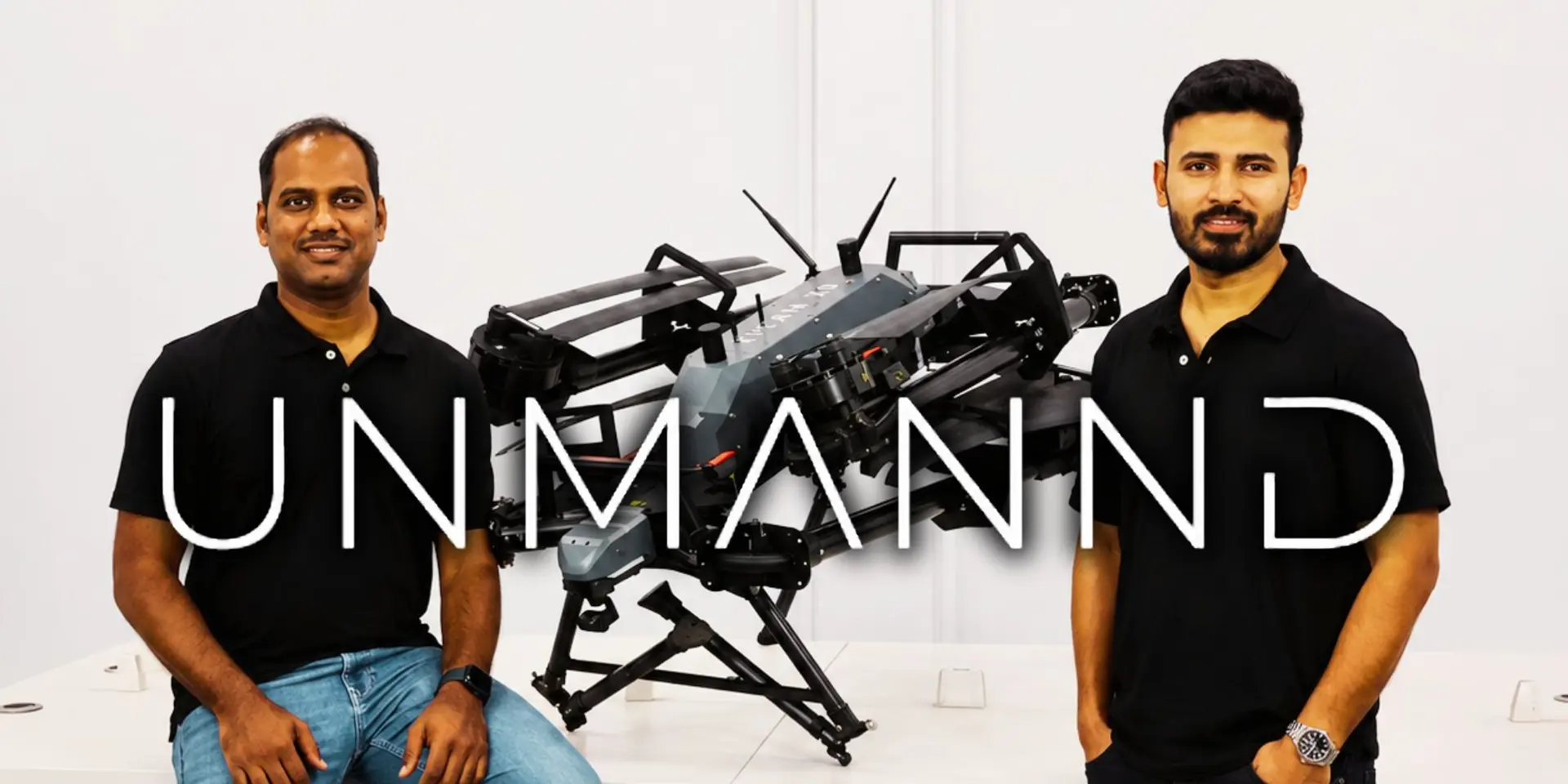

Recent conflicts have exposed an uncomfortable asymmetry in modern warfare: swarms of small, cheap drones can overwhelm defence systems that cost billions. Closing that gap between price and effect has become a priority for militaries everywhere, India included, and it is the problem Unmannd was built to work on.
The Bengaluru-based startup, founded in February 2025, builds autonomous aerial platforms for moving supplies, and bringing down hostile drones — two jobs the Indian armed forces increasingly need done.
Unmannd was started by CEO Yeshwanth Reddy and CTO Hemaditya Prasad, both former defence engineers who had built and run drone operations before starting the company.
Their pitch proposed a full-stack model. Rather than assembling drones from imported parts, they would build the custom computer hardware, the AI-driven autonomy and the multi-agent networking that lets a fleet coordinate, so the platforms could perceive, decide and act faster than an adversary in harsh conditions where GPS is jammed and the airwaves are contested.
A drone the Army has already cleared
The company's first product is Titan, a heavy-lift logistics drone. The Titan 30 variant can fly at altitudes of 20,000 feet and carry payloads of up to 30 kg, built to resupply troops in the high-altitude, GPS-denied terrain along India's borders where conventional logistics struggle.
In August 2025, the Indian Army certified Titan as qualified for battlefield use, an unusually early milestone for a company only a few months old, and one that puts it in line for procurement as the military moves to source unmanned systems indigenously.
The second product, Fury, is a counter-drone interceptor. The company says it can detect hostile drones up to 30 km away and launch interceptors travelling at a velocity of 300 km/h to bring them down. Fury is the newer of the two, moving from proof of concept toward deployment.
Both run on the same underlying autonomy stack, which is the part Unmannd treats as its real product: the software and custom hardware that let the drones operate together with minimal human input, rather than the airframes themselves.

Selling to one customer, and building for a decade
Unmannd sells to a single primary customer, the Indian defence establishment. The company sizes the market at around $25 billion, where unmanned systems have been designated under the priority procurement category. Titan's qualification is the near-term path to revenue, with supply contracts expected to follow; the startup is not yet generating meaningful income, which is normal at its stage.
However, the timing is prime. Indian defence-tech funding has climbed sharply in the past two years, and unmanned systems sit at the centre of the government's push for indigenous capability, giving an early qualifier like Unmannd a clearer route to contracts than the sector offered even a short while ago.
In September 2025, Unmannd raised $2 million in a pre-seed round led by Speciale Invest and Accel, with Accel's Prashanth Prakash being among the backers. Speciale Invest's Vishesh Rajaram pointed to the founders' record building and running drone operations across India and Southeast Asia as the reason for the bet.
The money is going toward commercialising Titan, pushing Fury to deployment, and growing the team from seven people to about 40, with early export conversations with allied nations on the roadmap. The larger bet is one the war in Ukraine has made mainstream: that the next decade of defence will be defined by autonomous machines, and that India will want to build its own rather than import them.
(This story has been researched and compiled using publicly available information.)