




Cubictree
View Brand PublisherWhy a 'Clean' Property File Isn't Enough: How Cubictree's AI Protects Lenders from Hidden Fraud
Fragmented records, unlinked newspaper notices, and manual checks that routinely fail have left India's lending system exposed. Cubictree’s AI Property Compliant Report is changing that, one property at a time



The file was complete. The legal opinion was clean. The sanction letter had been issued. By every conventional measure, an 180 crore loan processed through a major institution in New Delhi had passed. What nobody had looked at was a newspaper notice, published in a regional publication, flagging that the transaction was fraudulent.
"It cleared all the checks of the bank," said Hitesh B. Jirawla, Founder and CEO of Cubictree. "Yet it was 100% fraud."
This isn’t a story about one bad loan. It is a story about a system where the most consequential information about a property transaction routinely goes unread, unlinked, and undetected. And, it is the problem Cubictree was built to solve.
What an AI-powered property compliance report actually means
When a bank evaluates a home loan application, it collects documents, sends them to a lawyer for a title opinion, and cross-checks against CERSAI, the government's central registry for secured assets. The lawyer verifies the title chain to confirm that the current owner legitimately holds the property and that it carries no undisclosed charges. This has been the traditional process for decades.
What it cannot do is find what is not in the file.
In India, approximately 1,25,000 publications are registered across the country. By law, parties involved in property transactions are encouraged to publish notices in newspapers, covering everything from SARFAESI possession orders and auction announcements to inheritance disputes, lost documents, and title investigation notices. These disclosures are legally significant. They are also almost entirely unstructured, regional, multilingual, and physically printed. Nothing links them to SRO records or CERSAI. There has been no practical way to search them at scale.
Cubictree has spent over a decade building that link.
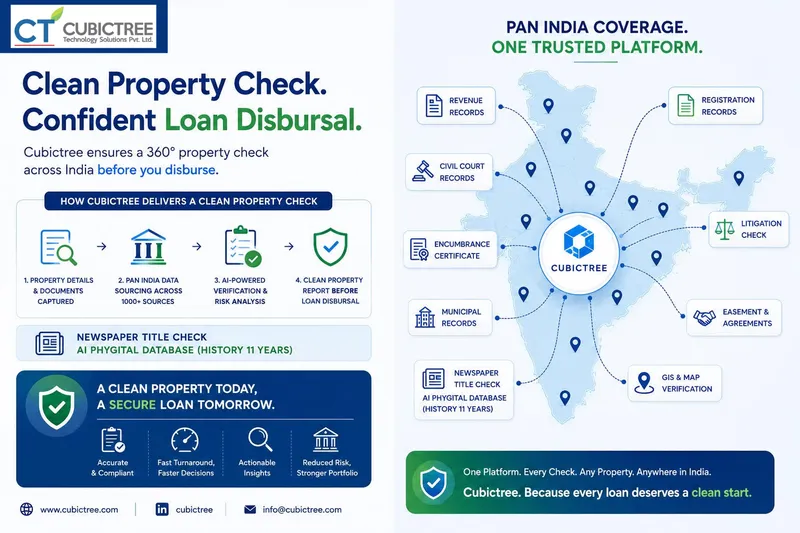
The company’s property compliant report is built on over 10 years of proprietary phygital newspaper data and digital archives. It is sourced from PAN India newspapers (physical and digital), with nearly 75 percent of records originating from physical publications. It now holds close to 3 to 3.5 crore unique property notices. Approximately 4 lakh new records are added every month. Using AI-based multilingual extraction and proprietary address-matching models, Cubictree converts unstructured notices into structured, searchable risk intelligence linked to specific properties and borrowers.
Combined with SRO data, CERSAI records, and a litigation database spanning over 50 years and more than 4.5 billion legal entries, this forms what Cubictree calls a 360-degree view of a property. Cubictree aggregates unstructured data from courts, forums, and tribunals, using Machine Learning and Artificial Intelligence to deliver the most relevant results from a database of over 250 crore records, with 10 lakh fresh records added daily. Reports classify each case across four clearly defined risk levels: No Risk (R0), Low Risk (R1), Medium Risk (R2), and High Risk (R3), enabling lenders to make calibrated decisions before any money moves.
Where the system breaks, and how badly
To understand why this matters, you first need to understand how thoroughly fragmented the existing system is.
CERSAI requires banks to enter loan data across ten separate fields. Inconsistencies in how banks fill those fields mean that a search for the same property can return different results depending on how the query is structured. Banks are supposed to update CERSAI in real time when a loan is issued. In practice, that does not always happen, particularly at smaller cooperative banks.
The consequence is a gap that is open for exploitation. In one documented pattern, a borrower obtains a loan from a smaller cooperative bank that does not promptly update the central registry. Using the same property as collateral, the borrower approaches a larger institution. The charge is not reflected. The second loan is approved. Cubictree identified one such case through a newspaper notice published in Dharamshala that flagged a recovery proceeding against a borrower who had simultaneously applied for a loan elsewhere against the same assets.
Then there are the cases where manual processes fail even when institutions follow the rules. During one round of testing, Cubictree flagged a property that a bank was actively moving to auction under a recovery proceeding. A newspaper notice, published and indexed in Cubictree's database, showed the property had already been sold to someone else years earlier. The bank's process had no mechanism to surface this information.
The phygital-AI model: Scale meets accuracy
Collecting physical newspapers at the scale at which Cubictree operates requires infrastructure that most organizations would not consider building. Publishers typically do not maintain archives beyond three months. Cubictree holds physical copies going back a decade. The data is then digitized and processed through AI models trained on regional language variation and the complexity of Indian address formats.
The system extracts and standardises property details from notices, even when descriptions are incomplete or written in regional formats, and then this data is cross-referenced against litigation, SRO, and CERSAI records to accurately link the notice to a specific property.
The company has structured data linked to over 26.5 million unique property addresses across India. In simple terms, our system doesn’t just scan random notices; it connects them to real, identifiable properties at scale. For example, if a bank is evaluating a property in a Tier II city, its database allows it to check whether that exact address has ever appeared in an auction notice, possession notice, or dispute publication. The larger the address base, the lower the chance of missing a hidden risk during due diligence.
The company covers over 80% of India's pin codes, reaching Tier II and Tier III towns where much of India's mortgage lending and property transaction volume actually sits. Its database is indexed against 26.5 million unique property addresses.
For high-risk or ambiguous cases, AI-driven processing is supplemented by legal and quality teams who validate findings before they reach the final report. The company delivers a single, structured risk view output to the institution before disbursement.
Property risk as infrastructure
Cubictree serves over 100 banks and NBFCs, and more than 450 enterprises across the broader financial and property ecosystem, including asset reconstruction companies and law firms. Its platforms cover the full lifecycle: pre-disbursement property due diligence, ongoing case monitoring, and NPA recovery tracking.
The wider argument, though, is about what the industry has been missing.
Property is the single largest asset class in India. It underpins trillions of rupees in mortgage lending and serves as the primary collateral for a significant portion of bank credit. Yet the infrastructure for assessing property risk has remained fragmented, manual, and dependent on checks that, by design, cannot see what has not been formally registered.
Cubictree's bet is that structured, AI-driven property intelligence is not an option for lending institutions, but a critical infrastructure requirement. It is the layer that makes every other check more reliable. The gold standard is not the lawyer's opinion or the valuation report. It is the one step that ensures nothing important has been missed before the money moves.
(Disclaimer: The views and opinions expressed in this article are those of the author and do not necessarily reflect the views of YourStory.)