



Woven for the world: Aparna Thyagarajan on taking Indian heritage to a global audience
At MSME Sparks 2026, Aparna Thyagarajan, Co-founder and Chief Product Officer of Shobitam, explained why Indian craft no longer needs to adapt to global tastes, and why the world is now adapting to it.

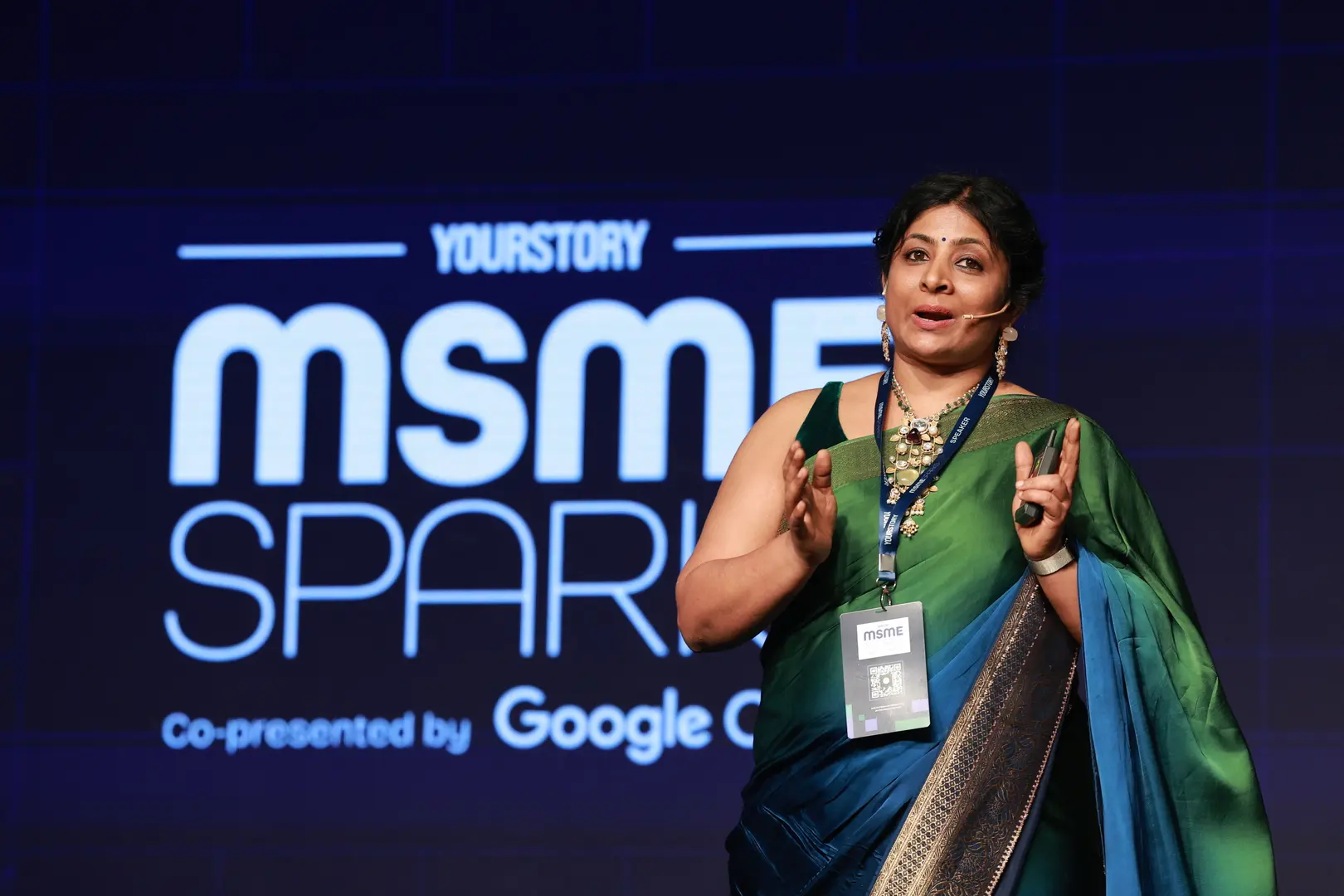

“India is no longer trying to blend in,” said Aparna Thyagarajan, Co-founder and Chief Product Officer of , at the grand finale of YourStory’s MSME Sparks 2026, on June 26 at ITC Gardenia, Bengaluru.
Delivering the opening keynote of the day, titled ‘Woven for the World: Taking Indian Traditions Global’, Thyagarajan traced her journey from a childhood spent stitching a birthday skirt out of leftover saree fabric in the early ’90s to building Shobitam into what she described as the largest cross-border ethnic fashion platform in the US and Canada.
"I chose to be different wherever I went. I took a piece of India with me, even in my Western silhouettes, and I did not look like someone who was odd. There was a ‘wow’ factor to it. People would pause and ask me about it, and I would have that pride in me because there was a cultural identity attached to it," she said.
Building a platform, not just a brand
Thyagarajan said Shobitam sets itself apart by representing the full breadth of India's textile traditions, from Kashmiri sarees and Madurai Sungudis to Ajrakh prints and Jamdani weaves, rather than concentrating on a handful of well-known styles.
The platform now hosts more than 75 partners and ships to customers across six continents, including remote locations such as Fairbanks in Alaska and Wellington in New Zealand.
"So many of our customers around the world think that we are local," she said, adding that Shobitam works to feel close to the customer regardless of geography, backed by fast, free global shipping, and a strong focus on customer experience.
The company has collected more than 13,000 five-star reviews, she added, so many that its review system periodically has to purge older entries to make room.
She also spoke about the role of storytelling and brand representation, pointing to actor Vidya Balan as Shobitam's global brand ambassador.
“Vidya really connected the dots; people from the north, south, west, and east, everybody connected with that. And then she has global appeal too as people around the globe recognize her. You don't want just a celebrity endorsing your product, you want somebody who really believes in what you’re making," Thyagarajan shared.

Five pillars for MSMEs going global
Thyagarajan framed MSMEs as central to India's economy, noting that the sector contributes close to half of India's exports, around 30% of the GDP, and supports roughly 33 crore livelihoods. She laid out five pillars she considers essential for an MSME looking to scale internationally.
The first is global value chain integration, or finding one strong link in an existing chain rather than trying to own the entire chain. The second is digital infrastructure, which she called non-negotiable for scale, along with a clear build-versus-buy approach to technology depending on how unique or repeatable a business process is. The third is operational excellence, since the discipline required to run a lean team does not automatically carry over as a business grows.
The fourth pillar is trade finance and global policy navigation. Referring to the 50% tariffs imposed by the US last year, she said businesses need to stay agile, whether by setting up entities in lower tariff jurisdictions or by tracking policy changes closely enough to recover costs once tariffs ease. The fifth pillar is heritage paired with global aesthetics.
“Just because your mom liked a particular saree or piece of jewellery doesn't mean that a woman in Australia is going to instantly like it,” she said. “Many women from today's generation say they don’t even know how to drape a saree. So that's where we come up with ideas and innovations. We have the preset saree that looks like a saree, but it's ready to wear in a minute. No matter what product you are developing, you always need to think of relevance.”
Thyagarajan summed up Shobitam's approach as look good, do good, feel good — describing a model built around grassroots artisans in India's handloom sector, which she called the country's second largest industry after agriculture.
"By working directly with artisans and completely eliminating middlemen, we support both ends of our supply chain, the makers and the customers, with a shared sense of purpose in taking India to the world."
Edited by Teja Lele