



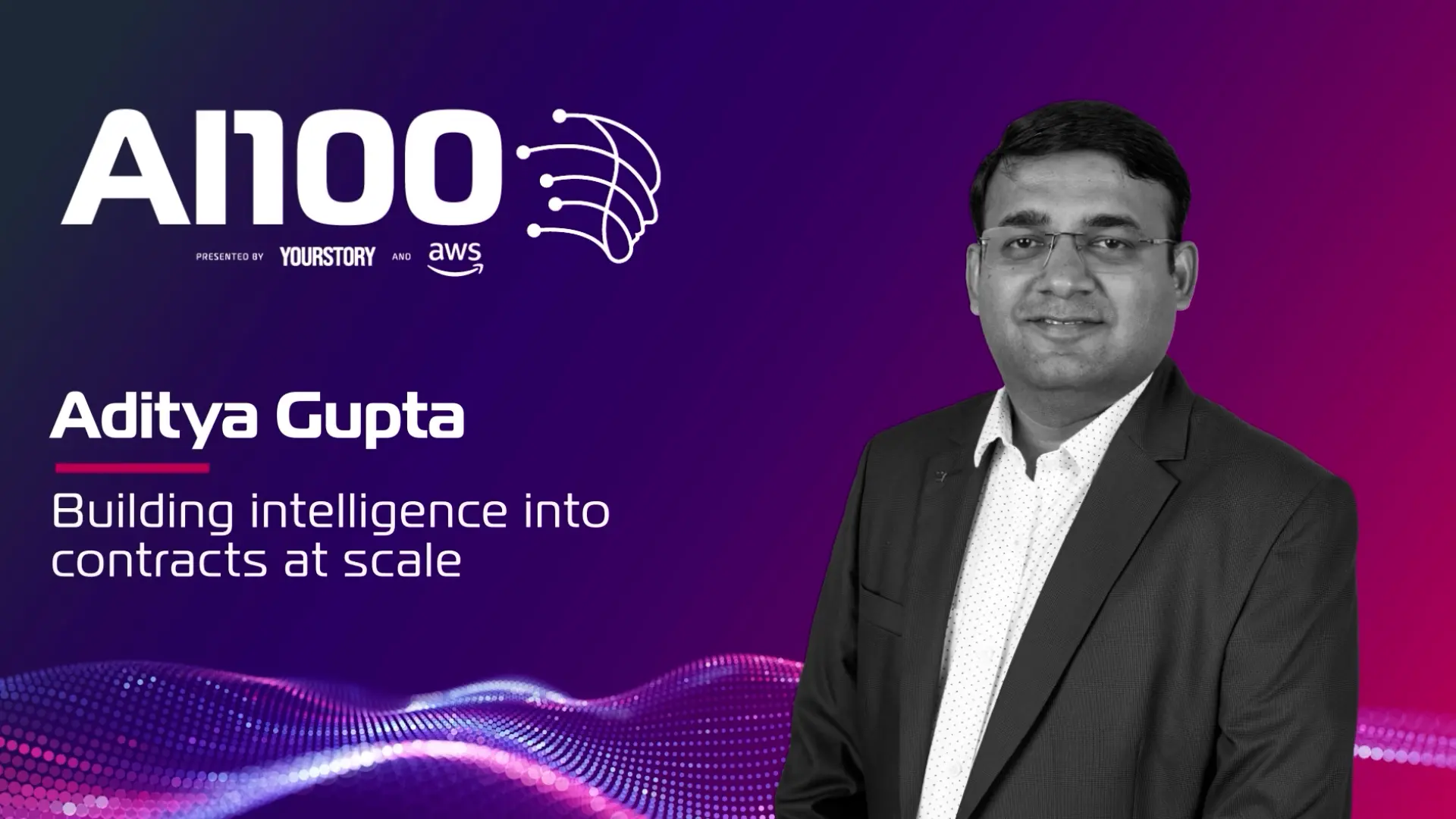
Aditya Gupta: Building intelligence into contracts at scale
From early experiments in autonomous systems to embedding AI at the core of enterprise workflows, the Sirion CTO is reimagining how contracts are understood, managed, and acted upon.


In today’s enterprise landscape, contracts are everywhere, governing relationships, defining obligations, and shaping business outcomes. Yet, for decades, they have remained static, opaque, and difficult to navigate.
Aditya Gupta wants to change that.
As Co-founder and Chief Technology Officer of Sirion, Gupta is leading a shift from contracts as passive documents to contracts as intelligent systems, powered by AI, capable of reasoning, and embedded directly into business workflows. His journey to this point, however, began far from enterprise software, rooted in a deep curiosity about how systems work beneath the surface.
Gupta started programming early, drawn to the idea that something built once could scale infinitely. Over time, this curiosity evolved, from writing code to designing systems that could serve thousands, then millions of users. That progression led him to enterprise software, and eventually to artificial intelligence, where systems go beyond deterministic logic to support reasoning and decision-making.
From Mars to systems thinking
At the Indian Institute of Technology (IIT) Kharagpur, Gupta was immersed in an environment that emphasized first-principles thinking, problem-solving, and peer learning. Alongside his classmates, he learned to break down complex, ambiguous challenges into solvable components.
One formative experience was working on autonomous robot systems designed for Mars exploration. In such scenarios, human intervention is limited, forcing teams to think through communication gaps, system failures, and collaborative behavior among machines. The challenge lay not just in engineering, but in designing systems that could operate reliably in uncertain environments.
By decomposing these problems into smaller, manageable parts, Gupta and his team were able to navigate the complexity and build workable solutions. These early experiences continue to inform his approach today, blending system design, scalability, and intelligent automation.
Sirion: From static documents to intelligent systems
Founded in 2012 by Gupta, Ajay Agrawal, and Claude Marais, Sirion offers AI-powered contract lifecycle management (CLM) software. Contract management, covering everything from creation to renewal, has traditionally been a fragmented and error-prone process, despite its centrality to business operations.
At Sirion, the founders identified a critical gap: contracts form the backbone of enterprises, yet they are treated as rigid, static documents. Users often struggle to locate agreements, interpret obligations, or assess whether new contracts conflict with existing terms. While many CLM tools focused on storage and workflow, they largely overlooked intelligence and usability.
Sirion set out to reframe this.
Instead of viewing contracts as files stored in repositories, the company approached them as living systems, entities that need to be understood, tracked, and acted upon continuously. Combining Gupta’s technology expertise with his co-founders’ legal background, Sirion positioned itself at the intersection of law and technology.
A key part of this transformation involved breaking contracts into smaller, actionable components. Obligations could then be monitored, tracked, and reported in real time, ensuring that decisions were informed by historical context rather than built from scratch.
“My role has evolved over time, but it broadly sits at the intersection of architecture, product, and AI strategy,” Gupta says. “One deliberate choice I made was that AI would not be a layer on top. At Sirion, it is embedded into the core system. Whether it is clause extraction, risk analysis, or obligation tracking, AI is deeply integrated.”
AI at Sirion: From assistance to participation
For Gupta, contract management, like the technology underpinning it, must remain flexible and adaptive. Sirion’s platform leverages AI and generative AI (GenAI), and is increasingly moving toward agentic systems.
In this model, AI does more than analyze or generate; it actively participates in workflows.
Sirion’s systems are designed to understand contracts end-to-end: analyzing documents, identifying risks, and guiding users on next steps. By drawing on historical data and contextual insights, AI surfaces relevant information directly, reducing the need to manually sift through lengthy documents. In high-confidence scenarios, the system can even act autonomously, accelerating decision-making.
He highlights that there has also been a shift in how generative AI is applied across the contract lifecycle. From drafting and negotiation to post-signature management, AI carries context across stages, transforming contracts into dynamic systems of intelligence. These systems not only store information, but actively inform decisions, govern relationships, and drive outcomes.
Building trust: Precision, scale, and explainability
Deploying AI in the legal domain, however, comes with unique challenges. Precision is non-negotiable: “almost correct” is insufficient. At the same time, users need to understand how and why decisions are made, making explainability critical. Scale adds another layer of complexity, with enterprises managing millions of contracts in varied formats. Underpinning all of this is the question of trust.
To address these challenges, Sirion has built a legal knowledge graph and ontology that ground AI outputs in domain-specific understanding. Every recommendation is paired with clear references, ensuring transparency. System design focuses on scalability and fault tolerance to handle enterprise-scale workloads.
For Gupta, trust emerges at the intersection of accuracy and clarity. By making AI decisions transparent and context-driven, Sirion enables users to rely on intelligent systems with confidence.
He acknowledges that AI is still evolving. “Nothing is 100% in AI. The closer we get to the high 90s, 98–99%, the more confidence users have. Every decision remains probabilistic, but the system’s role is to ground that probability and provide assurance that the outcome is reliable,” he explains.
The roadmap of AI: Responsibility and autonomy
Gupta sees AI as a foundational pillar of the future, comparable to the transition from telephony to the internet. Its applications span industries, from healthcare and climate modelling to scientific discovery.
Yet, the real challenge lies not in building capability, but in deploying it responsibly. Questions around governance, fairness, and equitable access remain central to AI’s evolution.
Gupta is particularly interested in the rise of agentic systems, which signal a shift from reactive tools to proactive systems capable of operating across workflows. He also points to the convergence of AI with knowledge graphs and the growing emphasis on domain-specific intelligence embedded within enterprise platforms.
Ethics, he stresses, is integral to this journey. Bias in data can distort outcomes, making rigorous data curation and the creation of “golden records” essential. Accountability and auditability ensure that every AI-driven decision is traceable.
“AI should augment human judgment, not replace it,” Gupta says, underscoring the importance of transparency, fairness, and human oversight.
Beyond AI, he continues to track developments in space exploration, quantum computing, and evolving model architectures, areas that reflect his enduring curiosity about complex systems.
From early adoption to deep integration: AWS and Sirion
Sirion’s technology journey has been closely tied to AWS since 2014. Starting with core compute services, the company gradually expanded its stack to include serverless architectures and, more recently, AI capabilities through Bedrock.
AWS has enabled Sirion to scale efficiently, offering reliability, global deployment, and compliance-ready infrastructure. The partnership extends beyond infrastructure, with close collaboration between Sirion and AWS’s research and machine learning teams.
This co-innovation has helped Sirion address complex challenges, refine model strategies, and accelerate its AI roadmap, while maintaining consistent performance and scalability.
AI and beyond: Staying curious, staying grounded
For Gupta, keeping pace with AI requires both discipline and curiosity. He dedicates time each day to reading about emerging research, technological shifts, and innovations across fields such as healthcare, generative AI, and quantum computing.
Equally important are conversations, whether with colleagues across disciplines or even with his children, whose questions often spark new perspectives. “Inspiration is everywhere,” he says.
At the same time, he emphasizes the importance of balance. In a fast-evolving technological landscape, staying grounded is essential. Continuous learning, open dialogue, and time away from the screen help him maintain the clarity needed to apply innovation meaningfully.
From designing autonomous systems for Mars to building intelligent contract ecosystems, Gupta’s journey reflects a consistent thread: curiosity translated into scalable systems.
At Sirion, that curiosity is now shaping the future of how enterprises understand, and act on, their most critical documents.