



Operation Sindoor architect AK Bharti signs off after 39 years
Air Marshal A.K. Bharti retired on 31 July 2026 after a distinguished career spanning frontline fighter operations, strategic appointments and a defining role in Operation Sindoor.

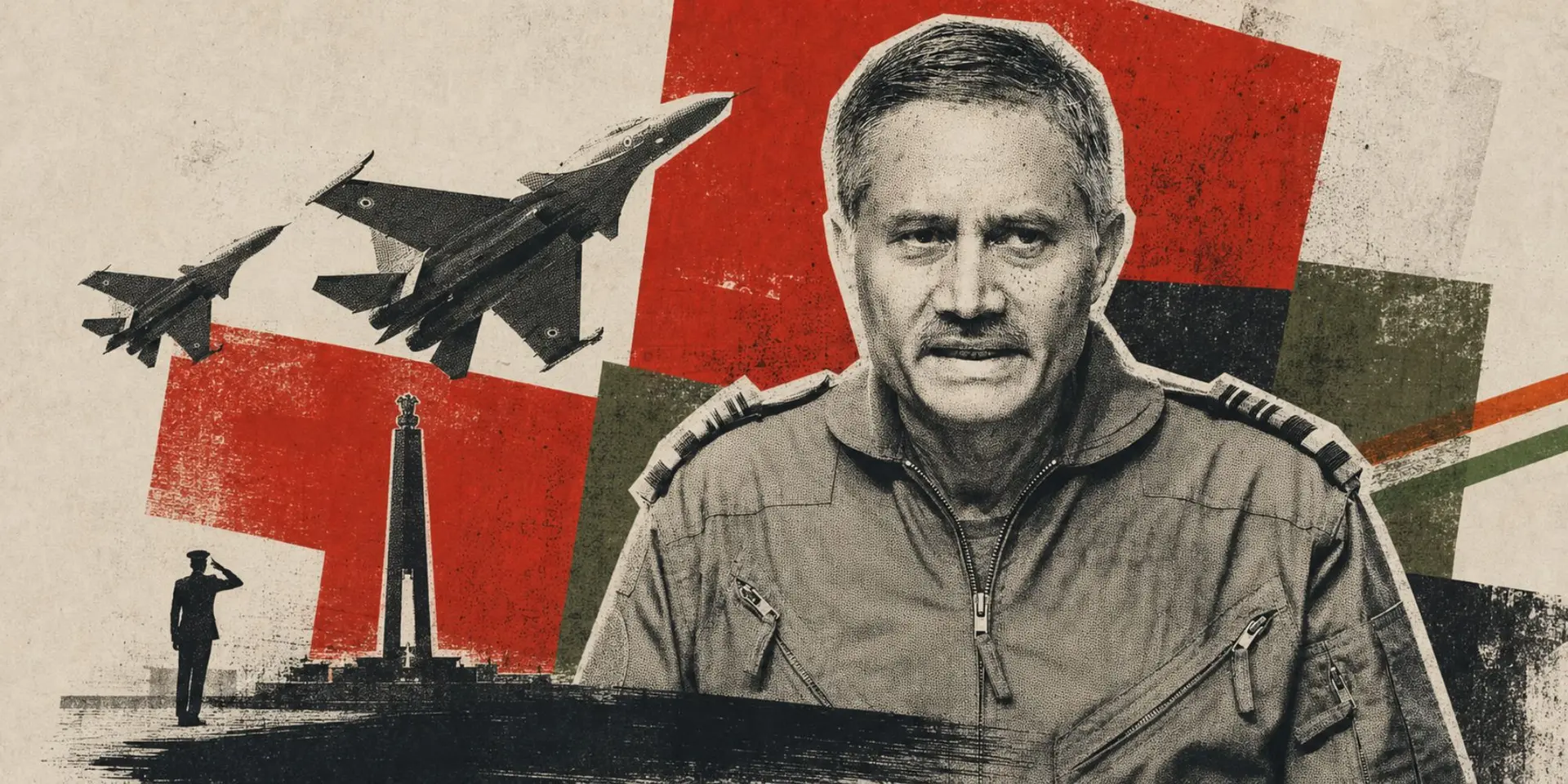

Air Marshal AK Bharti, the officer who became the public face of the Indian Air Force during Operation Sindoor, retired on 31 July 2026 after 39 years in uniform. He spent his last morning in service at the National War Memorial in New Delhi, laying a wreath for soldiers who never got a retirement of their own. He stepped down as Deputy Chief of the Air Staff, a post held since 1 June 2025, and was succeeded by Air Marshal Tejpal Singh on 1 August 2026.
The man nobody had heard of
Until the second week of May 2025, Awadhesh Kumar Bharti was a name known inside Air Headquarters and almost nowhere else. That changed on 11 May, when he sat at the National Media Centre in New Delhi alongside Lieutenant General Rajiv Ghai and Vice Admiral AN Pramod for the first joint briefing on Operation Sindoor. He spoke in short sentences, declined to guess at figures he could not confirm, and recited a couplet from the Ramcharitmanas from memory to explain the shift in India's posture. The lines describe Lord Ram's patience with the sea running out after three days, after which he lifts his bow.
He was born in Jhunni Kala village in Bihar's Purnea district, to Jiwachh Lal Yadav, who worked in the finance department of the Kosi Irrigation Projects, and Urmila Devi. In 1977 he was one of 140 boys admitted to Sainik School Tilaiya. Six years later, 28 of that batch cleared the National Defence Academy examination. He was among them. At the NDA he won the President's Silver Medal and set a cross country record that stood for years, which is where the nickname Galloping Horse came from. At the Air Force Academy, Dundigal, he finished first in overall merit and took the Sword of Honour.
Four thousand hours and a Sukhoi squadron
Commissioned into the fighter stream on 13 June 1987, Bharti logged more than 4,000 hours across the MiG-21, MiG-29, Su-30MKI and Su-30MKM. He qualified as a Fighter Combat Leader and earned three stars for accident free flying. He was Flight Commander of No. 24 Squadron before taking command of No. 30 Squadron in August 2005, a tenure to September 2007 that placed him at the centre of operationalising the Su-30MKI's weapon systems. Under his command the squadron took part in exercises including Gagan Shakti, Indradhanush 2006 and Garuda 2007. He later commanded a frontline fighter base at Lohegaon, and as Air Attaché in Malaysia trained Malaysian pilots on the Su-30MKM.
The staff appointments mattered as much. At Strategic Forces Command and then Air Headquarters, he held jobs concerned with how India would fight rather than how it trains. Promoted to Air Marshal on 1 September 2023, he became Senior Air Staff Officer at Central Air Command in Prayagraj, and took over as Director General of Air Operations in October 2024.
What does the Director General of Air Operations actually do
The DGAO sits at Air Headquarters and owns the air operations brief for the entire service: target sets, force allocation, tasking across commands and the air defence picture over Indian territory.
A political decision to strike is not a flying programme. Somebody has to convert intent into aircraft, weapons, routes, timings and the defensive cover that brings crews home. That conversion happens at the DGAO's desk, which is also why offence and air defence sit under the same appointment.
Fifteen days, then nine targets
Operation Sindoor followed the Pahalgam attack of 22 April 2025, in which 26 civilians were killed. Fifteen days later, in the early hours of 7 May, India struck nine terrorist sites in Pakistan and Pakistan occupied Kashmir, including facilities at Bahawalpur and Muridke. When Pakistan retaliated, the IAF shifted to military targets while the air defence network absorbed drones and missiles.
Asked at the briefings what weapons had been used and what damage they had caused, Bharti said only that the methods chosen had produced the desired effects on enemy targets. On Pakistani aircraft, he said their planes had been prevented from crossing, that a few had been brought down, and that all Indian pilots were back home. He credited the Integrated Air Command and Control System and indigenous platforms such as Akash, and tied that capability to a decade of sustained budgetary backing. Pakistan has disputed Indian accounts of the exchange.
He was awarded the Vayu Sena Medal in 2008, the Ati Vishisht Seva Medal on Republic Day 2024, and the Sarvottam Yudh Seva Medal, the highest of India's wartime distinguished service awards, in the honours list announced on 14 August 2025.
What he leaves behind
As Deputy Chief, Bharti spent his final year pushing indigenisation harder than the timelines were comfortable with. At an industry event in September 2025, he told manufacturers that even 99% indigenous content counts for little if critical components remain import dependent, and that innovation needed to move off cruise setting. That argument, more than any single operation, is the brief his successor inherits, at a moment when the IAF is chasing squadron strength, an indigenous engine and the AMCA programme at once. The campaign made his name. The procurement fight will decide whether its lessons hold.