



Andhra, Chhattisgarh, Bihar are outsmarting richer states on investments (without outspending)
A licence, a statute and a purchase contract: how three challenger states are gaining ground without simply writing bigger subsidy cheques.
Prem Manukonda
Thursday August 06, 2026 , 13 min Read

Two measures of India’s state industrial race landed within weeks of each other this July, and they tell different stories.
The first is money. Fresh investment announced across India swelled from ₹35.2 trillion in FY24 to ₹58.3 trillion in FY26, an increase of nearly two-thirds in over two years, with roughly seven of every ten rupees coming from private promoters rather than the state. On that scoreboard, the old hierarchy has broken. Andhra Pradesh ranked ninth in FY24 with ₹1.06 trillion; it reached fifth a year later and landed second in FY26 with ₹8.95 trillion, behind only Maharashtra. Rajasthan climbed from eighth to third. Madhya Pradesh moved from tenth to seventh. Chhattisgarh entered the top ten in FY25, taking the slot vacated by Tamil Nadu.
The second is readiness. NITI Aayog’s first Investment Friendliness Index, built with CRISIL from 84 indicators and a survey of more than 1,850 investors, ranks Gujarat first at 56.6, followed by Maharashtra at 53.7, Tamil Nadu at 53.3, Goa at 53.1 and Odisha at 52.4. No state crosses 60.
Place the two side by side and the gaps are striking. Andhra Pradesh took the second-largest share of fresh investment in the country and ranks eighth on readiness. Uttar Pradesh is ninth by announced value and nineteenth on readiness. Tamil Nadu is third on readiness and tenth on money.
Exhibit 1:
The convenient reading is that the challengers are all about announcements sans substance. That reading is too easy, and it misses what the numbers are actually recording. The index measures institutional inputs largely from historical data. Announced investment is a forward bet. When the two disagree by six or ten places, the useful question is not which one is wrong. It is what the money knows that the index has not yet caught up with.
The common factor across every fast-rising state is not the size of the subsidy.
Why the race changed shape
The reason has less to do with India than with what a factory is now.
In the manufacturing wave that built Guangdong in China and then Vietnam, locations competed on cost arbitrage: cheap labour, cheap land, cheap power. In an automated, sensor-dense, AI-adjacent plant, labour is a shrinking share of the cost base and land is rarely the binding constraint. What a modern facility actually consumes is uninterrupted electricity, dense digital infrastructure, steady supply of skilled workers and a predictable approval calendar.
Look at what the index rewards its winners for and the shift is visible in the indicators themselves. On almost every input a modern facility actually consumes, the leaders are separated from the pack by margins that have nothing to do with wage costs.
Exhibit 2:
None of that is a cheap-labour story. Automated capital does not shop for the lowest wage. It shops for the fewest unknowns. Bihar could not convert its wage advantage into broad-based industrial leadership. But it succeeded in ethanol once a critical unknown, demand, was reduced.
25% you inherit, 18% you can legislate
The mechanism becomes obvious once you stop reading the index’s headline ranks and read its weights.
Infrastructure carries 25 per cent, the single heaviest pillar: port turnaround, rail density, power reliability, road quality. Business climate carries another 20 per cent, covering GSDP per capita, exports, FDI and the innovation base. Between them, 45 per cent of a state’s score is the accumulated residue of three or four decades of investment. No government changes that inside a term.
Regulatory ease carries 12 per cent and institutional environment 6 per cent. Eighteen per cent of the score turns on how many licences a business needs, how long approvals take, how reliably land is allotted, how predictable officials are and how quickly grievances are settled. That is not built. It is written, and it can be written in a single assembly session. Unlike infrastructure, these rules can be rewritten within a term. But their credibility ultimately depends on implementation.
Exhibit 3:
Read down the last two columns and the pattern in the announced-investment tables suddenly has an explanation.
Chhattisgarh ranks first among all seventeen large states on regulatory ease, at 8.4 out of 12, ahead of Rajasthan and Punjab at 8.1, Tamil Nadu at 8.0 and Gujarat at 7.9. It also ranks first among large states on institutional environment at 4.5 out of 6. And it ranks last among large states on infrastructure, at 9.1 out of 25.
That is a state with the weakest inherited endowment in its peer group and the strongest governance scores in its peer group. It is not an anomaly. It is a strategy, and it is the clearest single illustration of what the challengers are doing: maximising the portion of investor confidence that can be manufactured rather than inherited.
Karnataka, worth noting, comes last among large states on regulatory ease at 6.2 despite ranking ninth overall. Bihar, ranked twenty-sixth in the country and last among large states overall, scores 7.0 on the same pillar, ahead of Odisha, Jharkhand and Karnataka. Whatever holds Bihar back, red tape is not the leading candidate.
Three ways to manufacture certainty
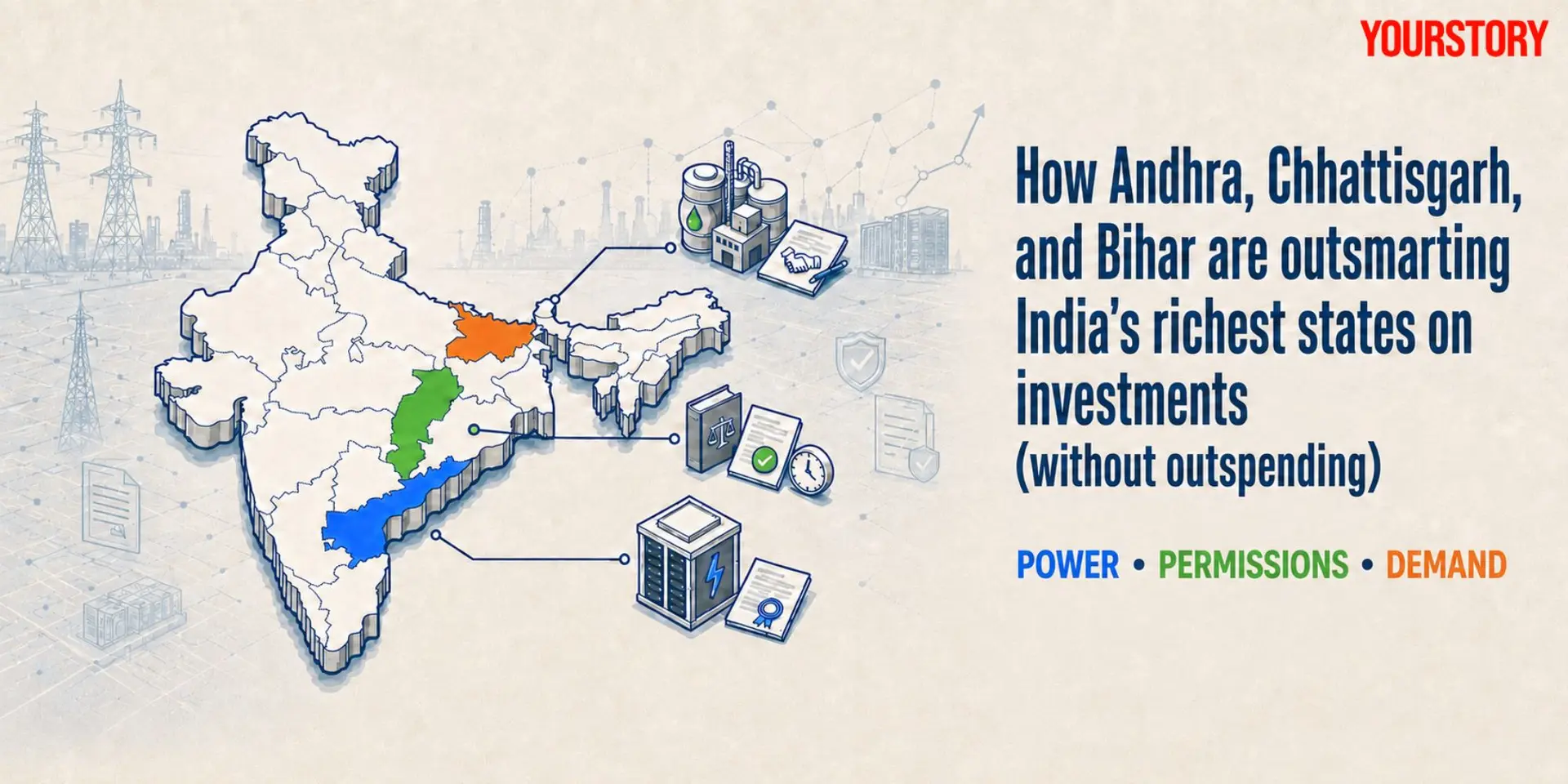
The three states climbing fastest (Andhra Pradesh, Chhattisgarh and Bihar) have each addressed a different investment risk. Taken together, they amount to a playbook that has nothing to do with incentive size.
Andhra Pradesh: certainty of time and power
AP’s pitch is speed and supply. The state runs 24 sector-specific policies under a Speed of Doing Business framework, with a public commitment that industrial approvals will be issued within 15 days.
The more consequential move was quieter. Andhra’s energy department created a framework for Deemed Distribution Licences covering large data centres, and issued the first such licence in India to Google, allowing the tech giant to distribute electricity for its own campus under a dedicated regulatory route. For a gigawatt-scale facility, power availability is the single largest execution risk. Andhra did not subsidise that risk. It legislated it away.
The response has been substantial. Google broke ground in April 2026 on a 1 GW AI hub at Visakhapatnam representing roughly $15 billion (₹1.43 lakh crore), its largest India commitment. Reliance has moved on a 1.5 GW cluster at close to $19.7 billion (₹1.87 lakh crore). Sify, Digital Connexion, Anant Raj Cloud, RMZ and Tillman have added to the pipeline. Data centre MoUs now total around 5.6 GW of capacity, close to AP’s stated target of 6 GW.
The index is candid about where AP struggles. Its financial health score is dragged by outstanding liabilities of around 35 per cent of GSDP, some 13 percentage points above the large-state average, and a fiscal deficit above the level the Fifteenth Finance Commission set out. That is precisely why the anchor-project route makes sense for the state: a treasury under pressure cannot outbid Gujarat on cash, but it can offer something Gujarat has not yet offered, which is a bespoke regulatory instrument for a specific class of investor.
Chhattisgarh: certainty of process
In July 2026, the Chhattisgarh assembly passed the Ease of Doing Business Act, described by the state as the first comprehensive statutory risk-based and trust-based business permission system in India. Enterprises are classified by size, investment and risk profile. Low-risk businesses, principally MSMEs and startups, move to self-certification and simplified documentation. High-risk and large industries retain full technical scrutiny.
The provision that matters is deemed approval. If a department fails to decide within the prescribed timeframe, the application is treated as approved. While not new to India (Telangana is the clearest precedent), Chhattisgarh is attempting to apply it as part of a broader statutory, risk-based permission system. MSMEs can obtain water-supply permissions by self-declaration; eligible building permissions can be issued on self-certification or professional certification. The state expects more than 15 lakh MSMEs to fall within scope.
The distinction from a subsidy is the whole point. An incentive package is an executive scheme; it can be revised in the next budget, and every investor knows it. A statute has to be amended or repealed. That difference in reversibility is one of the factors that a twenty-year capital commitment may price.
Chhattisgarh’s strong regulatory and institutional scores suggest that the strategy predates the legislation. The July 2026 Act attempts to place that approach on a statutory footing while the state waits for roads and rail to catch up.
Bihar: certainty of demand
The most instructive case is the one nobody cites, because it looks like a story about ethanol rather than a story about industrial policy.
Bihar was the first state to implement an ethanol promotion policy under the National Policy on Biofuels 2018. Its 2021 Ethanol Production Promotion Policy waived stamp duty, land conversion fees, state GST and electricity duty. Those waivers were not the decisive instrument. The decisive instrument was that public sector oil marketing companies signed long-term offtake agreements committing to purchase fixed quantities from dedicated ethanol plants, which converted an uncertain market into a contracted revenue line.
The first plant was commissioned at Purnia in 2022. Over the following three years, 19 ethanol plants were established in Bihar with a combined capacity of roughly 3,100 kilolitres per day.
Consider what that means against everything the rankings say. Bihar sits twenty-sixth of thirty-six on the readiness index and last among all seventeen large states. It scores 5.2 out of 20 on business climate, second lowest in its category. It has the lowest per capita income of any large state. And nineteen industrial plants arrived in thirty-six months, because the revenue was guaranteed before the first brick was laid.
This is the cleanest test of the certainty thesis in Indian industrial policy. Strip out infrastructure advantage, strip out market depth, strip out fiscal firepower, remove demand risk, and capital still comes. Bihar makes the case more forcefully than Andhra Pradesh or Chhattisgarh because capital arrived despite the weakest underlying investment conditions of the three.
The wider Bihar numbers support the direction. GSDP reached ₹9,91,997 crore in FY25, growing 13.1 per cent at current prices and 8.6 per cent in real terms against national figures of 9.8 and 6.5 per cent. The secondary sector’s share of gross state value added rose from 21.1 per cent in 2020-21 to 26.8 per cent in 2024-25, expanding 11.1 per cent in real terms, faster than services or agriculture. Between 2019-20 and 2023-24, fixed capital per person doubled to ₹25.9 lakh and labour productivity reached ₹10 lakh, or 93.5 per cent of the national level. Bihar’s factories are now close to national average productivity per worker, a fact almost entirely absent from the way the state is often discussed.
There is a corollary the state itself has been debating. Industry representatives have raised concerns that the October 2025 procurement tender changed the priority order for ethanol purchase in a way they consider inconsistent with the long-term agreements, and have argued that investor experience shapes future capital flows. Whatever the merits of that specific dispute, it makes the structural point rather than undermining it. If certainty is the asset that attracted the investment, then institutionalising that certainty, so it does not depend on the design of any single tender, is the entire task.
What the incumbents still own
None of this means the established industrial states are slipping. They are being crowded, which is a different thing, and on the measures that matter most for actual output, they remain ahead.
Tamil Nadu ranks first among large states on infrastructure and converts close to 100 per cent of its MoUs into projects, with an export-to-GSDP ratio 36 per cent above the large-state average. Investors surveyed for the index specifically commended the state for policy consistency. Against that, Bihar received 4,353 investment proposals worth ₹1.11 lakh crore, of which 956 units are operational, representing ₹10,635.90 crore and 42,999 jobs. Roughly a tenth of proposed value has become an operating factory.
Gujarat holds the lowest fiscal deficit of any state at 2.81 per cent of GSDP, outstanding liabilities of around 18 per cent of GSDP, about 40 per cent below the large-state average, and accounts for close to 31 per cent of India’s merchandise exports, nearly twice the next highest state. Its slip to fourth on announced investment is largely optical; its mega-project count actually rose from 95 to 117, and the ranking change reflects faster growth elsewhere rather than any deterioration at home. Maharashtra held first place throughout and closed FY26 with a record ₹11.05 trillion, up 39 per cent, while attracting 35 per cent of the country’s private equity and venture capital.
It is also worth holding the volatility in view. The top ten states still capture around 73.7 per cent of all projects and between 80 and 82 per cent of total investment value. A single mega-project can move a state several places in a year. Tamil Nadu's fall out of the top ten in FY25 and its return to tenth place in FY26 is a reminder of how thin the margins are at the bottom of that group.
The honest summary is that investment announcements and operating factories are not the same thing. The challengers are currently better at attracting commitments than converting them into production. Closing that gap will be the work of the next five years.
The healthiest thing happening in Indian industrial policy
For years, the standing critique of Indian state competition was that it amounted to a race to the bottom on incentives: a bidding war in which states competed to give away more, while the winning bidder risked paying too much for the investment. That critique is looking increasingly dated.
The states climbing fastest are not the ones writing the largest cheques. Bihar offers land for semiconductor projects at one rupee an acre against committed investment, and capital subsidies up to 30 per cent; it remains outside the top ten on announced investment. What moved capital in Bihar was a purchase contract. What Chhattisgarh is now attempting to institutionalise is certainty of process. What moved it in Andhra was a distribution licence and an approval clock.
That is a meaningfully better equilibrium. Subsidy competition transfers public money to private balance sheets and can be matched by any rival within one budget cycle. Certainty competition forces states to improve the thing every business in the state benefits from, whether or not it qualifies for an incentive, and it is durable precisely because it is harder to reverse.
NITI Aayog was explicit that the index is intended as a reform instrument rather than a league table, and it is being used that way. Chhattisgarh has published its top rank among large states on regulatory ease as an investment pitch. The index is recurrent, so states will now be able to see whether a statute passed this year shows up in next year’s score.
India lost its external benchmark when the World Bank discontinued its contentious ease of doing business rankings in 2021, and with it a good deal of the competitive pressure that had driven state-level reform. The domestic replacement has arrived at exactly the moment when what capital-intensive investors want has shifted from cheapness to greater predictability, which happens to be the one advantage a state with no port and no legacy industrial base can build from scratch. Twenty-five per cent of the score is inherited. Eighteen per cent is a decision. For the first time, a growing number of Indian states are treating that eighteen per cent as the main event.
Edited by Adith Charlie