




Ankit Maheshwari: AI, architecture and impact
From early coding experiments to architecting AI-native healthcare systems at Innovaccer, Ankit Maheshwari on why clean data, infrastructure-first thinking, and human-centered design will define AI’s next chapter.

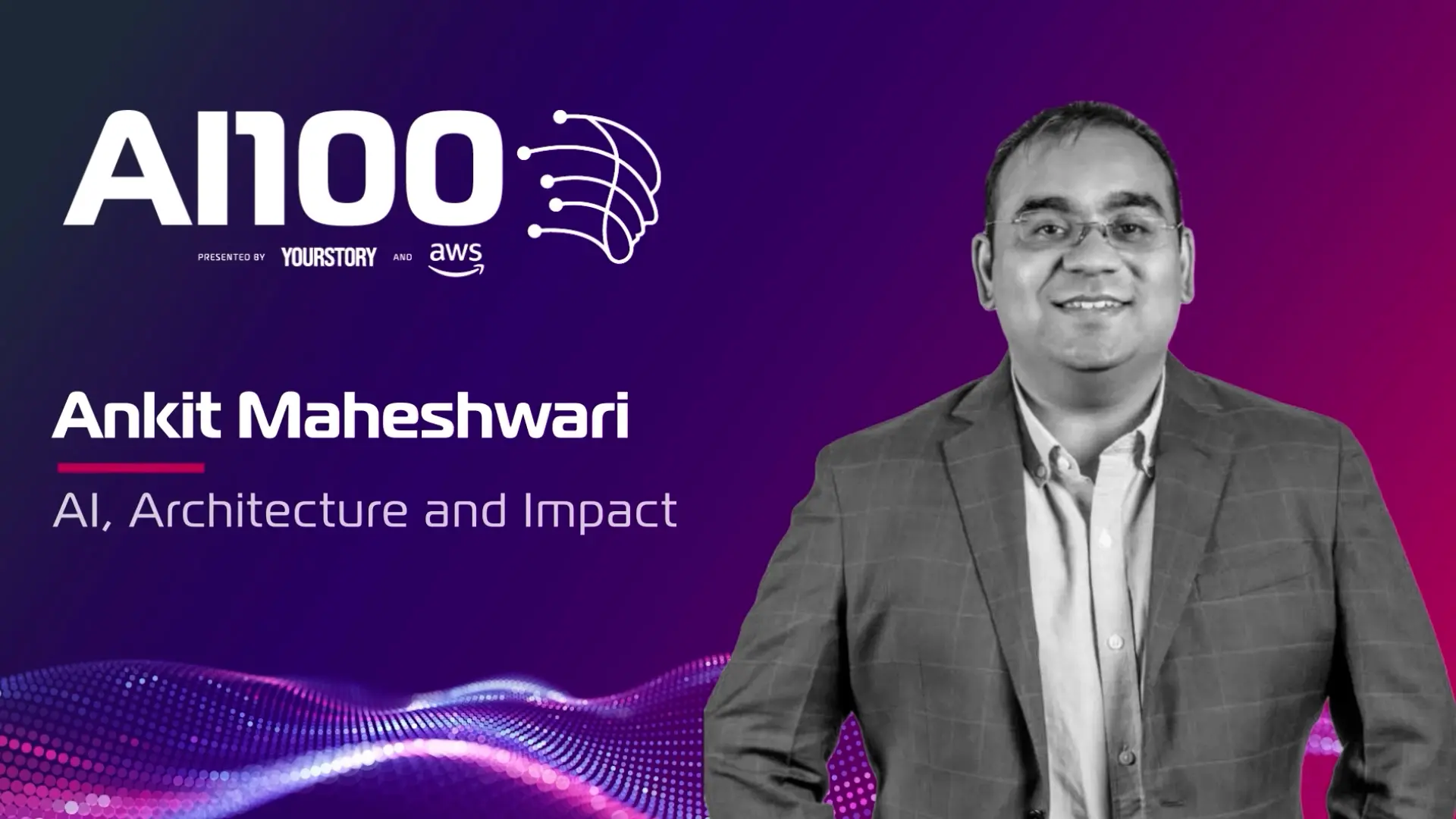

Ankit Maheshwari, Chief Product and Technology Officer and founding team member at Innovaccer, traces his fascination with artificial intelligence (AI) back to a moment many technologists recognize: the first time code felt like power. In school, as he was introduced to the basics of programming around Class 10, computing shifted from curiosity to possibility.
“That was the first glimpse of how a few lines of code could create something real,” he recalls. “It was a powerful interaction, one that sparked an attraction for creating and building anything with a few lines of code.” The experience would shape every decision that followed, from his choice of subjects to his career in technology.
By his second year of engineering, when AI and machine learning (ML) were largely academic concepts in India, Maheshwari was already pushing beyond theory. His college’s software incubator became a proving ground.
“We operated like a mini startup within the campus,” he recalls, building solutions not just for their own college, but for neighbouring institutes as well. Alongside his peers, he experimented with early intelligent systems – from a primitive GPT-like tool that transcribed and indexed lecture notes to a camera-based attendance system powered by rule-based logic and basic machine learning.
These early projects did more than sharpen his technical skills. They cemented Maheshwari’s belief that would later define his work at Innovaccer: that intelligent systems are not about replacing humans, but about amplifying human capability.
Building intelligent systems for healthcare
Innovaccer began as a horizontal data and analytics company, its name drawn from “innovation accelerated”. In its early years, the startup partnered with academic institutions, including Stanford University, Harvard University, Wharton School, and Massachusetts Institute of Technology, helping researchers test hypotheses using clean, analytics-ready datasets. The insight driving this work was simple but critical: even the most advanced machine learning models are only as good as the data they are built on.
While working across sectors, including projects with NASA and Walt Disney, the team encountered its first healthcare customer in Des Moines, Iowa. The engagement revealed a deeper problem: despite the US spending nearly $4 trillion annually on healthcare. data was deeply siloed, limiting providers access to patient histories and real-time insights at the point of care. This led to inefficiency, and excess spending to the tune of $1.2 million.
Recognizing both the scale of the challenge and its human impact, Innovaccer made a decisive pivot to focus exclusively on healthcare. The company set out to build intelligence systems that unify fragmented data, enable predictive insights, and support better clinical decision-making, a mission it has pursued for a decade.
As Chief Product and Technology Officer at Innovaccer, Maheshwari leads product strategy and technology architecture, with a clear philosophy: AI must be foundational, not layered on. Rather than adding chatbots to legacy systems, Innovaccer has built AI-native applications from the ground up, starting with data unification, analytics, longitudinal patient context, and, finally, actionable insights for providers.
“AI is only as good as the data and infrastructure behind it,” Maheshwari says. “Clean, connected data is the real differentiator. And that is our secret sauce: our systems have not built overnight.” That long-term investment now powers seven of the top 10 health systems in the US, with more than 80 million lives on the Innovaccer platform.
Challenges: Silos, compliance, and clinicians
For Maheshwari, the biggest barrier to deploying AI at scale in healthcare remains data itself. Decades-old systems built on legacy infrastructure continue to operate in silos, making clean, interoperable data difficult to access. Without unified and reliable datasets, even the most advanced AI models risk producing misleading results.
Regulation adds another layer of complexity. Healthcare organizations function within strict compliance frameworks and are cautious about adopting emerging technologies. This risk-averse environment often slows experimentation and large-scale implementation.
Change management, however, may be the toughest challenge of all. Clinicians work under intense pressure and rely on workflows refined over years. Introducing new tools requires more than technical capability; it demands trust, clear value, and seamless integration. “You can build something powerful, but asking clinicians to change how they work day-to-day is a hard sell if it doesn’t fit naturally into their routine,” Maheshwari says.
Impact & innovation: How AI can change the world
Maheshwari believes that AI is at a transformative inflection point, one that mirrors the industrial and internet revolutions. In the short term, it may introduce disruptions, from labour shifts to rising energy concerns. But, over time, he expects AI to help solve many of the challenges it creates, including breakthroughs in renewable energy and efficiency.
In healthcare and life sciences, the impact could be profound. AI has the potential to accelerate drug discovery, advance cancer research, and extend healthy ageing, compressing timelines that once took decades into years. Beyond healthcare, its applications in agriculture, climate resilience, and education could reshape how societies address food security and resource scarcity.
Maheshwari is particularly excited about two frontiers. The first is edge AI, moving intelligence from energy-intensive cloud systems to efficient, on-device models that are faster, more secure, and scalable. The second is the shift from digital AI to physical AI through robotics. Initiatives like Tesla’s Optimus, he says, point toward embodied intelligence capable of operating in the real world. For Maheshwari, these advances signal the next leap in how AI will reshape industries - and human potential.
AWS and Innovaccer: Accelerating innovation
Amazon Web Services has been a foundational partner in Innovaccer’s journey since its early days. As the company deepened its focus on AI, platforms such as Amazon Bedrock and Amazon SageMaker enabled rapid experimentation across models - without locking into a single ecosystem. This flexibility aligns with Innovaccer’s technology-agnostic approach, allowing engineers to test and deploy what works best for specific healthcare use cases.
Speed is equally critical. Scalable cloud infrastructure allows solutions to move swiftly from prototype to production, ensuring teams spend less time managing backend complexity and more time solving customer problems. “We want to be the fastest innovators, bringing solutions to customers quickly. If we are stuck figuring out how to deploy at scale, we lose focus on the problems that matter,” Maheshwari says.
AWS also brings enterprise-grade security and compliance capabilities, reducing operational burden while meeting the stringent requirements of healthcare systems. Together, faster experimentation, seamless scalability, and trusted compliance allow Innovaccer to innovate with confidence.
AI and beyond…
To keep pace with the rapid evolution of AI, Maheshwari turns to AI itself. He has built a suite of intelligent agents that scan global developments each morning, which track advances in models, agent frameworks, and healthcare innovation, and distil them into concise summaries. When something stands out, he dives deeper, either by prompting further research or exploring it firsthand
Beyond work, Maheshwari is an avid cricket fan and enjoys reading non-fiction, particularly biographies and autobiographies of leaders, which he saves for long flights and travel. Away from technology, he finds poker especially engaging, a game that blends probability, strategy, and human psychology.