



India's first woman Top Gun, and a first in the Army Chief's office
Squadron Leader Bhawana Kanth has cleared the Indian Air Force's Fighter Combat Leader course, while Captain Shivani becomes the first woman ADC to the Army Chief

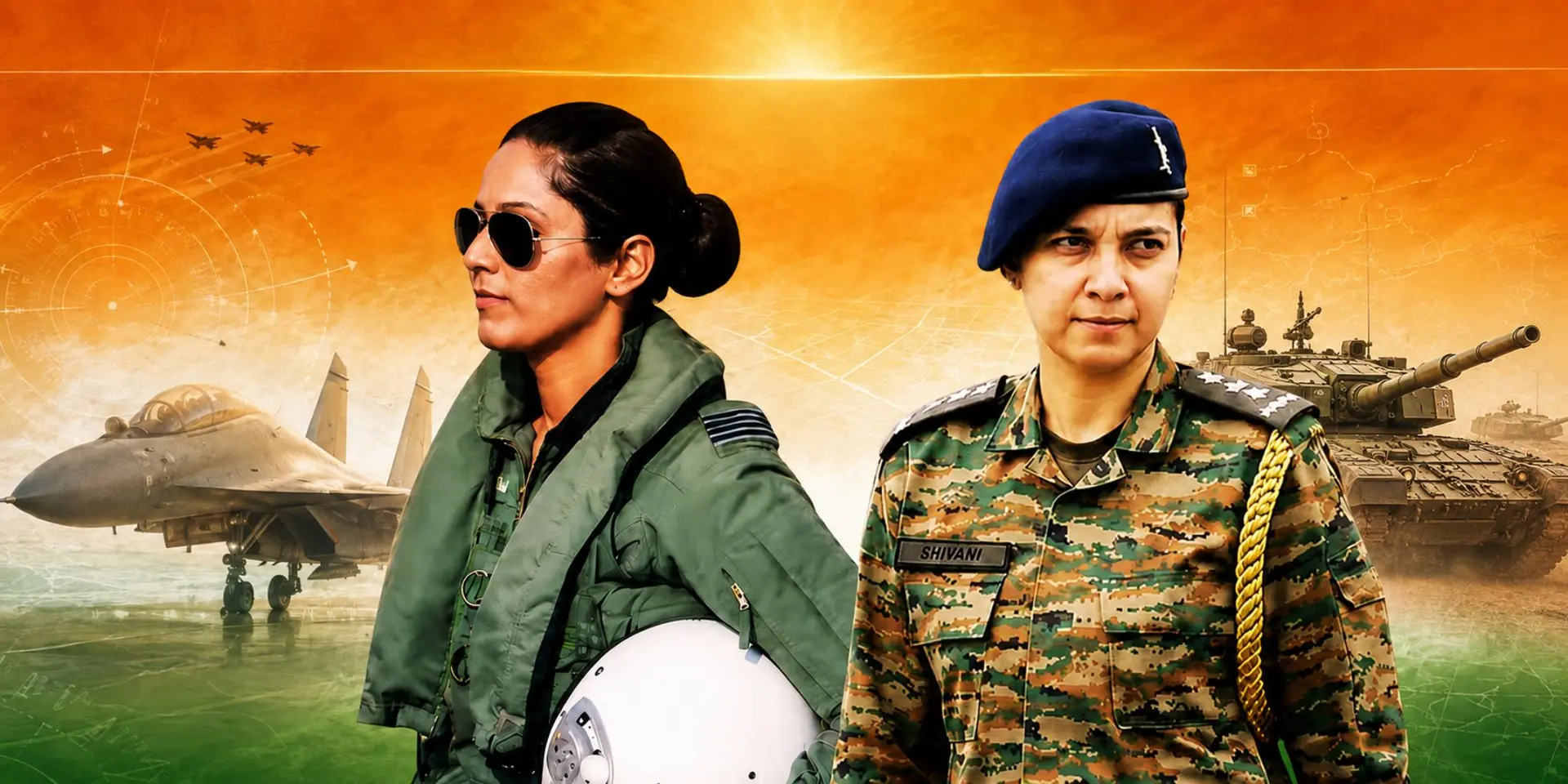

Two appointments announced within weeks of each other have pushed women in the Indian armed forces into roles that had stayed closed until now. Squadron Leader Bhawana Kanth has become the Indian Air Force's first woman Top Gun, and Captain Shivani has become the first woman officer to serve as Aide-de-Camp to the Chief of the Army Staff.
Squadron Leader Kanth cleared the Fighter Combat Leader course at the Tactics and Air Combat Development Establishment in Gwalior, the first woman pilot to do so. Captain Shivani was appointed Aide-de-Camp to General Dhiraj Seth, who took charge as the 31st Chief of the Army Staff on 30 June 2026.
Two decades of incremental opening
The Indian Air Force first opened its cockpits to women in 1994, when Flight Lieutenant Harita Kaur Deol flew solo. The combat stream stayed shut for another two decades. An experimental scheme to induct women into the fighter stream was introduced in 2015, and the first three women fighter pilots were commissioned in 2016.
Squadron Leader Kanth was one of those three, alongside Avani Chaturvedi and Mohana Singh. What has changed in the ten years since is not the entry point but the ceiling. The current run of firsts is happening in specialist and staff roles that sit well above the point of induction.
Inside India's first woman Top Gun qualification
Only about 1% of Indian Air Force fighter pilots are ever selected for the Fighter Combat Leader course. The 20-week programme at TACDE trains pilots in advanced combat tactics. Graduates return to their operational units as in-house authorities on weapons employment and air combat manoeuvring, effectively the officers who shape how a frontline squadron fights.
Squadron Leader Kanth, who is from Darbhanga in Bihar and trained as an engineer before joining the armed forces, was cleared in May 2019 as the first Indian woman to fly daytime fighter combat missions on the MiG-21 Bison, before moving to the Su-30 MKI. She represented the Air Force at the Republic Day parade in 2021 and the Republic Day flypast in 2024. She received the Nari Shakti Puraskar in 2020.
A staff appointment that sits beside the Army Chief
The Aide-de-Camp to the Chief of the Army Staff coordinates the Chief's official engagements and manages protocol during national and international commitments, working in close and continuous proximity to the Army's senior-most officer. It is a role open to officers of Captain or Major rank and is treated within the service as a high-trust posting rather than a ceremonial one.
Captain Shivani took up the appointment in July 2026. Women officers have held ADC positions before, including Lieutenant Ganeve Lalji as ADC to an Army Commander in 2013 and Lieutenant Commander Yashasvi Solanki as the first woman naval ADC to the President. The appointment to the Chief of the Army Staff had not been held by a woman until now.
Why these firsts are arriving in a cluster
Neither announcement is isolated. In October 2025, Squadron Leader Shivangi Singh, a Rafale pilot, became the first Indian woman to receive the Qualified Flying Instructor badge. On 18 May 2026, the Indian Air Force announced that Squadron Leader Saanya had become its first woman officer to earn the Category-A Qualified Flying Instructor qualification, with Air Chief Marshal AP Singh, Chief of the Air Staff, felicitating her. A Category-A rating is the highest instructional grade in Indian military aviation and requires a 22-week course at the Flying Instructors School at Air Force Station Tambaram, near Chennai.
The pattern is consistent. Each of these is a qualification or appointment earned through the same selection process applied to everyone else, which is what distinguishes them from earlier symbolic milestones.
What makes the Fighter Combat Leader course so hard to clear
A fighter pilot is trained to fly and fight an aircraft. A Fighter Combat Leader is trained to decide how a formation of them will fight, and then to teach it.
The course tests tactical judgement under compressed timelines, weapons employment across multiple scenarios, and the ability to plan and lead complex missions rather than execute someone else's plan. Candidates are already experienced operational pilots when they arrive, which is why the failure rate matters more than it would on an entry-level course.
That is also why the 1% selection figure carries weight. The bottleneck is not the training, it is getting nominated for it at all.
The number that has not moved yet
The visible ceiling is lifting. The base of the pyramid is a separate question. Ten women had been commissioned as fighter pilots in the years following the 2015 experimental scheme, a figure that remains small against the Air Force's total fighter pilot strength.
Two things are worth watching from here. The first is whether women who clear qualifications like the Fighter Combat Leader course and the Category-A instructor rating go on to command frontline squadrons, which is the appointment that converts individual firsts into institutional depth. The second is whether the intake of women into the combat stream grows enough that these milestones stop being firsts at all. Squadron Leader Kanth's cohort took ten years to reach the Top Gun course. The measure of whether the system has genuinely changed will be how long the next one takes.