



Taunted for driving, these six women now command Bihar’s Pink Buses
Meet Ragini, Anita, Baby, Gayatri, Aarti and Saraswati—six young women who overcame poverty and prejudice to become Bihar Pink Bus drivers.

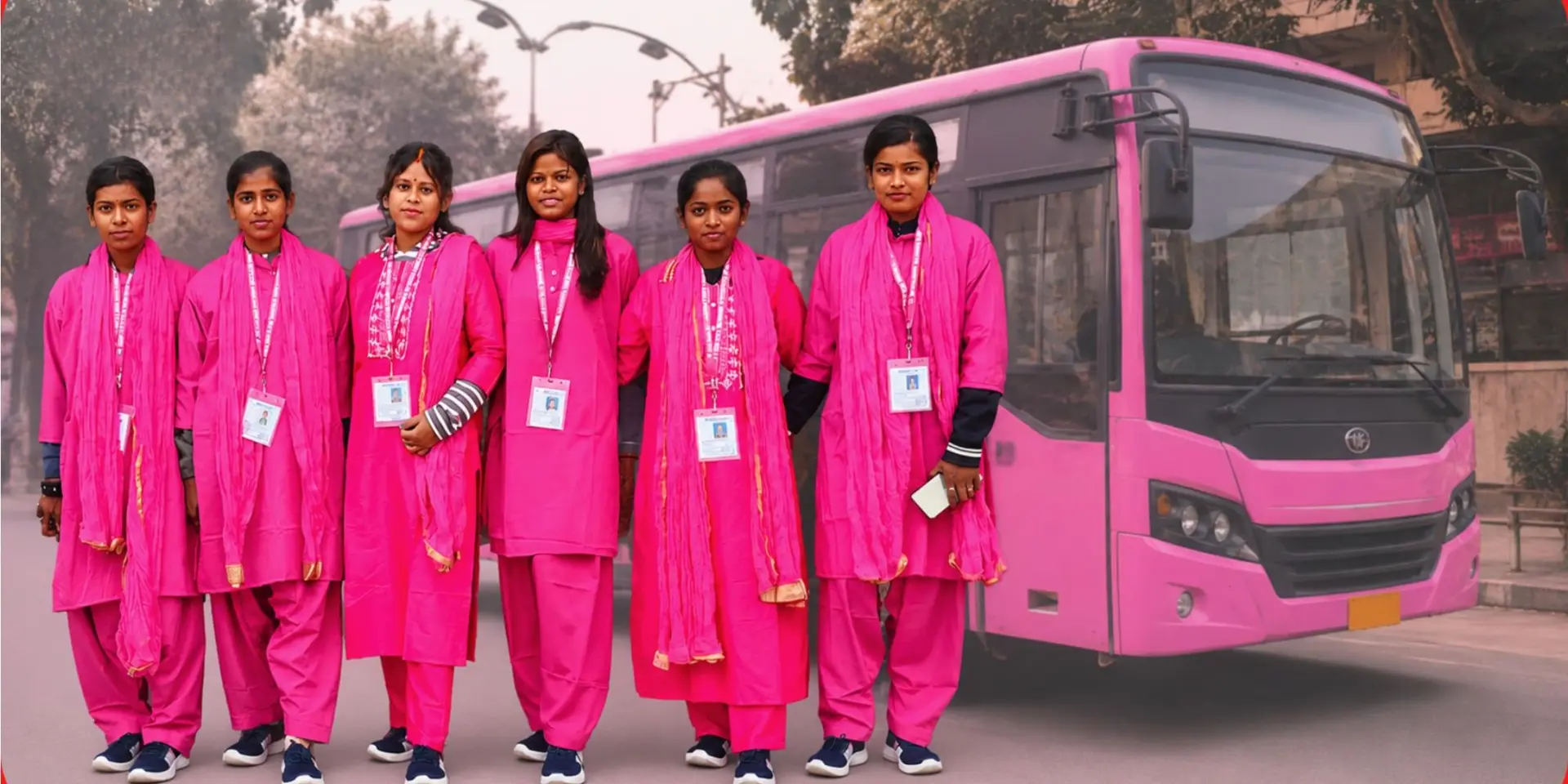

Six young women, Ragini, Anita, Baby, Gayatri, Aarti and Saraswati, left behind social barriers, hardship and taunts to build a new identity as drivers of Bihar's Pink Buses. Their story shows that given the opportunity and the courage, daughters can take command of any steering wheel.
Seen from a distance, the Pink Bus on Bihar's roads looks much like any other city bus. The difference is its colour, but a far bigger change shows up in the driver's seat. Travelling with these young women are their families' hopes, their villages' changing outlook, and their own aspiration to build a better future.
Ragini Kumari, Anita Kumari, Baby Kumari, Gayatri Kumari, Aarti Kumari and Saraswati Kumari are the face of that change. Several come from the Mahadalit community, with fathers who work as daily-wage labourers and mothers who worked in fields and in other people's homes. One was mocked for her height; another was told that driving heavy vehicles is not a woman's job. Today these same women drive buses and trucks, challenging those very assumptions.
Ragini: past the taunts to the driver's seat
Twenty-one-year-old Ragini Kumari, from Alauddin Chak in Patna district's Punpun block, belongs to the Mahadalit Musahar community and is the first woman graduate in her large joint family. With the family's finances weak, her mother worked in fields and in other people's homes to keep things running, so for Ragini a job was also an attempt to change the family's situation.
Her schooling began with Nari Gunjan, and she later lived at the Prerna Hostel in Danapur. After graduation she prepared for competitive exams, but it was then that driving gave her life a new direction. With help from the Women and Child Development Corporation, she trained on light and then heavy vehicles at the Institute of Driving Training and Research (IDTR) in Aurangabad, carrying on despite mockery of her height and ability in the village.
"When I went to Aurangabad for training, people in the village said a lot to my parents," she says. "Someone asked whether the girl had run away; someone said, how will a girl drive a bus? I didn't let those words get to me. Nari Gunjan, Sudha didi and my mentors always kept my spirits up."
Her goal does not end at the wheel. She wants to make her family financially strong so her mother no longer has to labour, and then to pursue a PhD and become a professor.
Anita and Aarti: turning fear into strength
Twenty-two-year-old Anita Kumari's father is a daily-wage labourer, and when the chance came to train on heavy vehicles in Aurangabad, even arranging the cost of getting there was a challenge.
"When I first saw a heavy vehicle, I was afraid. Could I really drive it?" she says. "Even going for the training was a worry. But slowly I understood the vehicle and my fear disappeared. Given the chance and the right training, girls are behind in nothing."
Twenty-one-year-old Aarti Kumari, from Sikarhatta Khurd in Bhojpur district, joined Nari Gunjan in 2023, trained on light vehicles and then completed a month-long heavy-vehicle course in Aurangabad.
"At first I didn't even know whether I could drive such a big bus, and many in the village didn't believe it either," she says. "But my parents always stood by me. Pappu bhaiya and Sudha didi told me to learn instead of being afraid." She now wants other girls in her village to find the courage to make their own career decisions.
Baby and Gayatri: a new road to self-reliance
Twenty-two-year-old Baby Kumari, from Punpun Dehri, has been connected to Nari Gunjan since childhood and learned about the driving training while looking for work, completing light vehicles in 2023 and heavy vehicles in 2025. The real challenge waited outside the training centre, where her short height was mocked.
"When I told people I was learning to drive, many mocked my short height and asked how I would drive such a big vehicle," she says. "I heard taunts many times, but I didn't quit. My parents supported me, and Sudha didi and Pappu bhaiya kept encouraging me." For her, driving a Pink Bus is now a matter of self-respect.
Twenty-two-year-old Gayatri Kumari, from Paimar Ghat in Punpun block, also comes from the Mahadalit community. Educated at a Nari Gunjan centre, she completed Classes 10 and 12 and is now doing a BA. She trained on light vehicles in 2023 and heavy vehicles in 2025 before being selected as a Pink Bus driver.
"My bond with Nari Gunjan goes back to childhood, and that is where my education began," she says. "When the chance to learn driving came, my family stood by me. Today I am studying as well as handling the Pink Bus, and my mother is part of a women's band too. Seeing this change in our family, I feel that if women are given the chance, the thinking of an entire generation can change."
Saraswati: an identity built at the wheel
For 21-year-old Saraswati Kumari of Paimar Ghat, the Pink Bus is a journey of building her own identity. Connected to Nari Gunjan since childhood, she studied in the classes run in her village and later trained on light and heavy vehicles. At first she too held the notion so often heard in society, that driving such a large vehicle is a man's job, but the training changed that thinking. In the village she was advised to become a doctor or teacher; she took it as a challenge.
"The first time I went for training, I felt driving a bus was a boys' job and I wouldn't manage it," she says. "But the teachers boosted my morale. When I returned, people said a girl can't drive a bus. I thought, when others can learn, why can't I?"
The Pink Bus has become her identity. Her most special moments come when a woman passenger, seeing her at the wheel, says she too wants to learn to drive. "I feel our hard work is paving the way not only for us but for other girls as well," she says.
Bihar's Pink Bus service was launched to give women safe and convenient public transport, but an important part of the story reaches the women driving them. Commercial and heavy-vehicle driving has long been male-dominated, so these young women reaching the driver's seat is a small but significant part of a larger picture: women's participation in employment.
That participation has risen in recent years. According to the Ministry of Statistics and Programme Implementation's (MoSPI) Periodic Labour Force Survey (PLFS) 2023-24, the Labour Force Participation Rate for women aged 15 and above was 41.7 percent, up from 23.3 percent in 2017-18. Even so, their presence in traditionally male-dominated sectors such as transport remains limited.
By completing training, licensing and selection, these six women have made a place in a profession where, only a few years ago, even imagining an opportunity was difficult. Their identity is shaped not by hardship, taunts and lack of opportunity, but by their decision to overcome them. Mothers in particular have been central, having worked in fields and homes to fund their daughters' education; now those daughters are trying to change the family's financial picture.
On the roads of Patna, these women give no speeches each day; their presence says enough. Their journey does not end at the driver's seat. Perhaps the real journey begins right here, as daughters in Bihar no longer just choose their destination but take the steering wheel to get there themselves.