




Context is the new intelligence in agentic AI
At DevSparks Hyderabad 2026, UBS CTO Elango Somasundaram explored what comes after copilots: agentic AI that understands context, connects the dots, and orchestrates enterprise workflows.

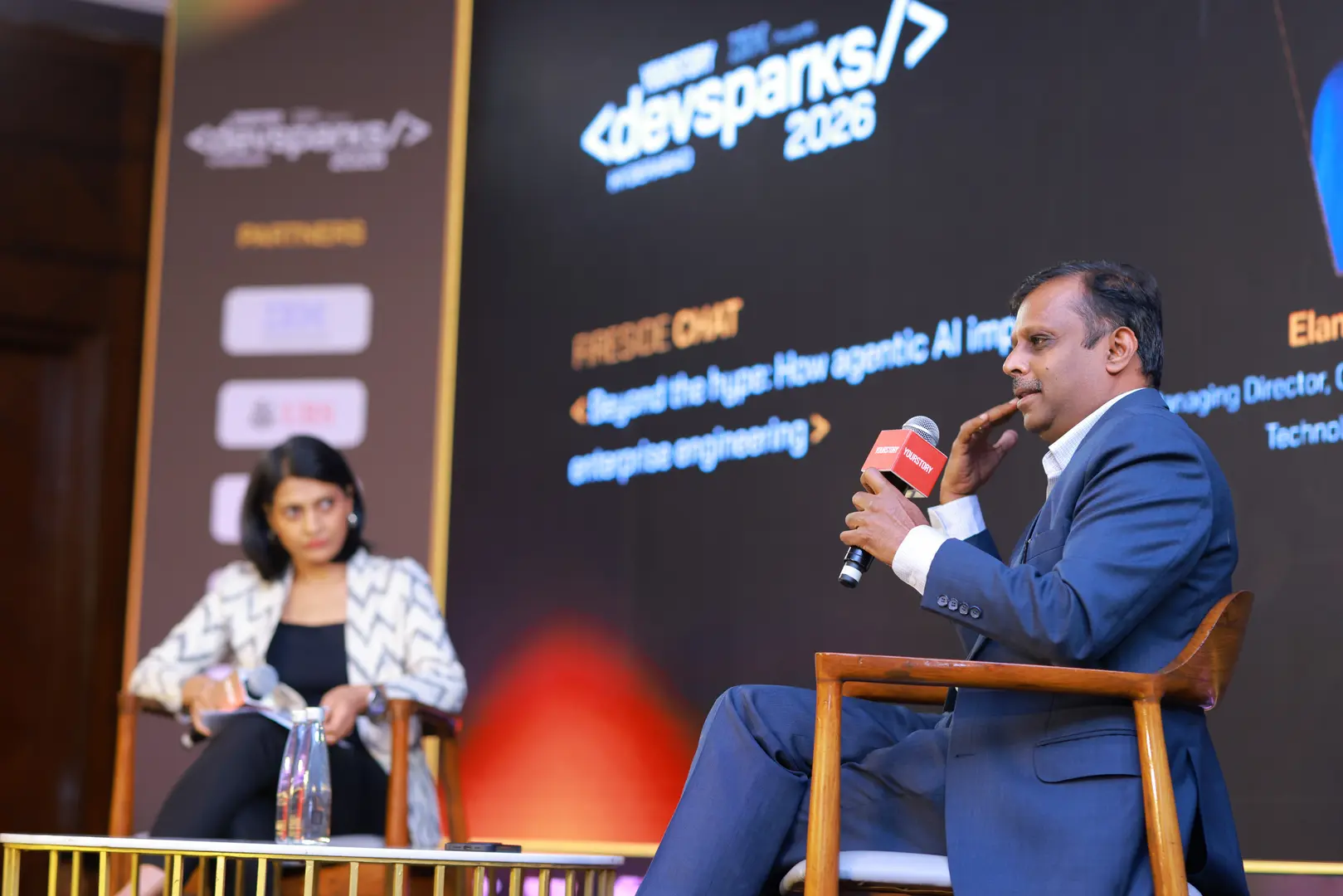

AI development is moving from copilots and vibe coding to AI systems that can reason across workflows, coordinate specialized agents and deliver outcomes with less human intervention.
At DevSparks Hyderabad 2026, Elango Somasundaram, Managing Director and Chief Technology Officer, UBS India, said the shift toward agentic AI is less about replacing engineers and more about changing the nature of engineering.
From banking and security to software architecture and enterprise governance, Elango said the next competitive advantage will depend not just on better models, but on richer context, stronger guardrails, and developers who can think beyond code.
“We’re moving into the era of agentic engineering, where AI agents don’t just respond to prompts but understand the context around a task and use that context to make better decisions,” he said.
Agentic AI enters the conversation
Elango traced the evolution of AI through several shifts, from robotic process automation and cloud to copilots, vibe coding, and task-specific AI agents.
While copilots can predict the next line of code, vibe coding allows developers to build through natural language prompts, and agents can execute specific tasks. Agentic AI goes a step further: it starts with intent, identifies the tasks required, delegates them across specialized agents, and delivers an outcome.
The next frontier, he said, is agentic engineering. Instead of developers manually breaking requirements into epics, identifying dependencies, coordinating teams, and stitching workflows together, intelligent systems will increasingly understand those relationships themselves.
This points to a different model of software engineering, where AI begins to participate in architectural thinking that has traditionally been handled by experienced engineers.
Context is the real differentiator
According to Elango, skills are quickly becoming commoditized. Most organizations now have access to powerful foundation models and specialized skills, capabilities that have been democratized through open-source ecosystems and AI/ML communities.
The differentiator, he argued, is context.
“How do we bring in more context to the agents we develop? You can get the skill, but how do you make sure you include context? Data becomes important,” he said.
For enterprises, particularly in regulated industries such as banking, context includes proprietary business processes, product knowledge, security policies, customer expectations, and organizational workflows.
Generic models can write code, but they do not automatically understand how a particular bank approves transactions, how a healthcare provider manages compliance, or how an automotive company designs its products.
This makes data quality foundational. Enterprises may have large amounts of information, but it is often fragmented across systems, duplicated, inconsistent, or disconnected from the workflows AI needs.
The focus, therefore, is shifting from how many employees use AI tools or how many tokens they consume to whether AI systems can use enterprise context to deliver accurate and reliable outcomes.
For developers, this changes the nature of the work too. Instead of only implementing stories and epics, they will increasingly need to enrich AI systems with the knowledge required to solve problems correctly.
Every layer counts in an agentic system
Agentic AI cannot succeed by focusing only on the application layer. Elango described enterprise architecture as a set of interconnected layers, spanning infrastructure and networking, identity management, software development practices, governance, and security.
A modern application may run across cloud and on-premises environments, connect to dozens of services and operate within architectural principles specific to an organization. Agentic systems therefore need to reason across the wider ecosystem, rather than simply generate functional code.
Identity and access management become particularly important as agents increasingly exchange information with one another. If inaccurate or hallucinated information passes from one agent to another, the error can amplify and lead to a wrong and unintended outcome from a workflow which will have major consequences.
Enterprises therefore need guardrails at every architectural layer. Connectivity, authentication, Software Development Lifecycle controls, regulatory compliance, and security policies become part of the agentic workflow rather than checks carried out at the end.
Elango also addressed the changing human role. As AI automates more of the execution, developers will continue to define objectives, validate outcomes, and provide business context.
The looming shadow of Mythos
For enterprises, more capable reasoning models have made AI adoption both more promising and more complex.
“While we get a lot of efficiency in terms of developing the code faster, even testing faster, the final outcome requires thorough testing. AI can generate tens and thousands of lines of code in just a minute; we need to make sure that there is nothing wrong in it,” he said.
Earlier AI workflows relied heavily on humans validating code before it moved through testing. Agentic systems add another layer of complexity, as multiple agents could independently generate, validate and execute different parts of a workflow.
As a result, enterprises are slowing down deployment—not because the technology lacks promise, but because governance has become more important than speed.
Every model entering an enterprise environment now requires careful curation. Security teams need to ensure proprietary information does not leak into external models, while developers need confidence that AI-generated outputs follow internal policies before reaching production.
Banking: a window into the agentic future
Elango sees banking as an early example of how agentic AI could reshape operating models. Routine processes such as payment settlements, customer operations, and workflow orchestration could eventually be managed by coordinated agents rather than large operational teams.
That future, however, still depends on architects, engineers, business leaders and operational experts designing the ecosystem behind those agents.
The bigger opportunity, he argued, lies in enterprise differentiation.
Every industry has a unique context that competitors cannot easily replicate. In banking, that includes regulatory knowledge, risk frameworks, payment infrastructure, and customer trust. As agentic systems mature, these contextual advantages could become more valuable than access to generic AI models.
The developer role is changing—not disappearing
Elango also addressed questions about what agentic AI means for developers.
Experience still matters, he argued. An AI model may generate a thousand lines of working code, but an experienced engineer often knows how to solve the same problem more effectively and efficiently because they understand the business context, learnings from part releases, understand the customer needs that aren't documented and learnt via continuous interactions and refinements.
The next generation of developers, he said, will need three capabilities: understanding the business problem, collaborating across complex enterprise ecosystems, and writing clear intent for AI systems rather than simply writing code.
As agentic engineering evolves, coding will become one part of the developer's toolkit. Context, judgment, and systems thinking will become increasingly important for those looking to lead with AI.