



Delectrik builds flow batteries that store renewable power for far longer than its counterparts
The Gurugram-based company has won the contract for India's first utility-scale vanadium flow battery, a 100 MWh system for NTPC at the Khavda solar park in Gujarat.


A lithium-ion battery stores energy in solid electrodes, and every charge cycle wears them slightly. A flow battery does it differently. The energy sits in two tanks of liquid electrolyte, pumped past a membrane where the reaction happens, and because the liquid is not consumed, the system can run for decades with little degradation.
The trade-off is size. Flow batteries hold less energy for their volume than lithium does, which rules them out of a phone or a car. For a grid, where space is cheaper than replacement cycles, the calculation reverses: a system that lasts twenty years and likely does not catch fire is worth a larger footprint.
Systems builds them. Based in Gurugram and led by founder and CEO Vishal Mittal, the company designs and manufactures vanadium redox flow batteries for commercial, industrial and utility-scale use.
The timing suits it. India has added solar generation far faster than it has added storage, and the mismatch between when power is produced and when it is needed has become the constraint on the whole build-out.
A tank instead of a rack
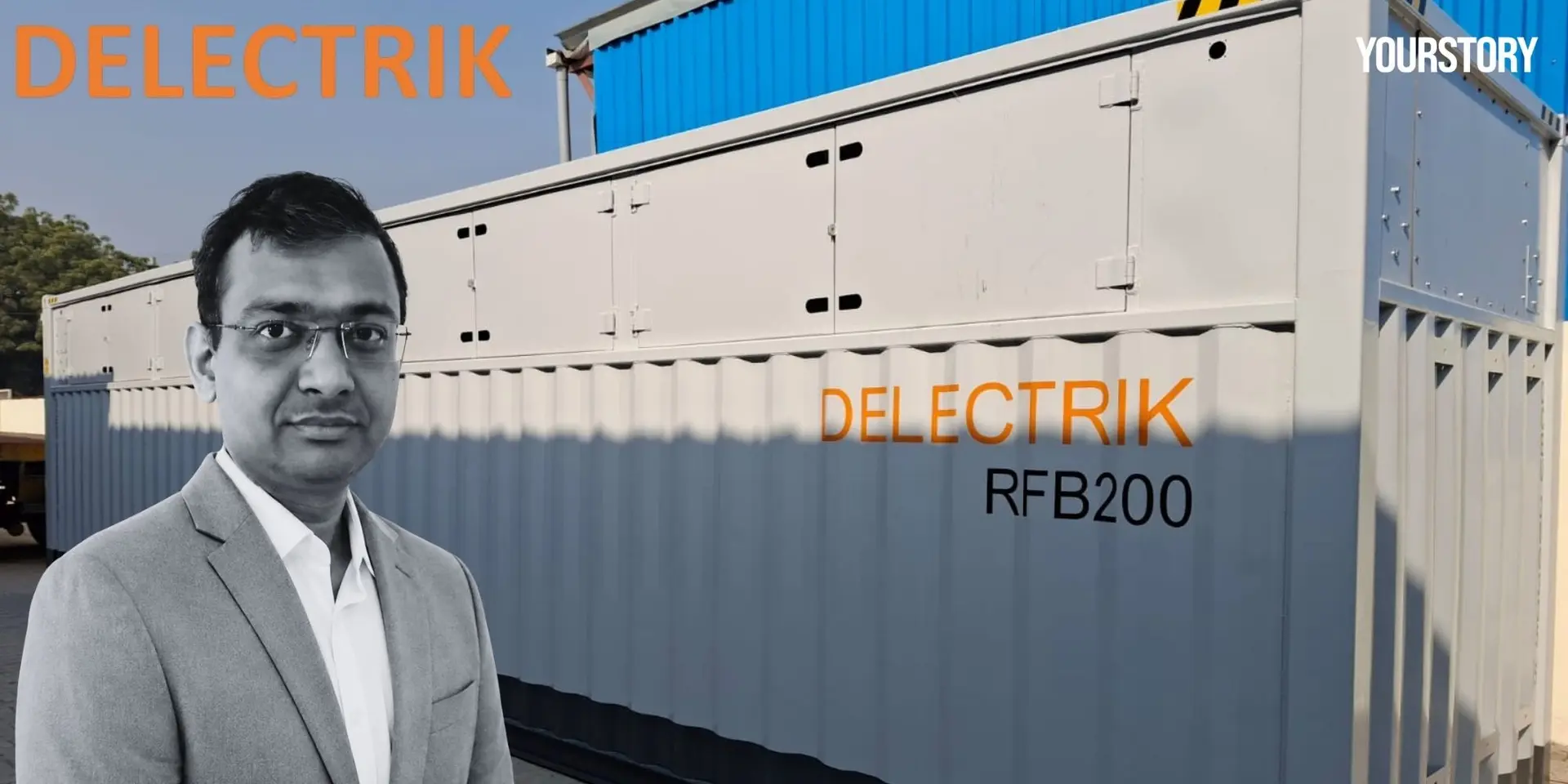
Its systems use what the company calls a non-containerised architecture. Most large batteries arrive as shipping containers packed with cells; a flow battery instead has tanks, pumps and stacks that can be built into a site rather than dropped onto it, which suits installations measured in tens of megawatt hours.
Chemistry matters for safety. Vanadium electrolyte is water-based and does not burn, which removes the thermal runaway risk that has driven fire-safety rules around large lithium installations. It also tolerates being fully discharged and left that way, which a lithium system does not.
The company has been building the business around the material as well as the product. It has set up two wholly owned subsidiaries: Delectrik Resources, which is moving upstream into vanadium oxide production and eventually vanadium assets, and Delectrik Esaas, which intends to sell storage as a service to commercial, industrial and data centre customers.
Vanadium is the constraint on this technology worldwide. The metal is not scarce, but its supply is concentrated, and the electrolyte is a large share of a flow battery's cost. So a company that can source and process its own has a structural advantage over one buying it.

A hundred megawatt hours at Khavda
In July 2026, the company announced it had won the tender to deploy a 100 MWh vanadium flow battery at the Khavda renewable energy park in Gujarat. The award came from NTPC Renewable Energy Limited, a subsidiary of India's largest power utility, with Bondada Engineering as the contractor handling construction and ten years of operations and maintenance. Delectrik is the technology partner. Deployment is scheduled for 2027.
Khavda is being built towards 30 gigawatts of generation by 2029, which is among the largest single renewable sites anywhere. Storage is what makes that output usable, since solar generates in the middle of the day and demand peaks after dark.
The company describes the project as India's first utility-scale flow battery installation and its first non-lithium utility-scale storage project. It had earlier commissioned a 3 MWh system at NTPC's Greater Noida facility in 2025, which is the reference the larger contract rests on.
Its stated target is an order book of at least a gigawatt-hour within twelve months, across India, Australia, Southeast Asia and Africa. No funding round, revenue figure or company valuation appears in any public source.
(This story has been researched and compiled using publicly available information.)