



Delhi Lakshmi Yojana goes live with an enterprise pitch
The Women and Child Development Department is calling it seed capital. The payout structure explains why

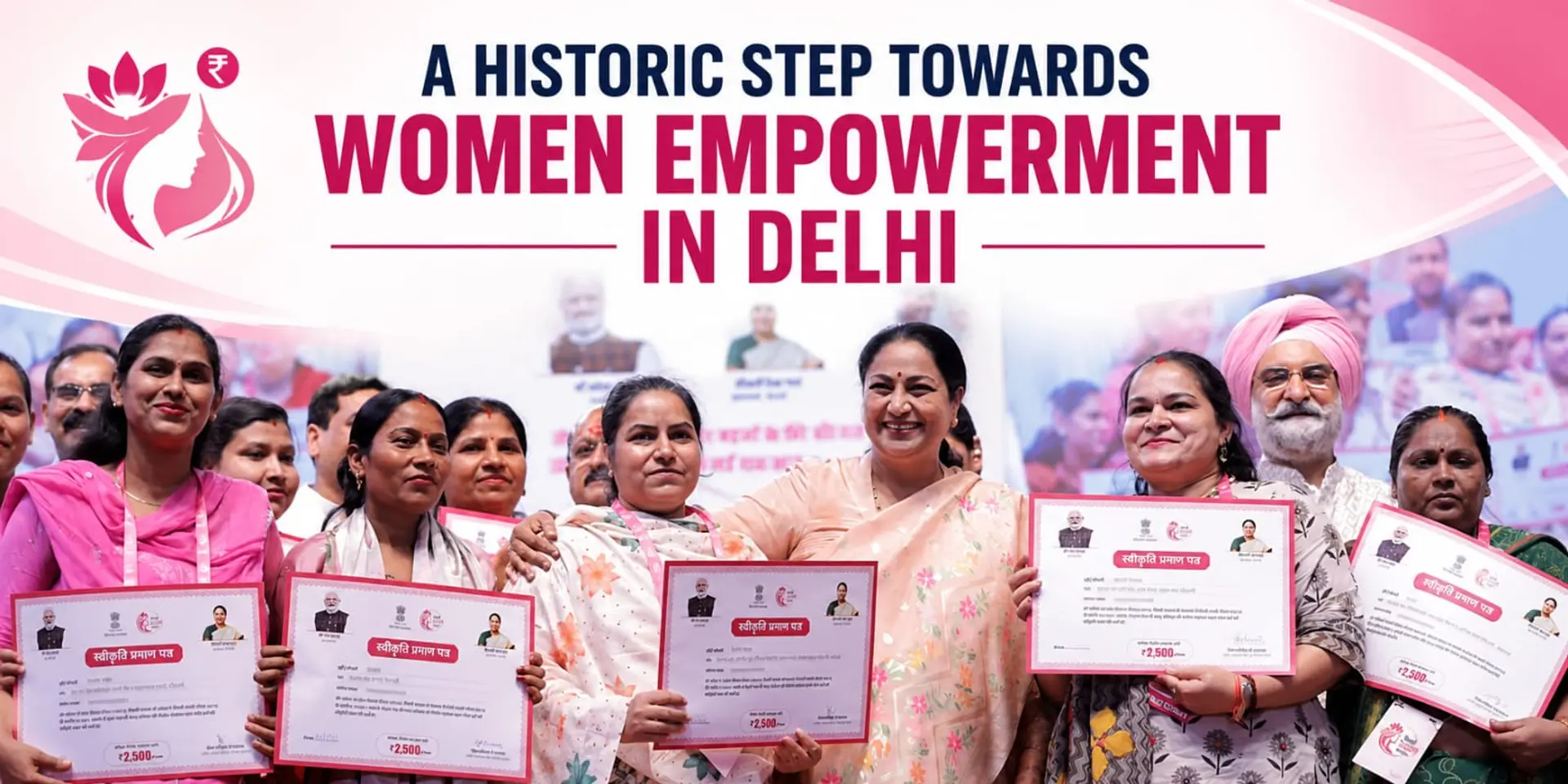

The Delhi Lakshmi Yojana was formally launched on 26 August 2026, with Chief Minister Rekha Gupta handing over the first batch of sanction letters to beneficiary women at Talkatora Stadium in New Delhi. The scheme gives eligible women aged 21 to 60 from lower-income households in the capital Rs 2,500 every month, with the first transfers due from 1 September 2026. Lieutenant Governor Taranjit Singh Sandhu and Union Minister of State Harsh Malhotra were among those on stage.
What separates the scheme from comparable state programmes is not the headline amount. It is that a majority of the money is routed into a locked savings instrument rather than into immediately spendable cash, and that the government is openly positioning the payout as seed capital rather than as monthly relief.
From portal to payout in under a month
Registrations opened on 1 August 2026 through the Women and Child Development Department's portal. As of noon on 25 August, official figures put registrations at 9,13,495 and completed applications at 6,52,223. Gupta said at the launch that nearly 9.5 lakh women had registered within a month. The Delhi government has budgeted Rs 5,100 crore for the scheme in 2026-27 and expects it to eventually cover more than 17 lakh women. The initiative was first announced as the Mahila Samriddhi Yojana before being implemented under its current name.
The Delhi government release put the first batch of sanction letters at around 4,000, while PTI reported that roughly 2,500 women received approval letters at the ceremony itself.
Rs 1,000 to spend, Rs 1,500 to save
Under the default arrangement, Rs 1,500 of the monthly assistance goes into a recurring deposit or fixed deposit account with a lock-in running until 31 July 2029. The remaining Rs 1,000 is credited to a bank account linked to a Central Bank Digital Currency (CBDC) wallet. Beneficiaries can instead choose to route the entire Rs 2,500 into the RD or FD, subject to the same lock-in.
Spending through the CBDC wallet is fenced off from a government-listed set of items, including alcohol, tobacco products, narcotic and psychotropic substances, lottery tickets, and gambling and betting. Applicants choosing a wallet-linked option must confirm they have a smartphone and hold an account with a bank participating in the CBDC ecosystem.
Eligibility is tightly drawn. The annual family income ceiling is Rs 2.5 lakh, applicants must be registered Delhi voters and meet a 10-year residency condition, and ordinarily only the eldest eligible woman in a household qualifies. Households consuming more than 2,400 units of electricity a year, owning a four-wheeler, or with more than three living children are excluded, as are income-tax payers, GST filers, government servants, public office holders and recipients of certain government pensions.
The enterprise pitch from the department running the scheme
Speaking at the launch, Dr Rashmi Singh, IAS, Secretary of the Department of Women and Child Development, Government of NCT of Delhi, framed the money as a starting point rather than an entitlement. The scheme, she said, "is not merely a means of providing financial assistance, it is also a powerful opportunity for our beneficiary sisters to realise their highest dreams."
She was more specific about what that opportunity looks like. Through the scheme, she said, "our sisters can start new enterprises, join self-help groups, and further develop their talent and skills." Singh, who also chairs the Delhi Commission for Women, credited the pace of the rollout to district approval committees, district administrations, departmental officers and Anganwadi workers.
How does the savings lock-in actually help a beneficiary
Most direct benefit transfer schemes for women, including Karnataka's Gruha Lakshmi at Rs 2,000 a month and Haryana's Deendayal Lado Lakshmi Yojana at Rs 2,100, put the full amount into the beneficiary's hands each month. Delhi is splitting income support from asset creation.
The arithmetic is straightforward. At Rs 1,500 locked away every month, a beneficiary accumulates Rs 54,000 in principal over three years, before interest. Choosing the full Rs 2,500 option takes that to Rs 90,000. For a household under the Rs 2.5 lakh income ceiling, that is a corpus that could fund a small enterprise or a skilling course rather than being absorbed into monthly running costs.
The trade-off is liquidity. A family under immediate pressure gets Rs 1,000 a month in usable money, not Rs 2,500, unless the design allows early exit in hardship cases.
What to watch from September
Registration stays open through the year, with the last day of each month treated as the cut-off, so the beneficiary base will keep expanding well past the launch cohort. The real test begins on 1 September, when the first transfers land and the gap between the 9.5 lakh who registered and the number actually verified and approved becomes visible. The harder question comes later. If the department's enterprise and self-help group framing is to mean anything, it will need visible linkage to Delhi's existing skilling and SHG machinery, not just a deposit maturing in July 2029.