



Every drone that flies over a city is one motor failure from being a falling object. This startup is building a safety kit to combat such failures.
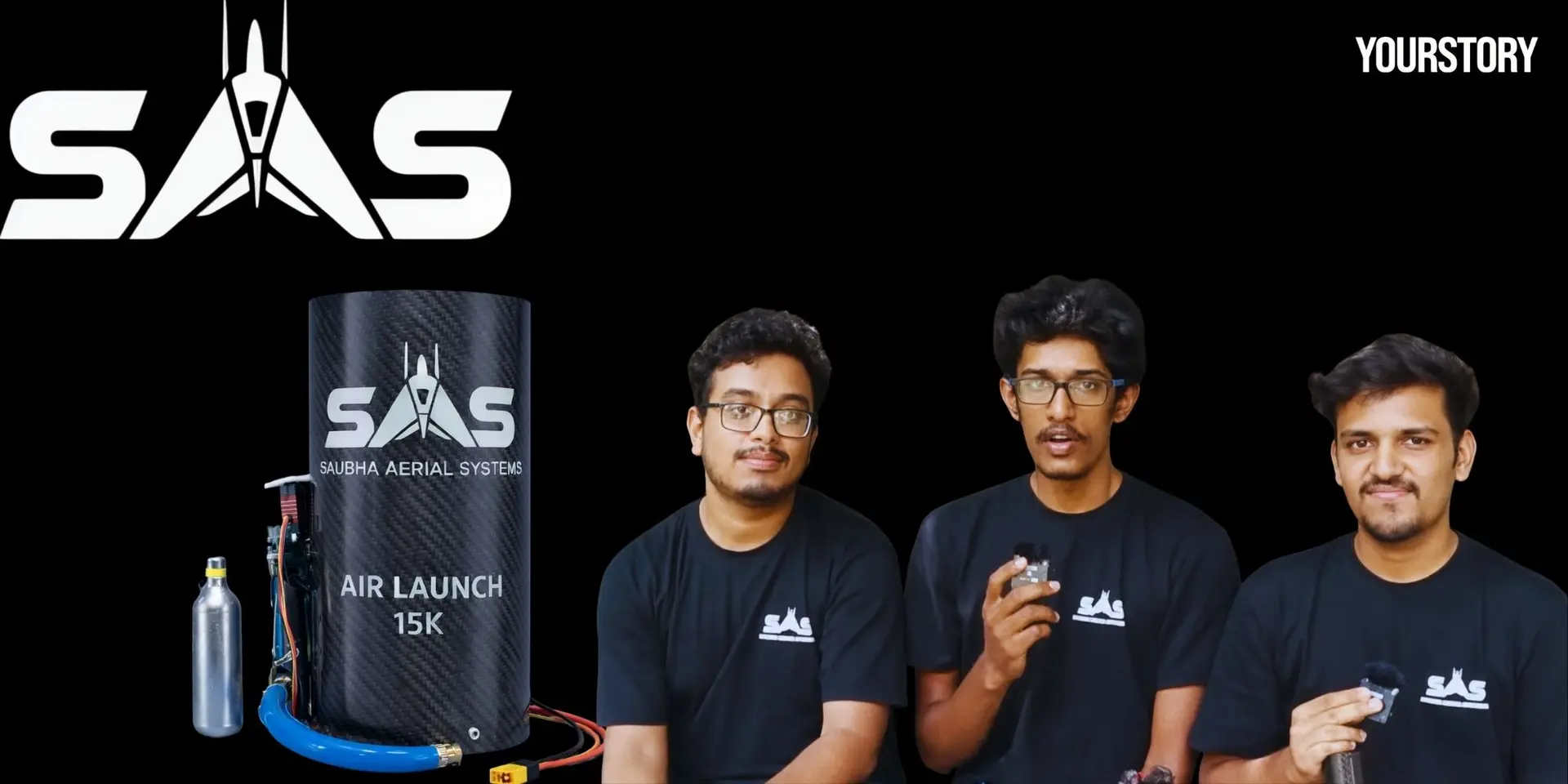
The Bengaluru-based Saubha Aerial Systems has developed an autonomous parachute trigger for drones and has since tested a netgun for catching hostile ones.


A drone that loses a motor does not glide. It drops, and whatever is underneath it- a road, a warehouse yard, a crowd at an event- is where it lands. That single fact is behind much of why regulators are cautious about letting drones fly over people, and why insurers price the risk the way they do.
The answer that aviation settled on long ago is a parachute, and the difficulty in a drone is not the canopy but the timing. A drone that fails at 60 metres has a couple of seconds before impact, which is not enough for a human operator to act. The system has to work out that something has gone wrong and fire on its own.
builds that.
Incorporated in Bengaluru in January 2025 by Ksheeraj Krishna K V and Ruturaj Yellurkar, with Naijith Rai as a third director, the company describes itself as making aerospace-grade emergency parachute recovery systems for commercial drones.
A trigger that does not wait for a pilot
The product has two halves. One is the recovery system itself: a canopy packed to deploy fast enough to matter at low altitude. The other is the detection layer, which the company calls Mayday, an onboard trigger that watches for a critical failure and fires without pilot input.
The company describes the Mayday trigger as India's first autonomous parachute deployment system for drones, and says it has run controlled reefing tests on fixed-wing aircraft. Reefing is the technique of opening a parachute in stages rather than all at once, which reduces the shock load on the airframe at the moment of deployment.
The customers it is aiming at are the operators with the most to lose: logistics companies flying over built-up areas, defence users running test flights, and anyone carrying an expensive payload or working at high altitude.
The commercial argument it makes is not really about the drone. It is that a recovery system lowers insurance costs and makes it easier to get permission to fly somewhere a crash would be unacceptable.
That framing puts the company in an unusual position in the drone industry. Most Indian drone startups sell the aircraft or the software that flies it. This one sells the thing that matters only when everything else has gone wrong.

A netgun, and a very small company
In July 2026, Saubha Aerial Systems said it had successfully tested a drone netgun, a system carried by one drone to fire a net at another and bring it down without destroying it. Physical capture is one of the answers to small hostile drones that are too cheap to shoot at and too low to jam reliably, and it leaves no falling debris, which matters over a city.
That takes the company into counter-drone work alongside safety. Both draw on the same underlying engineering, which is deploying a fabric structure from a moving aircraft at the right moment, but they are different markets with different buyers.
The business behind it is very small. The company has been registered for about eighteen months, has no disclosed funding, carries paid-up capital of Rs 1 lakh, and employs around three people. Its MCA classification covers radar, navigation and aeronautical equipment manufacture.
Its website names organisations it says rely on its systems, and it lists a product range rather than a prototype. What is not public is a customer name we can confirm, an order, a delivery figure or a revenue number, and no funding round has been announced.
(This story has been researched and compiled using publicly available information.)