



How Dynolt is building India’s EV charging electronics around software instead of hardware
The Bengaluru-based company makes power converters for two-wheeler and three-wheeler chargers and battery swapping stations, and claims to have deployed more than 14,000 across India.

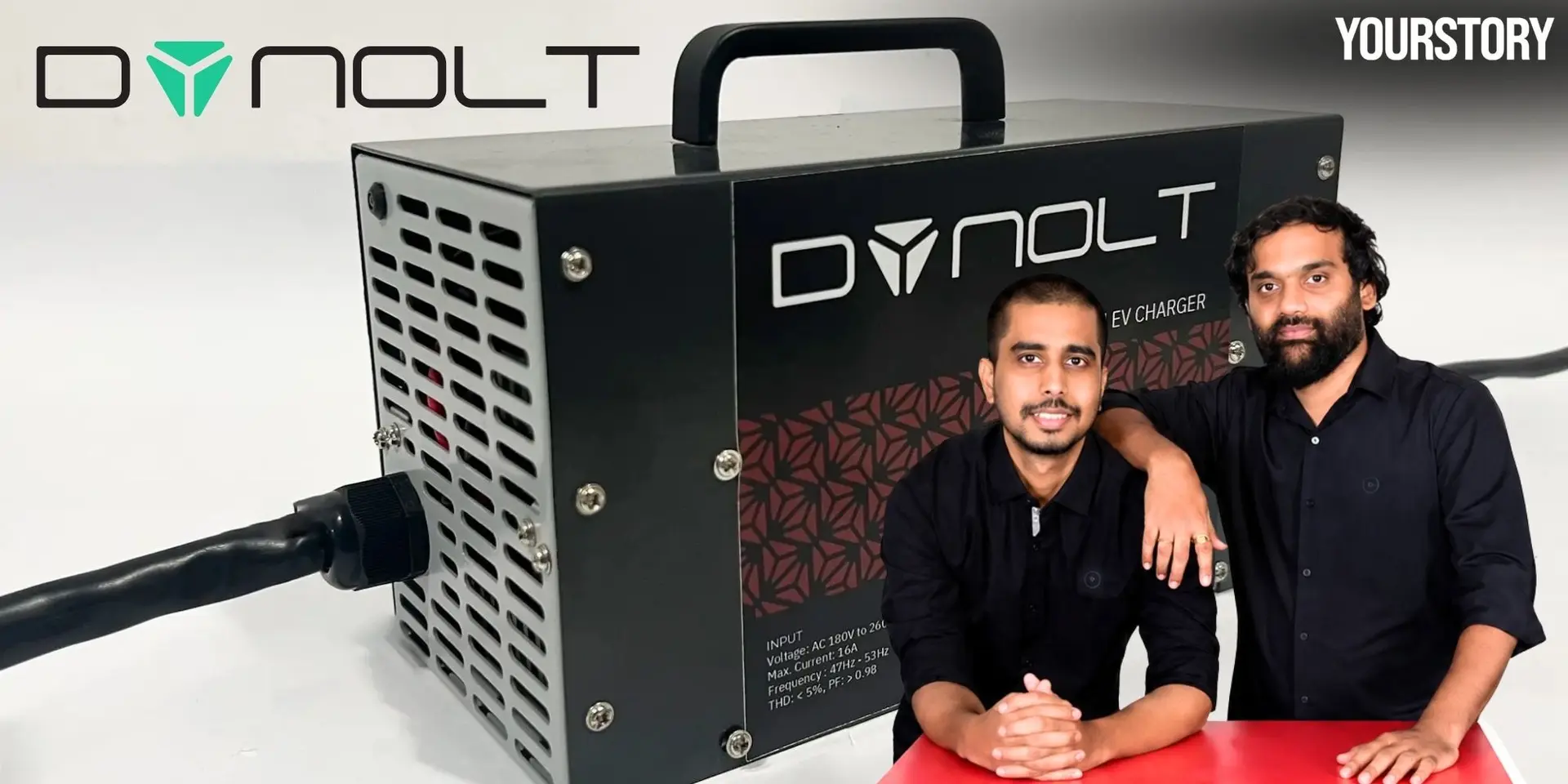

Every electric vehicle charger, battery swapping cabinet and solar inverter contains a power converter, the component that changes electricity from one form into another. How well it does that sets the cost, the efficiency and the heat of everything built around it.
From a simplistic point of view, the control logic inside a converter is fixed in dedicated silicon, which means each new application needs its own chip and its own design cycle. That is slow and expensive in a market where product requirements are still changing quickly.
was founded in Bengaluru in 2022 by Rajesh Sura, who is the CEO, and Teja Kumar Balivada. Both are power electronics engineers, and the two previously worked at General Motors and Crompton Greaves, between them covering two decades of engineering and product development.
The company builds converters whose behaviour is set in software rather than fixed in hardware. It calls them software-defined power converters, and says the same underlying stack can be reused across applications, which shortens the development cycle for each new product.
Software where the silicon used to be
Shoeb Ali of Transition VC, which led the company’s seed round, described the core intellectual property as control systems built on general-purpose microcontrollers and software in place of application-specific integrated circuits (ASIC), and said this reduces both cost and design turnaround time.
The practical claim is reuse. If the control logic sits in software on a general-purpose microcontroller, the same board can be adapted to a different voltage, a different battery chemistry or a different application by changing code rather than redesigning silicon.
The current product line is aimed at small electric vehicles, covering on-board and off-board chargers for two-wheelers and three-wheelers along with converters for battery swapping stations. The company operates a research and development centre in Bengaluru, where it claims it has more than 50 engineers.
Dynolt says it has deployed more than 14,000 power converters in India, which have run more than 30 million charging cycles between them. It names EMO Energy, Sandhar, Bounce, International Battery Company, Numeros Motors, Yulu, Yuma Energy and River as its customers.

From scooters to storage
The seed round was closed at $1.7 million, announced in February 2025 and led by Transition VC, with angel investor Yashovardhan Shah participating. It was the company’s first outside capital, and Sura described it at the time as funding an expansion beyond electric mobility.
The stated plan runs in two directions. In mobility, the money goes towards higher-power chargers built with wide-bandgap semiconductors, which tolerate higher temperatures and frequencies than silicon and allow smaller cooling systems, for use in fast charging stations.
Beyond mobility, the company said it would move into solar and hydrogen with high-frequency inverters and direct current to direct current (DC-DC) converters, and into battery energy storage systems. Transition VC has said it expects Dynolt to supply power conversion across all of those rather than remain a mobility supplier.
Sura told Outlook Business in February 2025 that the company aimed to reach 35,000 deployed converters by that December, up from 14,000, on the existing product line. Dynolt has not published an update on that figure, and no announcement has followed the seed round.
What is not public is revenue, order value or the terms of any customer relationship. The client list is the company’s own, and the deployment and charging cycle figures are company statements rather than audited numbers. Nothing has been announced since the round.
(This story has been researched and compiled using publicly available information.)