


EyeROV builds underwater robots that inspect where divers cannot reach
The Kochi-based company makes remotely operated vehicles and surface vessels for inspecting dams, tunnels, ports and ships, and sells both the machines and the service.


Inspecting a dam wall, a ship's hull or an underwater tunnel means sending a person down. It is slow, dangerous, needs a dive team and a support vessel with safety protocols, and below a certain depth it stops being possible at all. The assets still need checking, so the work gets done anyway, at cost and at risk.
But a robot does not have those limits. It goes deeper, stays longer, carries sensors a diver cannot, and records everything it sees. The obstacle was never really the engineering.
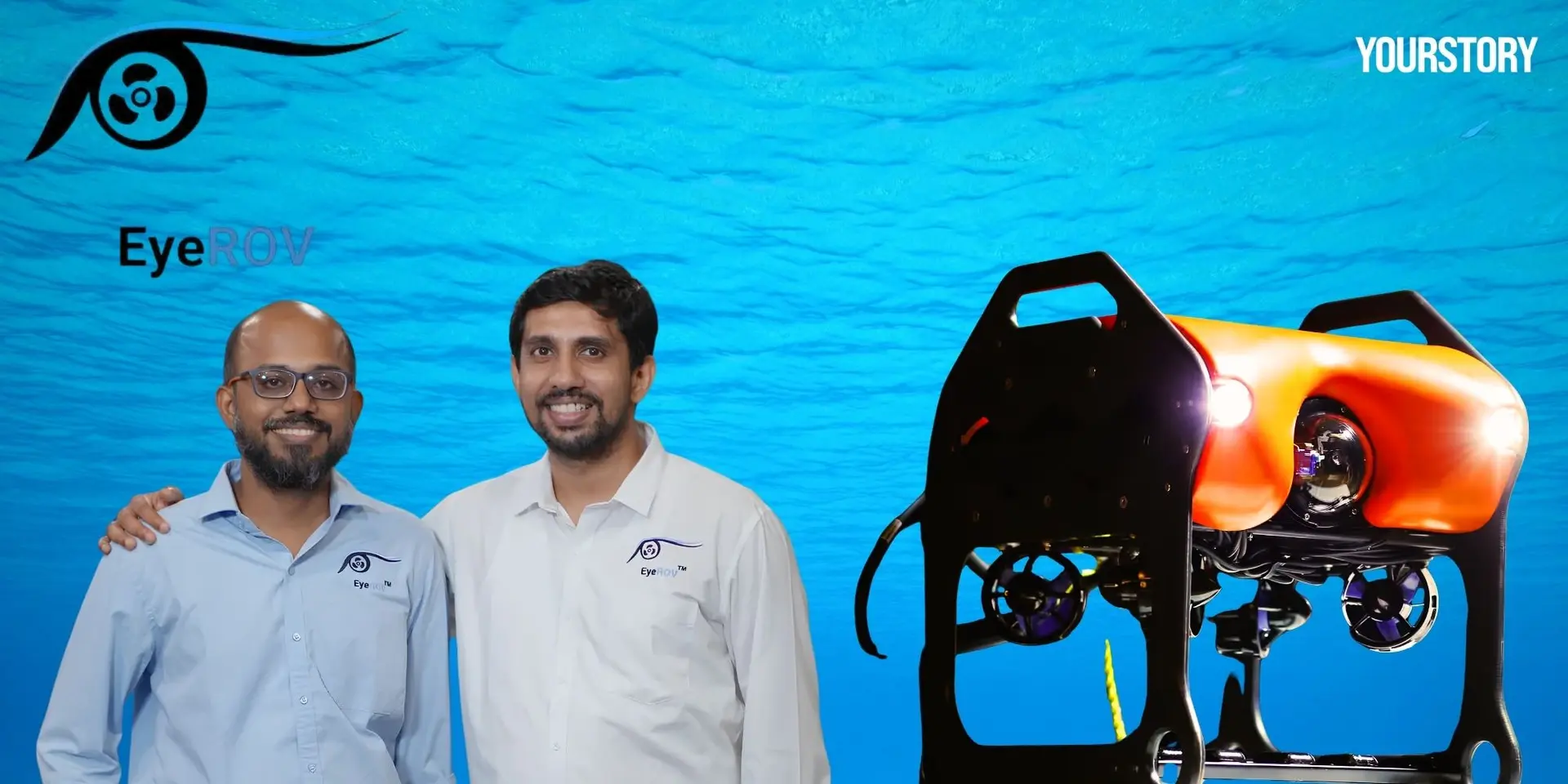
was founded in Kochi by Johns T Mathai and Kannappa Palaniappan P, who studied at IIT Delhi and IIT Madras respectively and were friends before either went to engineering school. Mathai has described the harder problem as trust: persuading industries to replace a diver with a robot from a new Indian company was not an easy sale.
From a fishing aid to the Navy
The technology started somewhere unexpected. Its earliest use was helping fishermen identify fishing zones, before the company turned it towards inspecting infrastructure.
The breakthrough came from a government customer. DRDO became one of the earliest buyers, validating the company's TUNA underwater robotic system for laboratories including NSTL and NPOL. Mathai has said that changed the conversation entirely, which is the usual pattern in Indian deep technology: a state customer buys first, and private industry follows.
The product line now covers remotely operated vehicles, which are tethered and controlled from the surface, and unmanned surface vessels for hydrographic survey. On top of these go non-destructive testing payloads: ultrasonic testing, sonar imaging and AI-based defect detection that identifies corrosion, cracks and structural wear as the robot moves.
The specifications the company gives are about reach. Its robots work to 450 metres, and it says its tunnel inspection capability extends to 10 kilometres, which it describes as putting it among a small group of companies worldwide with comparable range. It has run projects in Antarctica and developed what it calls India's first tunnel leakage monitoring solution.
Rs 47 crore, and a customer list
The commercial record is the strongest part. EyeROV says it has completed more than 150 projects for over 80 clients, a list that includes Tata Power, NHPC, Adani, ONGC, BPCL and Maersk on the industrial side, and the Indian Navy, DRDO and the Indian Coast Guard on the government side.
In September 2025, it secured an order worth Rs 47 crore from the Indian Navy for underwater robotic systems. That is several times the size of any funding round it has raised, which is an unusual position for a company of this age.
It sells in two ways. One is direct product sales, where a customer buys the machine outright. The other is robotics as a service, where the company runs the inspection as a project, which removes the capital cost for buyers who need the work done occasionally.
The second model is what opens the market beyond large buyers. A port authority or a dam operator that inspects twice a year has no reason to own a robot, and every reason to hire one.
In February 2026, it raised Rs 13 crore in a pre-Series A round co-led by AWE Funds and Unicorn India Ventures, taking total funding above $2 million. Earlier backers include GAIL. The money is going into research, new product lines and expansion into international markets, which is where the larger subsea inspection business sits.
(This story has been researched and compiled using publicly available information.)