




Snowflake
View Brand PublisherFrom data to decisions to action: How agentic AI is powering the always-on startup
At the Snowflake Startup Mixer in Hyderabad, founders, operators, and investors explored how AI is moving beyond automation to become an always-on operating layer.

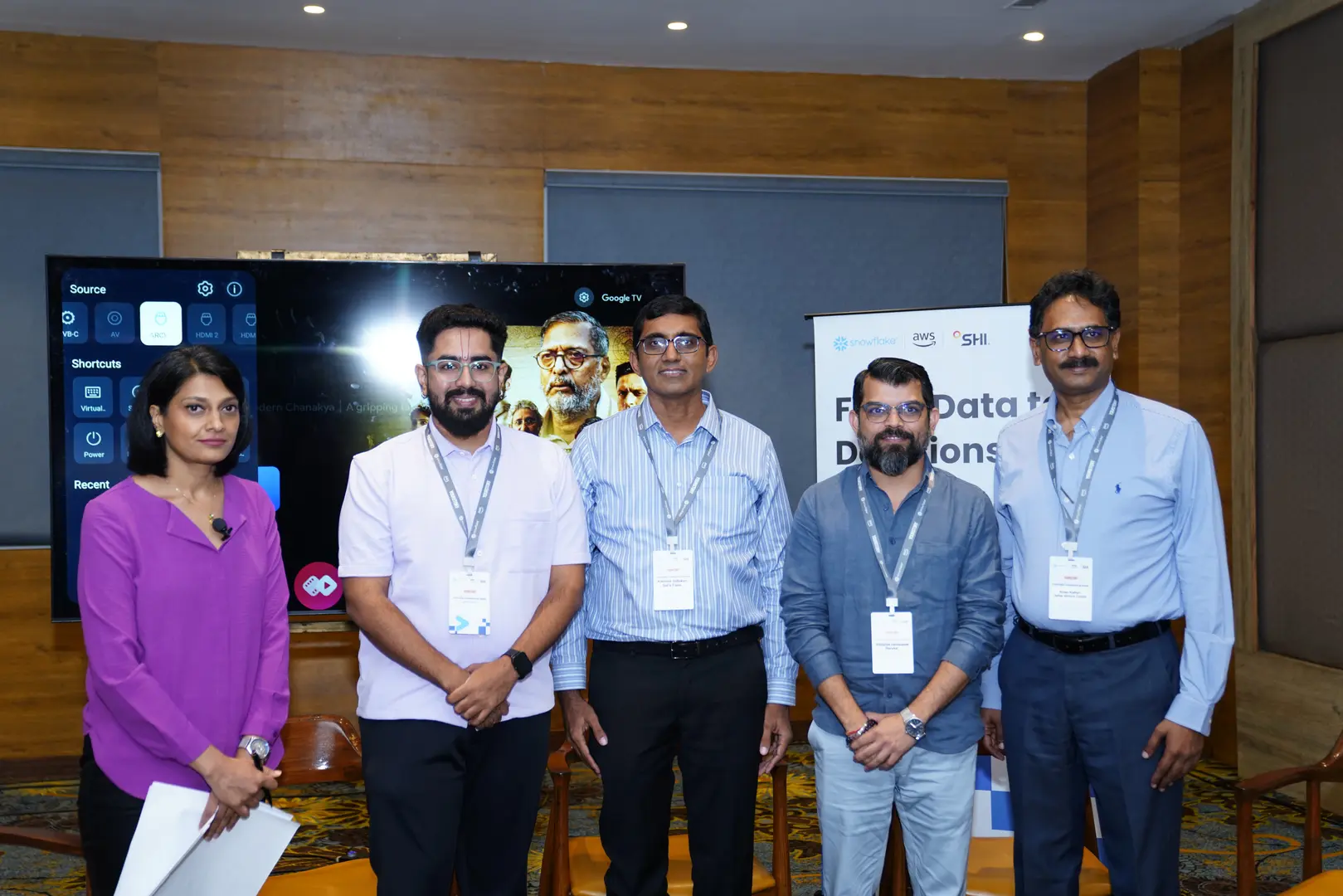

On July 17, startup founders, technology leaders, and investors gathered in Hyderabad for the Snowflake Startup Mixer, centred on the theme 'From Data to Decisions to Action.' Through a panel discussion, live product demonstration, and networking session, the event explored how startups are moving beyond collecting and analyzing data to building intelligent systems capable of taking autonomous action with agentic AI.
The panel discussion, ‘Always-on startups: Building companies that never sleep’, examined what it takes to build organizations where AI keeps critical business functions moving around the clock. Moderated by Shivani Muthanna, Senior Director – Content Partnerships at YourStory, the session featured Uttkarsh Sharma, Associate Creative Director at Pocket FM; Kishore Indukuri, Founder and CEO of Sid’s Farm; Abhishek Deshpande, COO and Co-Founder of Recykal; and Kiran Kalluri, Partner at Dallas Venture Capital.
Building businesses that never switch off
The discussion opened with a simple question: what does “always on” actually mean?
For the panelists, it wasn't about employees working 24x7. It was about building systems that continue executing critical workflows long after teams have logged off.
For Pocket FM, which serves audiences across multiple countries, content production never really stops. AI has become an embedded collaborator throughout the creative process, helping accelerate production while maintaining quality. Rather than replacing creative teams, the company uses AI to generate outputs, process assets, and support production while humans remain responsible for quality and storytelling.
The same idea plays out differently at Sid’s Farm. With thousands of daily deliveries, supply movements, and customer interactions, data flows continuously from farms and manufacturing facilities to logistics networks and customers' homes. Indukuri explained that AI helps the company interpret this data quickly enough to respond before small operational issues become larger ones.
At Recykal, the workday starts before sunrise as waste collectors begin their routes and continues late into the night as shipments move across cities. Every stage generates operational data, creating opportunities for AI to optimize decisions across a supply chain that rarely pauses.
From an investor's perspective, Kalluri said the real distinction lies between companies that simply use AI tools and those fundamentally built around AI-enabled operations.
If removing AI leaves workflows largely unchanged, the company is using AI primarily for efficiency. But if removing AI means redesigning the business itself, that’s when an organization can truly be considered AI-native.
Scaling faster without scaling teams
As AI becomes more deeply embedded in business operations, startups are also rethinking how they scale.
For Recykal, AI is no longer viewed as a standalone technology initiative but as an organization-wide mandate.
“We have an internal mandate. Every Monday there has to be a new AI initiative. We have to talk, and anyone can come up with it, from an intern to a CXO,” Deshpande said.
He explained that the company mapped every business function, identified repetitive processes suitable for AI, and used years of operational data to redesign workflows. The results have been significant. Recykal grew from annual revenue of Rs 400-500 crore with around 80 employees to Rs 1,400 crore with just 128 employees.
At Pocket FM, Sharma said leadership positioned AI as an enabler rather than a replacement for creative professionals. The company invested early in AI-generated audio, video, image generation, and editing tools while ensuring people continue performing quality checks and preserving the emotional experience audiences expect. Producing stories that run into hundreds, or even thousands, of episodes still requires human judgement, with AI accelerating production rather than replacing creativity.
At Sid’s Farm, AI efforts are concentrated on customer-facing operations. “Where we use AI actively, or the area we are constantly looking at is the consumer side,” Indukuri said.
The dairy business generates enormous amounts of operational data every day. AI is increasingly helping forecast demand, reduce wastage, optimize production planning, and dynamically adjust inventory across delivery channels.
Kalluri said these examples also illustrate what separates durable AI companies from businesses merely wrapping existing language models.
“If that ability to capture those processes is not there, then those are the red flags that we see. And these are not companies which will scale and build. They might succeed with one particular customer, and in a very, very specific case, but if they have to expand their business and attack the entire TAM, then that becomes very difficult if they do not have these basics right.”
For investors, owning differentiated data, building robust workflows, and embedding AI across products, go-to-market functions, and internal operations are stronger indicators of long-term scalability than simply branding a company as AI-first.
Human judgement remains essential
As startups automate more workflows, another question becomes increasingly important: where should AI stop and humans remain in control?
Across industries, the panellists agreed that while AI can dramatically accelerate execution, critical business decisions still require human oversight.
Deshpande cautioned against treating AI outputs as unquestionable.
“I feel like AI is a ‘yes man’, so we have to be very smart. Human intervention is needed. You cannot replace humans. Fundamentally, you need to be clear on what you want.”
Indukuri said Sid’s Farm is integrating AI across hiring, customer support, and operational planning, but believes AI should first handle routine queries before escalating more complex situations to people.
Customer support, for example, can automatically answer delivery or order-status queries, while dissatisfied customers or quality-related issues should be routed to human teams. Rather than replacing employees, AI allows them to focus on problems that require judgement, empathy, and context.
Strong fundamentals still matter
The discussion also highlighted that technology alone will not determine which startups succeed.
Founders first need disciplined organizations, reliable processes, high-quality data, and a clear understanding of where AI creates genuine business value.
Deshpande observed that AI is already reshaping how startups think about talent. “I have witnessed it—an intern sharing a better output than someone with 10 years of experience. The young generation is adapting faster,” he said.
He added that founders themselves need to become active AI users before expecting their teams to adopt new tools. Success depends on identifying the right business problems first; only then can AI deliver meaningful outcomes instead of adding unnecessary complexity.
Live demo: Turning ideas into production-ready workflows
The evening concluded with a live demonstration titled ‘The Blueprint: From Data to Action with Agentic Workflows’, presented by Akshat Parik, Senior Solution Engineer; Harish Chintakunta, Senior Partner Solution Engineer; and Navedya Ojha, Solution Engineer at Snowflake.
The session demonstrated how startups can significantly reduce the time needed to build AI-powered applications by combining enterprise data with agentic AI capabilities.
Using Snowflake Cortex Code, a purpose-built AI coding agent for data and AI workloads, the presenters showed how developers could move from a natural-language prompt to a production-ready application within minutes.
A fictional fintech fraud detection use case illustrated the process. A single prompt generated an application that ingested customer and transaction data, calculated fraud-risk scores, created dashboards, and built an AI-powered investigation workspace.
Beyond dashboards, business users could ask natural-language questions about fraud trends, customer behavior, and transaction patterns. AI broke those requests into multiple reasoning steps before generating actionable insights.
The team also highlighted Snowflake's model flexibility. Rather than locking organisations into a single foundation model, the platform supports multiple leading models, including Claude, Llama, DeepSeek, Mistral, and OpenAI, allowing businesses to choose the right model for each workload while keeping data within a secure governance framework.
Throughout the evening, one message was clear: AI is no longer simply helping startups work faster. Increasingly, it is becoming part of how businesses are designed and operated. Rather than treating AI as a standalone tool, startups are beginning to build it into the core of their products, workflows, and day-to-day decision-making.