



The billion-dollar business hidden behind Google Maps’ free service
Google Maps costs consumers nothing, but businesses pay for every map load, route and location search. Here is how Google’s powerful API business works behind the scenes.

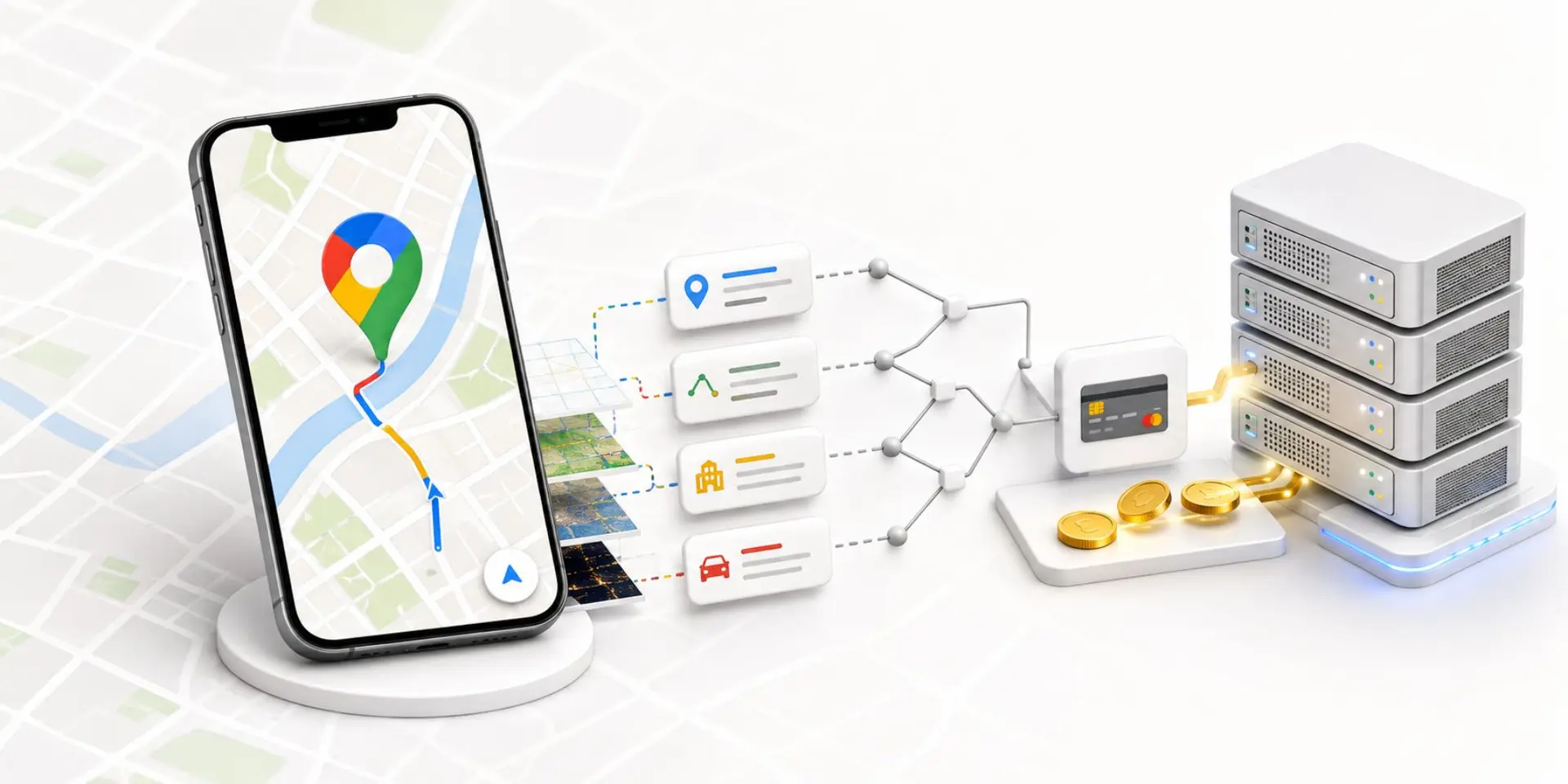

pen Google Maps to check traffic on your commute and it costs you nothing. No subscription, no paywall, not even a login. Open a food delivery app, a real estate listing site, or a logistics dashboard built on Google Maps, and somewhere behind that clean consumer experience, a business is paying Google for every map load, every place search, every route calculated.
A free product with a very unfree backend
Google Maps Platform bills developers on a pay-as-you-go basis, priced per SKU rather than per product. Published rates for the core mapping services run from $2 per 1,000 calls for Static Maps up to $40 per 1,000 for the most feature-rich Places lookups, with outliers on both ends: 2D map tiles at $0.60, Solar API data layers at $75. Maps, Places, Routes, Geocoding and Street View are each billed separately, and their free allowances do not pool. Every SKU carries its own monthly free cap, 10,000 calls for Essentials-tier services, 5,000 for Pro, 1,000 for Enterprise.
Those caps disappear fast once an app has real users. Run the arithmetic against Google's own price list and the volume tiers it applies:
A property platform serving 100,000 listing views a month, where each view loads a map, a Street View panel, a place detail lookup and a geocode, pays roughly $3,300 a month. A logistics operation running 500 drivers, generating around 300,000 monthly calls each across maps, routing, geocoding and route optimisation, lands near $6,000 a month.
Both numbers apply Google's free caps and automatic volume discounts. Cost estimates circulating online frequently run 30 to 40 percent higher because they multiply headline rates by total volume and skip the tiering, and many of them are published by companies selling alternatives to Google Maps.
Where this quietly gets expensive
The sharpest edge in the pricing model is not the rate card. It is Places Autocomplete, which has two billing modes that differ by a factor of thousands.
Used correctly, autocomplete is nearly free. A session token groups every keystroke a user types into a single session, all of those requests bill at zero, and only the terminating place lookup is charged. Used without a session token, or with one that has expired or been reused, each keystroke becomes its own billable request at $2.83 per 1,000. Typing "pizza" costs five calls instead of one free session.
The failure is silent, and it compounds. Reaching $2,000 a month on autocomplete alone requires roughly 870,000 billable requests, which is about 174,000 address searches at five characters each. That is an unremarkable month for a mid-sized delivery app. Nothing in the invoice indicates that a single missing parameter caused it.
Google has also restructured pricing twice in under a year. On March 1, 2025 it retired the flat $200 monthly credit every account received, replaced it with per-SKU free caps, reorganised services into Essentials, Pro and Enterprise categories, and moved Places API, Directions API and Distance Matrix API to Legacy status.
Later in the year it layered optional fixed-price subscription plans on top: Starter at $100 a month, Essentials at $275, Pro at $1,200. Vendors selling competing mapping APIs have been loud about the resulting unpredictability, a critique worth weighing alongside their commercial interest in making it.
Why almost nobody notices this business exists
None of this billing touches the consumer experience. When you check directions in the Google Maps app, you are using the free consumer product. When a ride-sharing app, a real estate marketplace, or a restaurant locator shows you a map inside their own app, you are looking at output from an entirely different, metered product that their business is paying for behind the scenes, per request, in real time, as you scroll.
The map feels like a shared public utility. It is actually thousands of individual billable transactions firing every time you open an app that uses it.
A business Google does not disclose
Google does not report Maps revenue as its own line item. Alphabet's FY2024 10-K splits Google Services into Search & other, YouTube ads, Google Network, and Google subscriptions, platforms and devices, the last of which brought in $40.34 billion. That segment is defined in the filing as consumer subscriptions, Google Play, Pixel devices, and "other products and services."
Maps Platform fees are never named. The most reasonable reading is that they sit inside that final catch-all, but Alphabet has never confirmed it and has never indicated the size of the business. Every figure you see quoted for Google Maps Platform revenue is an outside estimate, not a disclosure.
The consumer app is not outside the money either. Alphabet's filings list Google Maps among the owned and operated properties that generate advertising revenue, alongside Gmail and Google Play. Promoted pins and sponsored local results are real products. The map is free to you. It is not free of commerce.
Why this matters beyond mapping
Google Maps is a clean example of a pattern that now runs through most of consumer tech: a free consumer product functions as the on-ramp, building trust, habit and ubiquity, while a separate metered B2B product monetises every company that wants to build on top of that trust.
You will never see an invoice from Google Maps. Thousands of businesses whose apps you use every day already have.