



HoverIt builds loitering munitions and surveillance drones in Lucknow
The company designs and manufactures unmanned systems ranging from compact surveillance drones to strike platforms and flew India's first jet-powered loitering munition this month.

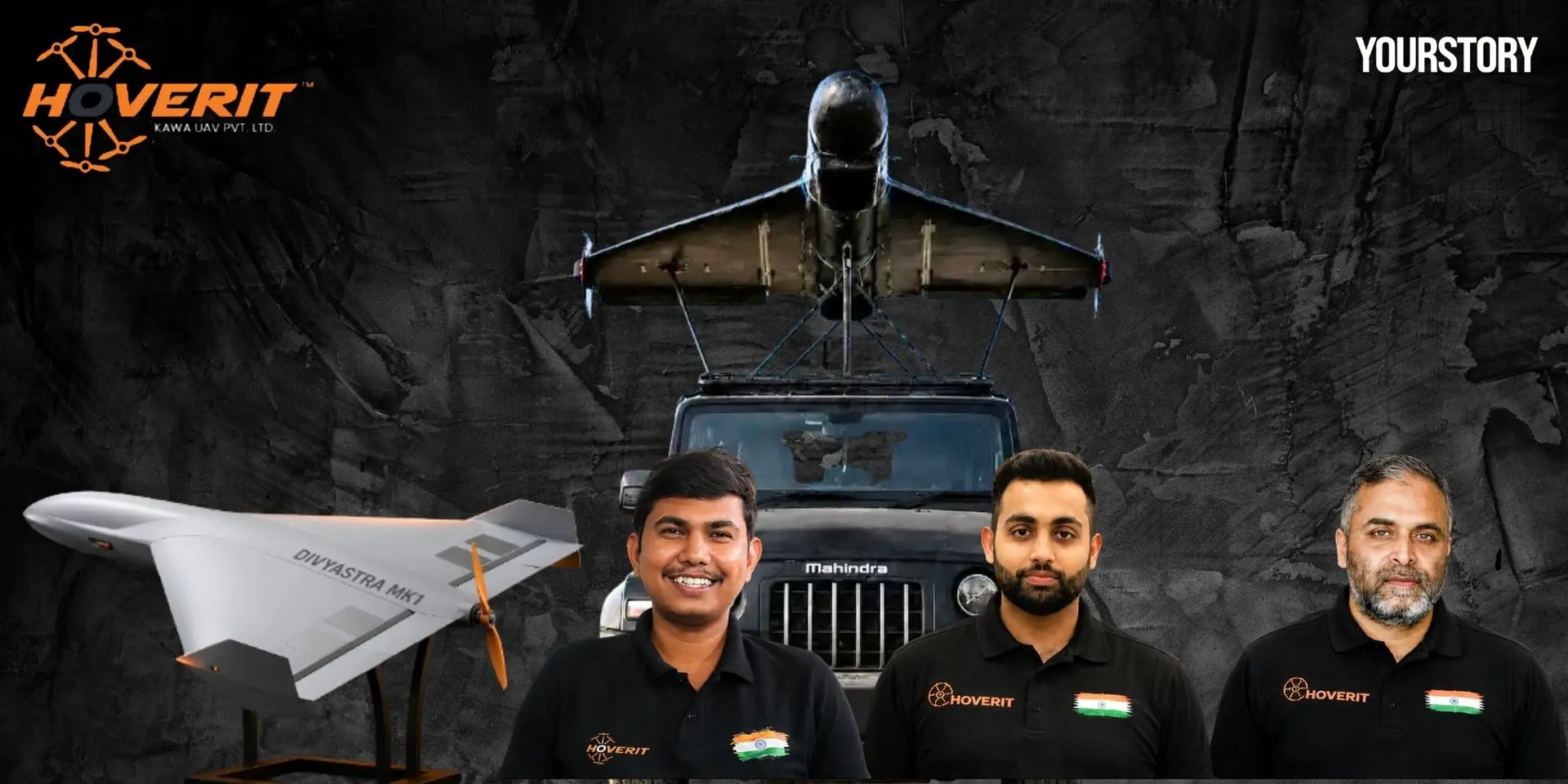

A loitering munition sits between a drone and a missile. It flies to an area, circles while an operator or its own sensors look for a target, and then flies into it. It's cheap compared to a guided missile, and a small unit can launch one without needing an aircraft, which is why it's caught on. It costs a fraction of a guided missile and can be launched by a small unit rather than an aircraft.
Most of the ones in Indian service have been bought abroad or built around imported components, and the engine has been the hardest part to replace. Propeller-driven designs can use electric motors made anywhere; a jet-powered one needs a turbojet, and those come from a short list of foreign suppliers.
, which trades under Kawa UAV Private Limited, was established in Lucknow in August 2022 and works from the Uttar Pradesh Defence Industrial Corridor. It designs and manufactures unmanned aircraft and has moved from surveillance platforms into strike systems.
From surveillance to strike
The product range covers several roles. Aankh is a compact drone for intelligence, surveillance and reconnaissance with thermal imaging. Raftaar is a fixed-wing platform for long-range surveillance with vertical take-off. Baaz carries payloads for precision delivery and high-altitude work.
The Divyastra line is the strike family, and the company numbers its versions Mk1, Mk2 and Mk3 in order of development. The Mk1 is the propeller-driven original, which the company describes as a multi-role loitering munition with swarm capability and for which it has claimed a 500 km range with five hours of endurance. It conducted high-speed taxi trials of the Mk2 on the Ganga Expressway earlier this year.
On 11 August 2026, it flew the Divyastra Mk3, a jet-powered version, powered by a turbojet from the Delhi company DG Propulsion. Both companies describe it as the first Indian jet-powered loitering munition to fly, and say the programme ran from inception to maiden flight inside a single year. The company says its platforms have been tested in operational environments, including high-altitude deployments in Ladakh, riverbed reconnaissance and payload-delivery exercises with defence forces, and that its drones have been used by Indian Army units. The same airframe takes different payloads, so a buyer gets one platform that can do several jobs instead of building a separate aircraft for each.

Half a million dollars, and a factory to open
HoverIt announced $500,000 in seed funding in January 2026, describing itself as the first drone company to establish itself in the Uttar Pradesh Defence Industrial Corridor. It said at the time that its valuation had passed $5 million and that it was preparing a second round.
Production is the next step. Invest UP said in March 2026 that the company was set to begin manufacturing operations from the Lucknow node of the corridor by the end of the year, and the company demonstrated its systems to state industrial development officials in Lucknow.Its stated ambition runs beyond India. The company has said it intends to market its platforms to international buyers on the argument that a system proven in Indian terrain and Indian testing standards will hold up elsewhere.
What has not been disclosed is an order value, a delivery volume or a named customer. The company's account of Army use is its own, and no contract, tender or induction has been announced publicly. For a company whose strongest asset is a flight that happened a week ago, the commercial record is the part still to be written.
(This story has been researched and compiled using publicly available information.)