



Why India pays highway builders even when roads stay empty
India’s Hybrid Annuity Model protects highway developers from traffic risk by guaranteeing scheduled payments. But growing land acquisition and financing delays are exposing new weaknesses.

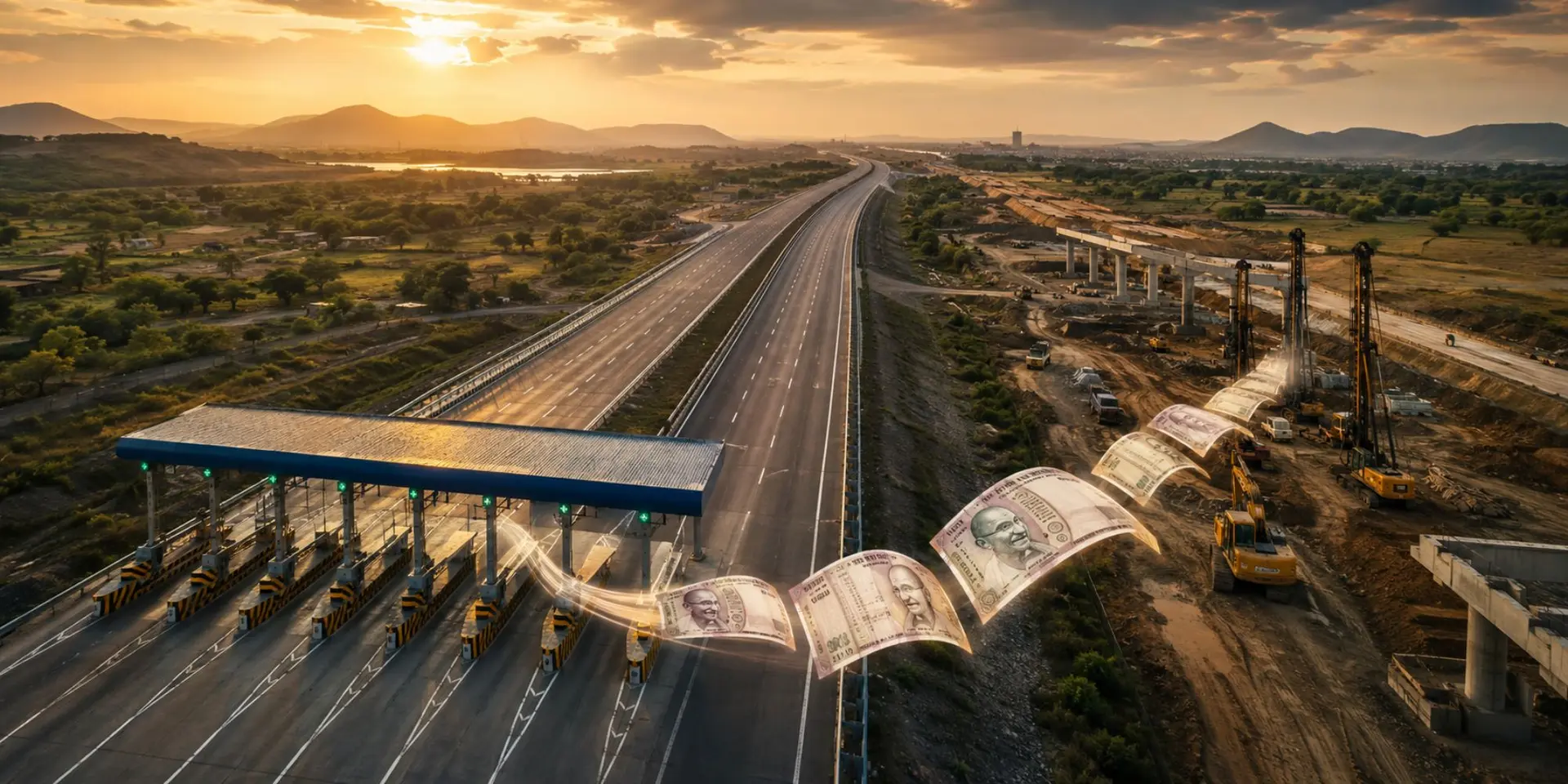

Intuitively, a toll road company should want traffic. More cars, more tolls, more revenue, it seems like the whole point of building the road. But a large share of India's national highways today are built under a model where the private company that constructs the road gets paid on a schedule that has nothing to do with how many vehicles ever use it, and the government, not the developer, absorbs the risk of an empty highway.
What the government actually built to fix a broken system
This is the Hybrid Annuity Model (HAM), approved by the Cabinet Committee on Economic Affairs in January 2016 and issued as a circular by the Ministry of Road Transport and Highways the following month. It was a direct response to a wave of failed projects under the earlier Build-Operate-Transfer (BOT) toll model. CRISIL Ratings estimated in 2015 that roughly 7,500 km of highway projects, 5,100 km under construction and 2,400 km already operational, awarded mostly between fiscals 2010 and 2012 on a BOT basis, were at high risk, with about half the under-construction stretch unlikely to be completed because of cost overruns and weak sponsors. Private developers had taken on toll revenue risk they could not reliably manage.
HAM restructured that risk entirely. Under the model, as confirmed in an official Press Information Bureau release dated 21 November 2019, the government funds 40% of the project cost directly during construction, paid out in milestone-linked installments tied to physical progress. The remaining 60% is raised by the private developer through debt and equity, and recovered afterward through semi-annual annuity payments from the National Highways Authority of India (NHAI), spread across the operations period, along with separately calculated interest and maintenance payments. Critically, per the same PIB release: "Toll fee collection from the highways projects developed under the hybrid annuity model is the responsibility of the Government/Authority," not the developer.
Those annuities are not fixed in nominal terms. They are indexed to inflation, and the interest component floats with the average one-year marginal cost of lending rate of the top five scheduled commercial banks plus 125 basis points. What is fixed is the developer's exposure to traffic, which is zero.
Why this actually works, structurally
The Asian Development Bank's working paper on HAM is explicit about what this changes. In its analysis, the authority assumes the full risks associated with traffic forecast and revenue leakage, and its risk matrix classifies both revenue forecast and revenue collection under HAM as government-borne. The developer's annuity payments arrive on schedule whether the highway carries heavy daily traffic or sits comparatively empty. The developer's job is to build the road well and maintain it, full stop. Whether commuters actually choose to drive on it, and how much toll revenue that generates, becomes the government's problem to manage, not a variable that threatens the company's return on investment.
This isn't a small, experimental corner of India's highway programme either. According to CareEdge Ratings' analysis of HAM projects awarded between fiscal years 2016 and 2023, 306 HAM projects were awarded to 62 different sponsors, spanning a combined 12,700 km of highway, with a total bid project cost of Rs 3.35 lakh crore. Of the projects awarded before 2020, representing over Rs 1 lakh crore in project cost, CareEdge found in September 2023 that 88% had reached operational status, with only 12% delayed.
Where the model shows real strain
That 88% figure covers the oldest and simplest cohort, and the picture for everything awarded since has deteriorated sharply. In a February 2025 update covering 374 HAM projects awarded between 2015 and 2024, spanning roughly 16,000 km and over Rs 4.03 lakh crore in bid project cost, CareEdge found that only 42% of the sample cost had been commissioned as of September 2024, with 45% still under construction and 13% yet to receive an appointed date. Among the under-construction projects, 55% with an aggregate bid project cost of Rs 1 lakh crore were running more than six months late, up from roughly 33% in June 2023.
The causes are split. India Ratings and Research (part of Fitch Group) flagged in May 2024 that newer sponsors, many of whom had moved from EPC contracting to HAM for the first time after technical and financial qualification norms were relaxed, were struggling to secure funding as banks tightened capital requirements. Small and medium developers, the agency noted, had largely managed to execute their projects. For financially strong and medium sponsors, the binding constraint was different: land acquisition. More than 110 projects worth over Rs 1 trillion were awaiting an appointed date, mostly on right-of-way issues. Ind-Ra nonetheless held its FY25 outlook for both annuity projects and toll-collecting assets at stable.
Why this matters beyond highways
HAM is a clean illustration of how infrastructure financing can be deliberately restructured to make projects investable again once a previous risk-allocation model has failed. The BOT-toll model asked private companies to bet on traffic forecasts, a bet that had already stranded thousands of kilometres of road. HAM keeps developers focused on what they can actually control, building and maintaining quality infrastructure, while shifting the genuinely unpredictable variable, how many people choose to drive on a given stretch of road, back to the government, whose job it arguably always was to manage.
What the model could not fix is everything upstream of the contract. Land that has not been acquired and lenders who will not lend are not risks the annuity structure was designed to absorb, and they are where the delays now sit. Sometimes the smartest fix for a broken system isn't a completely new idea. It's simply moving the risk to whoever is actually positioned to carry it, and then discovering which risks nobody had allocated at all.