



India saved handloom. Now it must save weaving as a livelihood
India makes 95% of the world’s handloom, yet its weavers work barely 200 days a year and exports are just ₹1,359 crore. Making weaving a viable livelihood means filling the order gap and measuring how much value actually reaches the loom.
Prem Manukonda
Friday August 07, 2026 , 11 min Read

India has achieved something almost no other industrialising nation managed. More than 120 years after the Swadeshi Movement placed the loom at the centre of economic self-reliance, millions of Indian families still practise weaving techniques that have declined or disappeared across other textile economies. The Union Textiles Minister Giriraj Singh told the Rajya Sabha in March 2026 that nearly 95% of the world's handloom products are made in India, with around 35.22 lakh weavers and allied workers and over 28 lakh looms.
That is worth celebrating on National Handloom Day. But survival is not prosperity, and the workforce has been shrinking: the Third Handloom Census counted 43.32 lakh workers in 2010-11, the Fourth 35.2 lakh in 2019-20. India kept the skill. It has not yet built the economics that would keep the people.
The number that frames the day
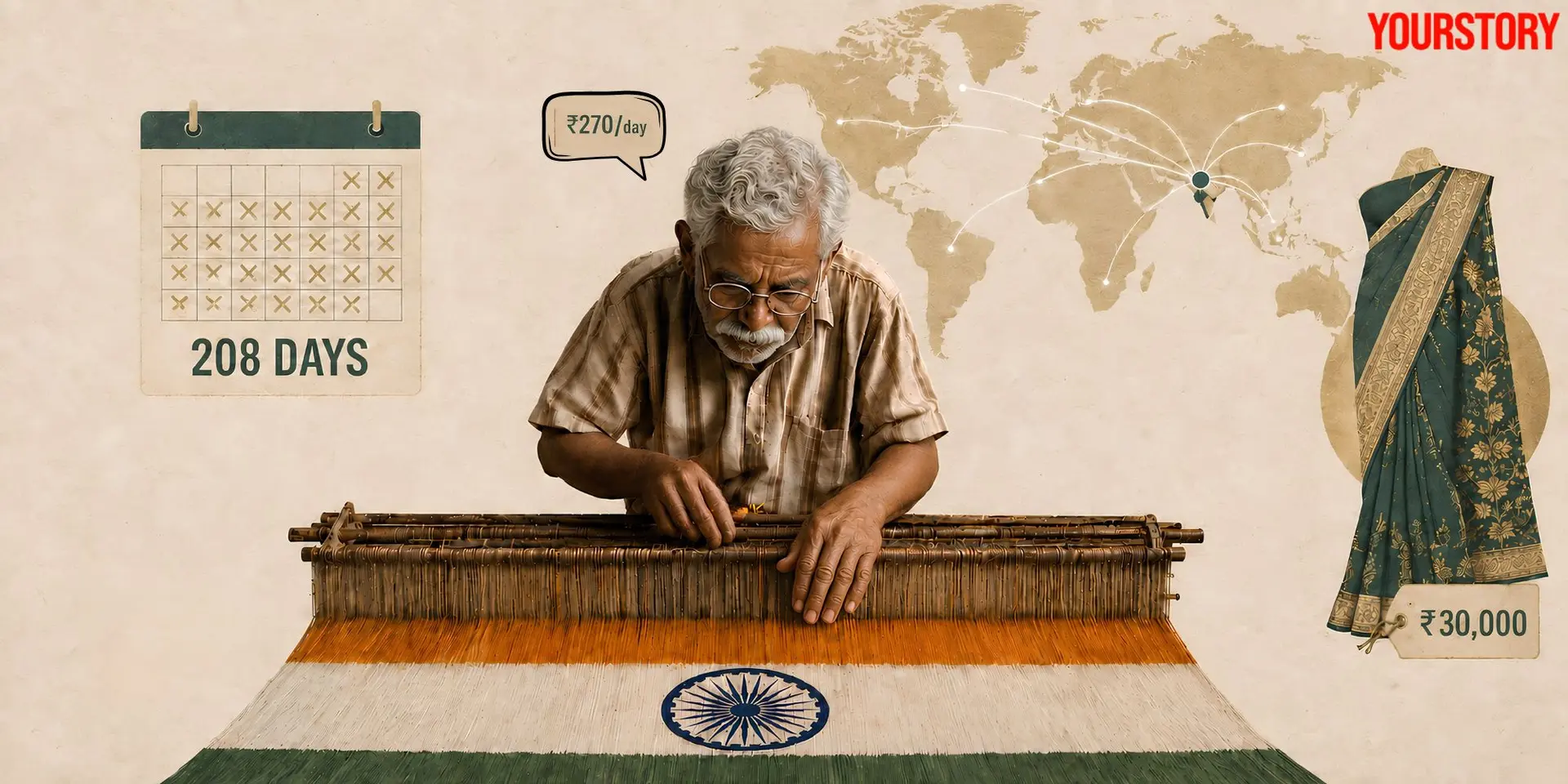
A handcrafted Kanjeevaram sari can retail for ₹30,000 or more. A study of handloom and handicraft enterprises across five states, released in May 2026 by the Institute for Human Development and the Crafts Council of India, put average value added at roughly ₹7,000 per worker per month, or about ₹270 a day.
The two numbers are not directly comparable, and it is worth saying so plainly. A sari's retail price carries silk, zari, dyeing, pre-loom setup, design, working capital, inventory holding and retail overheads, usually spread across several contributors. The ₹7,000 figure is a per-worker average across two sectors and five states, not take-home pay for a specific garment.
Yet the contrast points at something real. Value accumulates as fabric moves toward the showroom. The economic position of the person at the loom does not move with it.
The macro picture mirrors the micro one. India exported ₹1,359 crore worth of handloom products in FY2025-26, from a textile, apparel and handicraft basket worth ₹3.25 lakh crore: about 0.42%. For a country that makes most of the world's handwoven cloth, that is a remarkably small share of its own textile earnings.
Source: Ministry of Textiles, FY 2025-26 export data.
The missing days
There is a number inside the Handloom Census that explains more about weaver earnings than any argument about wage rates, and it is almost never cited. The Fourth Census records average weaving activity of 208 days per person per year: 262 in urban areas, 201 in rural.
This is an improvement; the Third Census recorded 183 person-days. But at 201 days in the villages where 88.7% of weaver households live, a rural weaver is still idle roughly two days in five. That reframes the problem: a weaver working 201 days is not simply underpaid per piece; there is not enough work to fill the year. Low income is substantially an order-flow problem, and order flow is what design institutions, export channels and market linkage exist to generate. That gives handloom policy a simple test.
Does an intervention increase paid days at the loom? Does it increase the share of value reaching the artisan? And does it make that income more predictable? Every intervention below should be judged on whether it puts more days of paid work on the loom.
Seven in ten handloom workers are women
Women make up 72.29% of India’s handloom workforce, or more than 25 lakh workers. Yet in July 2025, the Ministry of Textiles said it had not conducted a specific study of women weavers’ incomes and working conditions.
That is a serious blind spot. If women dominate the workforce, handloom policy should track what they earn, how many paid days they get and whether finance, technology and market access actually improve their incomes.
Women’s income cannot remain an inferred outcome. It has to become a headline metric.
The problem is not simply the middleman
It is easy to blame intermediaries for the gap between retail price and weaver earnings. The reality is more nuanced. Master weavers, contractors and traders finance yarn procurement, distribute designs, manage quality and absorb market risk. Removing them without replacing those functions leaves weaving households worse off, not better.
The real issue is the imbalance in information and bargaining power. The artisan holds production knowledge and technical skill; the intermediary holds customer relationships, order flows, wholesale prices and design trends. Confined to production alone, weavers are cut off from pricing power and from everything the fabric earns downstream.
The financial exclusion behind this is stark. Fewer than a quarter of the 26.73 lakh weavers enumerated in the census had bank accounts, and only about 4% were insured. A household without a bank account cannot easily be paid by a distant buyer, cannot build a credit record, and has little alternative to whoever pays cash at the door. The answer is not to eliminate intermediaries but to build institutions that give weavers visibility, bargaining power and a share of the final margin.
Authenticity has to command an economic premium
Powerlooms will always produce fabric faster and cheaper. The economic question for handloom is therefore whether customers can reliably distinguish authentic handwoven products from cheaper substitutes. And whether the premium they pay for authenticity ultimately reaches the loom.
India has tried to solve this with certification, twice. The Handloom Mark, introduced in 2006, certified authenticity. The India Handloom Brand, launched on the first National Handloom Day in 2015 for zero-defect, environmentally sound products, added quality assurance. As of August 2024, it had issued 1,998 registrations across 184 product categories: a real achievement in standard-setting, and also roughly 220 registrations a year in a sector of 35 lakh workers.
The lesson is not that branding was the wrong instrument, but that a mark does not generate orders. Certification tells a buyer the cloth is real; it does not bring the buyer to the cloth. Certification therefore has to be judged not only by the number of registrations issued, but by whether it creates buyer confidence, higher realised prices and repeat orders for certified producers.
Digital reach is not the same as artisan income
Marketplace programmes have significantly expanded geographic reach, and the state has built its own channel too: the Office of the Development Commissioner (Handlooms) runs the India Handmade Portal, intended to let weavers sell without third-party intermediaries, alongside weaver listings on the Government e-Marketplace.
Reach should not be confused with income. On any platform, the seller of record is generally not the individual weaver; it is a cooperative, brand, master weaver or aggregator. Growth in an account's sales demonstrates channel efficiency, not that piece rates at the loom went up, and platform metrics rarely disclose net payouts after commissions, logistics, returns and aggregator margins. The fix applies equally to private platforms and government ones: publish an annual artisan-economy scorecard showing how many weavers were paid, how much reached them, how quickly, and what happened to per-piece rates.
The government has started measuring outcomes. Now it has to scale them
India does not lack handloom schemes, and it is no longer true that public reporting counts only inputs. In its National Handloom Day material this year, the Ministry of Textiles published something more useful than a tally of distributed looms: what those interventions did to earnings.
Source: Ministry of Textiles.
A household moving from ₹9,600 to ₹15,000 a month clears the band that traps most of the sector; at the last census, 66.3% of weaver households earned under ₹5,000. The interventions work, and the government can now show it.
The gap is reach. Between 2021-22 and June 2026, more than 40,000 Weaver MUDRA loans worth over ₹280 crore were sanctioned, averaging about ₹70,000 and reaching roughly 1.1% of the census workforce. In 2025-26, ₹94 crore was released for worksheds, looms, accessories and electronic jacquards combined. Over the same period, 357 small clusters were sanctioned and ₹370.72 crore reached 1,62,682 weavers through mega clusters. For 2026-27, the National Handloom Development Programme has ₹205 crore and the Raw Material Supply Scheme ₹200 crore.
The picture is of a proven intervention that has reached a small minority of those who could use it. That is a different problem from the one usually described, and a more tractable one. The question for the next cycle is not what works, but what it would take to put an electronic jacquard or a proper workshed in front of the other 99%. The timing helps: the current scheme cycle runs to 2025-26, so whatever follows can be benchmarked against the metrics the Ministry has now shown it can produce.
Turn Weaver Service Centres into commercialisation centres
India has 29 Weaver Service Centres, confirmed by the Textiles Minister in June 2026, alongside a network of Indian Institutes of Handloom Technology. They hold deep capability in CAD design, dyeing and loom improvement, and cluster guidelines already provide up to ₹15 lakh for a designer-cum-marketing executive within a ₹2 crore per-cluster ceiling. The infrastructure and the budget line exist; what is not visible is any published measure of what they produce commercially.
Each centre could adopt specific cluster hubs and stay engaged from product development through to repeat orders, judged on products brought to market, export orders converted and documented change in artisan take-home pay. That would turn an existing technical institution into an accountable commercial bridge between public investment and actual order flow. The metric that matters is whether more paid days appear on the loom.
The newest institution is built for this. The Centre of Excellence for Handloom Technology was inaugurated at IIT Delhi on 3 August 2026 with a Government of India investment of ₹11.99 crore, launching the Handloom 4.0 productivity app, the Handloom e-Vidya learning platform and HandloomX, an accelerator for sector startups. It plans to train at least 1,000 people over five years. The agenda is right; the scale question is worth asking early.
Finance the order, not just the loom
The financing problem begins before a piece of cloth reaches the customer. A confirmed order can still leave a weaving household dependent on whoever is willing to advance money for yarn, dyes and wages while the product moves through production and retail.
The larger startup opportunity sits behind the label, in backend cluster infrastructure: purchase order financing against confirmed brand orders, which loosens the working capital dependence that ties weavers to whoever advances the yarn; standardised quality control to prevent powerloom substitution; shared export documentation; and payment rails that pay weavers within days of delivery rather than after retail settlement. Technology should not try to automate handloom. It should remove the economic uncertainty around it. This is also where formal finance can move beyond loans tied to individual beneficiaries. If confirmed orders can become bankable assets, working capital can follow demand rather than forcing the artisan to carry the risk until the product is sold. There is also a demand-side lever already in law and rarely discussed. Central Government departments must source at least 20% of their textile requirements from handloom origin, including from cooperative societies, self-help group federations, producer companies and weavers holding Pehchan cards. That is the largest guaranteed order book available to the sector, and what compliance against it looks like department by department is a question worth answering.
Judge the next handloom policy by income, not beneficiaries
The infrastructure for a more commercially accountable handloom economy is largely in place: 200+ handloom producer companies formed between 2020-21 and 2026-27, 29 Weaver Service Centres, a new Centre of Excellence, a government e-commerce channel, a procurement mandate, and, for the first time, published evidence of which interventions raise weaver income. The e-Pehchan portal, launched in January 2025, is building the identity layer that would make income measurable at the level of a person rather than a scheme.
The next step is to connect these systems around outcomes rather than beneficiaries. A producer company, training programme, loan or marketplace listing should ultimately be traceable to changes in annual income, paid weaving days, repeat orders and payment timelines. That scorecard should also be gender-disaggregated, given that women make up more than 72% of the workforce.
The Textiles Minister has set a target of raising weavers' annual income to ₹5 lakh through training, raw material, design technology and market access, alongside an ambition of $10 billion in handloom exports by 2031. Against ₹1,359 crore today, that export figure cannot be reached by selling more of the same cloth at the same price. It requires the weaver to capture more of what the cloth is worth. The two goals are the same goal.
National Handloom Day commemorates a movement that tied domestic production to self-reliance and dignity. India has preserved the physical capability to weave, which is the harder half and the part that cannot be rebuilt once lost. The task now is to fill the missing days, measure what reaches the loom, and make weaving a career the next generation chooses to inherit.