



Karnataka explores voice AI pilots with ElevenLabs across skilling, health and citizen services
Karnataka is exploring voice AI pilots with ElevenLabs for skilling, healthcare, investor services, culture and citizen services.

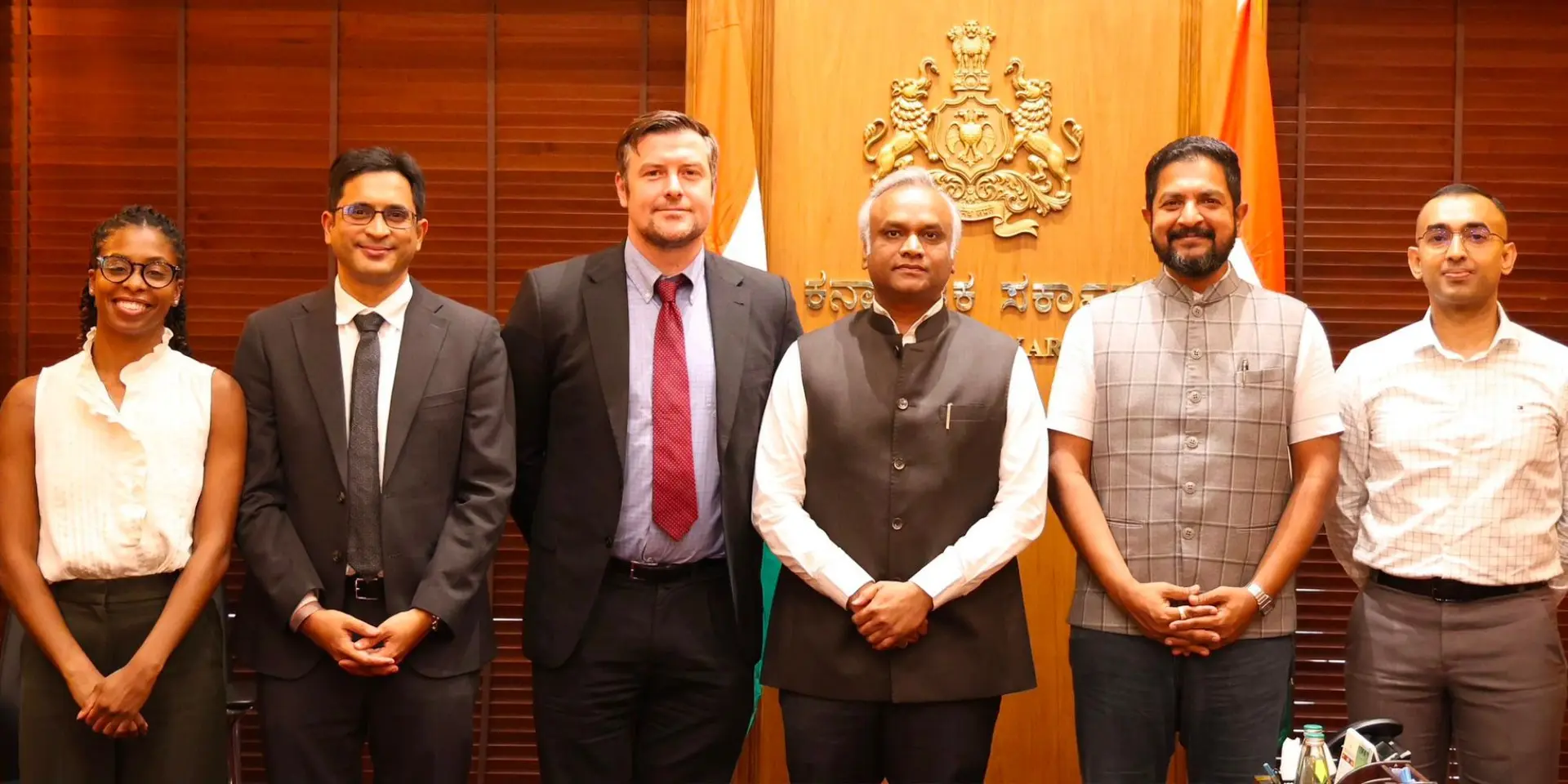

The Government of Karnataka is exploring pilot projects built on voice AI from ElevenLabs across skilling, investment promotion, healthcare, culture and citizen services, following discussions in Bengaluru on 27 August 2026. No agreement has been signed, and the engagement remains exploratory at this stage.
The talks were held between Priyank Kharge, Minister for Home, Information Technology, Biotechnology and E-Governance, and a visiting team from the AI audio company. The state is trying to identify where advances in AI can be converted into working delivery models for citizens rather than remaining at the level of demonstrations.
Karnataka has been courting global AI majors steadily through the year. The state signed a letter of intent with the World Economic Forum for an AI centre, cleared a Centre of Excellence in AI with an outlay of Rs 28 crore, and has been working on a dedicated AI framework, with Kharge declaring the coming ten years the state's "DeepTech Decade" and doubling startup grants to up to Rs 1 crore.
Earlier this month, the state also opened discussions with Anthropic on AI in governance, higher education and research. Bengaluru is home to over 1 lakh AI professionals and a tech workforce that has crossed one million.
Who was in the room
The ElevenLabs delegation included Ben Supple, Global Head of Public Sector Partnerships and Policy; Nihal Chauhan, APAC Head of Public Sector Partnerships and Policy; and Arielle Andrews, Chief of Staff and General Counsel.
From the Karnataka side, Sharath Kumar Bache Gowda, Chairman of KEONICS, and Dr Avinash Menon Rajendran, IAS, Managing Director of the Karnataka Innovation and Technology Society, attended along with senior officials of the department.
Five areas where voice AI could be deployed
The discussions covered five potential applications. These were voice-enabled interview practice and skilling, including in Indian languages; investor assistance services to help prospective investors navigate schemes and opportunities; voice restoration for people who have lost the ability to speak; voice technology for cultural and public-service initiatives; and responsible AI and voice safety, including safeguards against deepfakes and misinformation.
The company demonstrated a voice-enabled interview-practice tool and set out its work on synthetic-audio detection, provenance, traceability and watermarking. A significant part of the conversation turned to the risk of AI-generated voices being used to spread false information about government schemes and announcements.
Kharge asked the teams to draw up a clear roadmap across the identified areas and to work towards an initial pilot with demonstrable public impact.
"Our approach is to engage with companies that are building some of the most capable technologies globally, understand where those technologies can solve real problems, and then move towards pilots that can be scaled across the state," he said.
ElevenLabs, founded in 2022 by Mati Staniszewski and Piotr Dabkowski, raised $500 million in a Series D round led by Sequoia Capital in February 2026 at a valuation of $11 billion. Bengaluru features on the company's list of markets for locally embedded teams. In February 2026, it extended its Impact Programme to India, offering nonprofits free access to its tools for speech restoration, multilingual classroom content and regional language preservation, areas that overlap closely with what was discussed in Bengaluru.
How authenticity is checked in synthetic audio
Voice AI systems can now clone a speaker's voice from a short sample, which makes verifying the origin of an audio clip a governance problem rather than only a technical one.
The common approach combines three methods. Watermarking embeds an inaudible signal into generated audio at the point of creation. Provenance records attach information about how a clip was made and by whom. Detection models are then trained to identify machine-generated speech even when the file has been re-recorded or compressed.
For a government, the practical value lies in being able to establish quickly whether a circulating audio clip carrying an official announcement is authentic.
The company has invited the minister to its India summit in Bengaluru on 6 October, where it is expected to outline its India plans. For Karnataka, the immediate test is narrower: whether the roadmap the minister has asked for produces a pilot that citizens actually use.