



How a Kashmir agri university became J&K's most unlikely startup engine
How SKUAST-Kashmir became J&K’s unlikely startup engine under Vice Chancellor Prof Nazir Ahmad Ganai, turning agricultural research, patents and policy into startups and jobs.

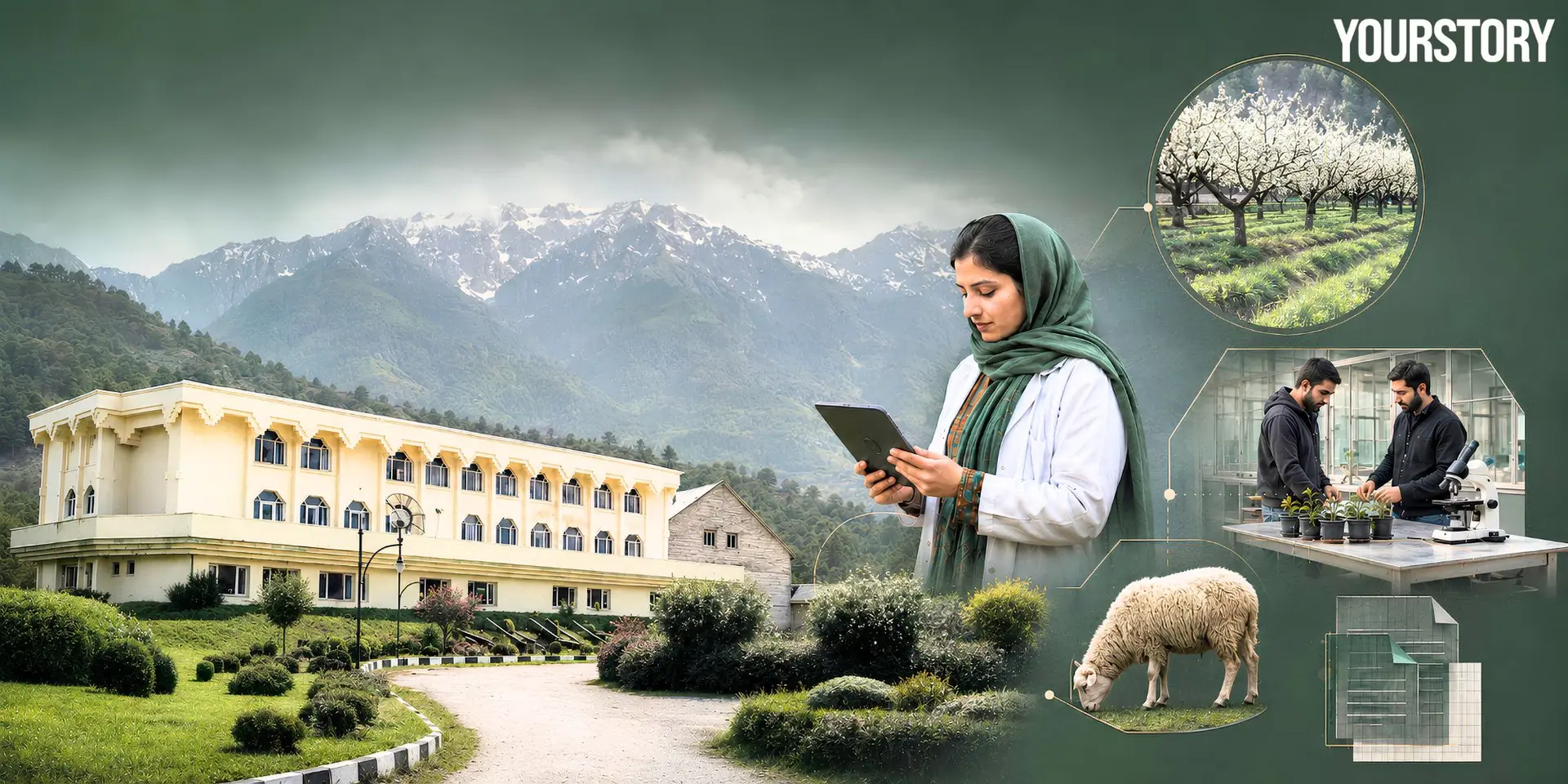

Under Vice Chancellor Prof Nazir Ahmad Ganai, SKUAST-Kashmir has gone from a conventional state agricultural university to the scientific spine of a Rs 5,013 crore farm programme, and the first incubator in Jammu and Kashmir that the state's startup ecosystem now measures itself against.
In January 2026, at the Annual Startup Mela in Jammu, Chief Minister Omar Abdullah handed the Incubator of the Year award to a centre that did not exist five years ago. The SKUAST-K Innovation, Incubation and Entrepreneurship (SKIIE) Centre took home a Certificate of Excellence, Rs 50,000 in prize money and a Rs 50 lakh capital seed fund. Four of its incubated ventures, Cashmircarbozone, Alhamdan Crafts, Safavi Organics and Innxu Innotech, walked away with Rs 20 lakh each in Government of India seed grants.
For an agricultural university in Srinagar, it was an odd sort of trophy. It was also the point.
"The SKIIE Centre is a place of hope for young innovators and startups," Prof Nazir Ahmad Ganai, Vice Chancellor of Sher-e-Kashmir University of Agricultural Sciences and Technology of Kashmir, said at the ceremony. It is a line he has been repeating, in one form or another, since he took charge in December 2021.
From curriculum to commerce
Prof Ganai's thesis is straightforward and, for a state agricultural university, faintly heretical: an agri university's output should not be measured only in papers and passing grades, but in patents that become products and graduates who become employers.
The restructuring started with the classroom. SKUAST-K became the first agricultural university in India to adopt the ICAR Sixth Deans' Committee report, the framework aligning agricultural education with the National Education Policy 2020, at its Academic Council meeting in September 2024. The university had also contributed to drafting that report. It went on to launch India's first BTech in Artificial Intelligence in Agriculture, run with IIT Mandi, alongside a BSc in Economics and Data Science, and it moved the entire examination system to a paperless, computer-based format.
The undergraduate "Degree by Design" model, which lets students assemble specialisations around a career intent rather than a fixed syllabus, is one the university says has since been picked up as a national template across 78 institutions.
Hiring followed curriculum. Prof Ganai has spoken of adding roughly 400 teachers in two years, filling close to 90% of vacant posts, a contrast with the staffing crises that hollow out many peer institutions. Enrolment now stands at 4,333 students, with women outnumbering men, and 85 students clearing the ICAR/CSIR/UGC NET in a single year.
The policy play
The bigger lever was policy. J&K's Holistic Agriculture Development Programme, Rs 5,013 crore across 29 interlinked projects in agriculture, horticulture and livestock, was conceptualised by a UT-level apex committee of national experts chaired by Dr Mangla Rai, the former ICAR Director General, and dedicated by the Prime Minister in 2024.
SKUAST-K is its scientific advisor and directly leads 27 of those projects. When the apex committee sat for HADP's midterm review in September 2025, it sat at SKUAST-K's Shalimar campus, with Prof Ganai presenting the programme overview.
The returns being claimed for HADP are substantial: over 3.7 lakh registered farmers, more than 92,000 productive units, and roughly Rs 2 of revenue and close to Rs 1 of profit for every rupee of subsidy deployed.
Running parallel is the IFAD-funded J&K Competitiveness Improvement Project, under which the university ran 150 rural credit workshops across the Valley in October 2025 alone, connecting 18,714 farmers, FPO members and bankers. Twelve Farmer Producer Organisations have been operationalised, pooling 1,505 smallholders around high-density apple, walnut, honey, trout and dairy.
Patents to products
The lab side has kept pace. Forty-seven patents were granted in 2024-25; the university crossed its hundredth IPR in November 2025. Eighteen new climate-resilient crop varieties were released in a single year, and a Salmonella vaccine was commercially transferred to Ivati Industries.
The headline science, though, is a sheep. In December 2024, a team of eight SKUAST-K researchers led by Dr Suhail Magray under Prof Riaz Shah produced Tarmeem, Arabic for "modification", India's first gene-edited sheep, created by using CRISPR to knock out the myostatin gene. Seven years in the making, Tarmeem carries about 10% more muscle mass than her non-edited twin. In a Valley running an annual mutton deficit of 30,000 tonnes, that arithmetic matters.
SKIIE now lists more than 106 registered startups and a dozen completed technology transfers, funded through DST, BIRAC, MEITY, NABARD and IFAD. The university takes equity through a Section 8 company, an institution learning to earn from its own research.
The next climb
The scoreboard has followed. SKUAST-K ranked 3rd among State Agricultural Universities and 7th in agriculture and allied sectors in NIRF 2025, up from 5th and 10th the year before. In April 2026, Prof Ganai was selected for the Fulbright-Nehru International Education Administrators Award, recognition, he said, of "SKUAST-K's growing global academic presence."
The ambition now is scale: moving a hundred patents from grant certificates to shop shelves, and turning 106 startups into the kind of employers that keep Kashmir's agriculture graduates in Kashmir. It is the harder half of the job, and it is the one the university has openly set for itself under the banner it uses everywhere: Patents to Products.
What Prof Ganai has already done is change the baseline. An agricultural university in Srinagar is now a place where a startup award is not a surprise.