



Kusho AI is building AI agents that test software before it breaks
Founded in 2023, Bengaluru startup Kusho AI is helping engineering teams automate software testing and maintenance. Kusho’s AI agents generate, run, and update tests across APIs, web applications, and mobile apps.


As software becomes increasingly complex, writing code is no longer the biggest challenge. Maintaining it is.
Modern applications rely on APIs, workflows, and third-party integrations that must continue working as new features are released. While AI has made it easier for developers to write code, engineering teams still spend significant time testing releases, identifying bugs, and ensuring updates do not break existing systems.
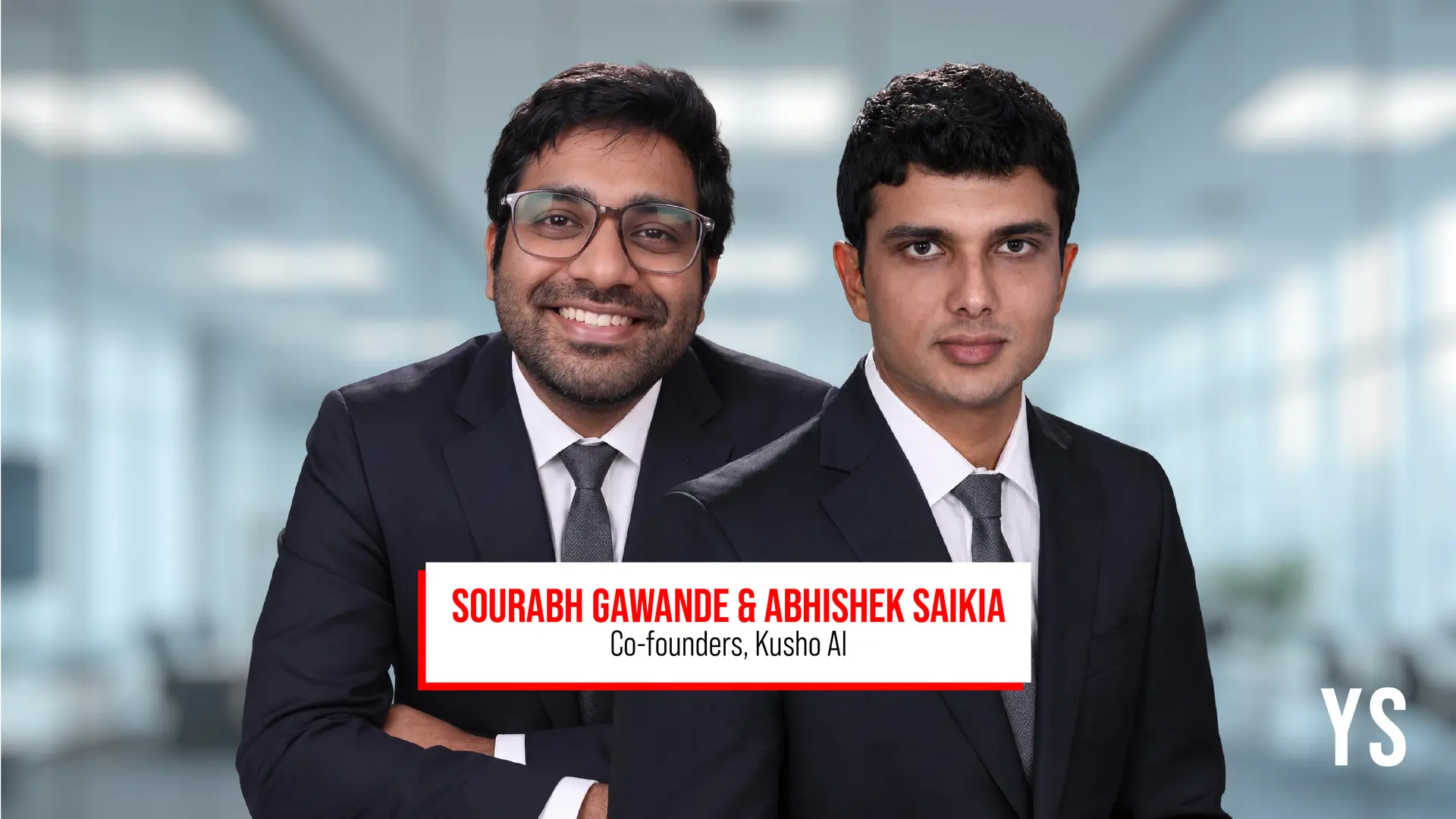
Founded in 2023 by Abhishek Saikia and Sourabh Gawande, Bengaluru-based Kusho AI is building an AI-powered platform that automates much of that work. Its AI agents generate, run, and continuously update tests for APIs, web applications, and mobile apps, helping engineering teams spend less time on software maintenance and more time building new products.
Using proprietary models layered on top of foundational large language models (LLMs), the platform functions like an AI software engineer, testing code during development and after every release to detect issues before they reach production.
The idea grew out of the experience of Abhishek Saikia, Co-founder and CEO, as a product manager at Flipkart. A graduate in economics and chemical engineering from BITS Pilani, he later teamed up with college batchmate Sourabh Gawande, now Co-founder and CTO, who previously worked as a full-stack engineer at FalconX.
How Kusho AI works
Consider a food delivery app launching a new recommendation engine. The feature needs to work for users with five previous orders as well as those with thousands, across multiple cities and usage patterns. Testing every possible scenario manually means designing test cases, writing code, running tests, and reviewing results, a process that can take hours or even days while still missing edge cases.
Kusho AI automates that process.
The platform first builds an understanding of a company's software environment before simulating how a human tester would approach it. It identifies important scenarios, generates the required tests, runs them automatically, and flags issues that need attention.
Saikia says the process runs “almost 100x more efficiently and at a much faster pace” than manual testing.
The platform supports engineering teams throughout the software release cycle.
Before code is merged, Kusho AI automatically generates and runs tests to identify risks early. At release, it acts as an additional checkpoint, verifying whether new code is ready for production.
Saikia describes this as one of the company's biggest advantages for enterprise customers. “Even if your developer is in a hurry and wants to quickly push to production, Kusho AI is standing there almost like a sentry,” he says.
If a release is not ready, the platform sends it back with a report outlining what needs to be fixed.
After deployment, Kusho AI continues monitoring for anomalies and breaking changes. As applications evolve, the platform updates its own tests to reflect those changes, creating what Saikia describes as “self-healing systems that identify changes and make changes accordingly”, reducing the need for repeated manual updates.
Every release also receives a risk score based on the underlying code changes and the tests that were executed.
Beyond automated testing, Kusho AI positions itself as an enterprise testing control panel, offering release gating, audit trails, domain-aware automation, and integration with existing software release workflows. The aim is to give engineering leaders visibility across the entire testing process rather than individual test runs.
Built for high-stakes software
Rather than relying on a single AI model, Kusho AI operates through what Saikia calls an “agentic orchestration layer”.
Different testing requests are routed to specialised models depending on the application. A banking API, for example, is handled differently from an ecommerce platform.
According to Saikia, the company's competitive advantage lies in this orchestration layer and the proprietary data used to fine-tune it. “That's a proprietary learning that you can only have once thousands of people use your product.”
The startup is also selective about the customers it serves.
“Our entire ICP (ideal customer profile) is people who cannot afford even one minute of downtime,” says Saikia, referring to sectors such as banking and ride-hailing, where even brief outages can have immediate business impact.
Kusho AI counts Ultrahuman, Paytm, Ola Electric, HCL, Michelin, HP, Razorpay, Roche, Schneider Electric, and Paymentus among its more than 5,200 clients.
Growing through developers
Kusho AI has largely followed a product-led growth strategy.
The platform is free to use without requiring payment details, allowing it to spread through developer and quality assurance communities via technical content rather than paid marketing. Free users can opt in to let the platform learn from how they use it.
Kusho AI tracks which auto-generated tests users keep or discard, using that anonymised data to improve future recommendations.
As adoption grows within engineering teams, enterprise conversations often follow. To date, the platform has generated and executed nearly 10 million tests and serves around 35,000 developers and QA professionals on its free tier.
According to the company, one Indian payments platform reduced API testing time by 95%, while a private bank lowered annual QA costs by 80-90%. User reviews also highlight reductions in manual UI testing through continuous test generation.
What's next?
Kusho AI operates in the growing AI-native software testing and reliability market alongside companies including Postman, Qodex.ai, and Devzery.
Saikia says the startup's annual recurring revenue is in the “late six figures” (dollars), growing between 10% and 20% month on month.
The company has raised $600,000 in pre-seed funding led by Antler India, with participation from Blume Founders Fund, UpSparks Capital, and angel investors including Ultrahuman Co-founders Mohit Kumar and Vatsal Singhal, and IDfy CEO Ashok Hariharan. Saikia says the company plans to raise another round later this year or early next year.
Kusho AI is incorporated in the US, with Indian founders and its official headquarters in San Francisco. Its seven-member team currently operates from Bengaluru, with a physical San Francisco office planned for late 2026 or early 2027 as it expands its US customer base, which already accounts for 60-70% of its customers.
Over the next year, the startup plans to deepen its presence across banking and financial services, logistics and supply chain, and healthtech, targeting the 10 largest companies in each sector.
For Saikia, the long-term vision is simple: make software maintenance so automated that engineers can focus entirely on creating new products.
Edited by Affirunisa Kankudti