



Meine Electric is building fast-charging iron-air batteries to store solar power overnight
The Chennai-based company is developing long-duration storage using iron, air and water, aimed at grids that need to hold daytime solar generation until the evening.

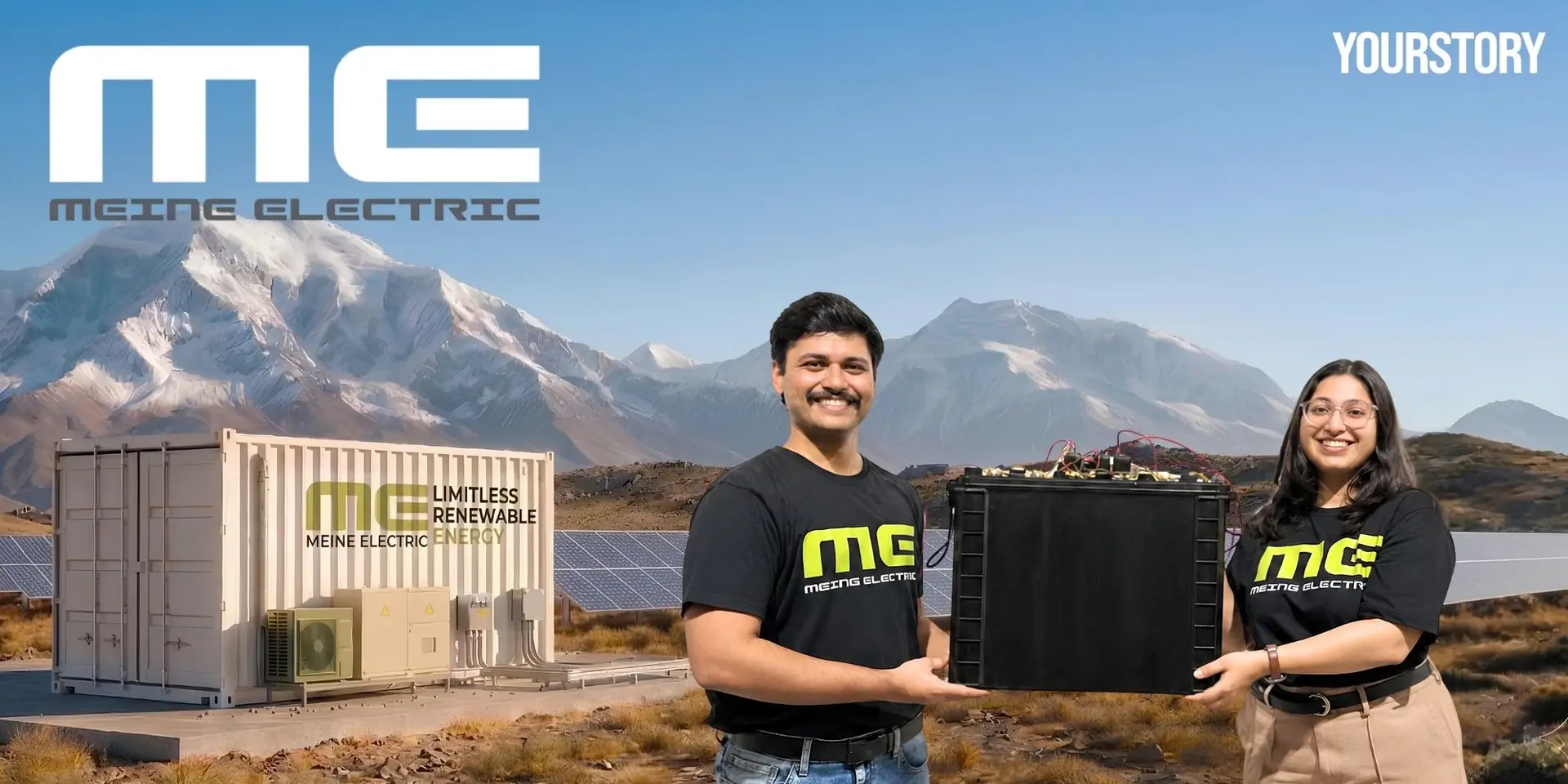

Lithium-ion batteries are good for short bursts. They will hold power for a few hours, which covers an evening at the most, but storing a full day of solar output to release overnight is a different problem, and lithium is expensive at that scale. The materials also come from supply chains India does not control.
But iron-air batteries work on a cheaper premise. The cell charges and discharges by oxidising and reducing iron, which is to say by rusting it and then reversing the rust. Iron, air and water are abundant and cheap. The catch has always been speed: conventional iron-air designs charge slowly, historically over 100 hours, which makes them unsuitable for a grid that cycles every day.
was founded in 2022 by Priyansh Mohan and Stuti Kakkar to close that gap. Mohan is the CEO while Kakkar is the COO, and the company operates from Chennai. It began life under a different name and a different plan, as TRI Automotive, an electric two-wheeler venture, before moving to storage.
Six hours in, eighteen hours out
The company's stated advantage is charge time. It says its Fast Charge Long Discharge design takes a full charge in six to eight hours and discharges over eighteen hours, which would match the daily rhythm of a solar grid: absorb through the middle of the day, release through the evening and night.
In July 2026, that performance was tested by Customized Energy Solutions, a US-headquartered energy services company and the parent of the India Energy Storage Alliance. The company says the CES battery laboratory ran a structured protocol assessing electrical performance and cycle stability, and that the results confirmed its claims.
Independent testing of this kind is not the same as a peer-reviewed result or a field deployment, but it is a step most early battery companies do not reach, and it puts a third party's name against the numbers.
Meine says its chemistry can deliver a cost of storage below $0.05 per kilowatt hour, and is targeting systems in the 16 to 24 hour range. It reports four granted patents and has filed for seven international applications.
Rs 6.7 crore, and the road to a pilot
The company raised Rs 6.7 crore, $750,000, in a pre-seed round announced in January 2026. Antler, Rebalance, Venture Catalysts, gradCapital and the AIC-AU Incubation Foundation hosted by Anna University all took part, along with angel investors including the energy industry figure Alexander Hogeveen Rutter.
The money is for the move from laboratory-scale prototypes to pilot-ready systems. The customers it is aiming at are from the utilities and heavy industry, in India first and then across the Asia-Pacific, Middle Eastern and African markets. The uses it describes are firming renewable output, meaning smoothing the gap between when power is generated and when it is needed, and giving thermal plants more flexibility.
India has been adding solar faster than storage, and the mismatch is the reason long-duration storage has drawn policy attention.
The startup has gained recognition along the way, including a National Startup Award in 2026 and a place in Nasscom's Emerge 50 list, and was featured by the government during the tenth anniversary of the Startup India programme.
(This story has been researched and compiled using publicly available information.)