



P3C is making solar modules from perovskite, a material that could replace silicon
The Gurugram-based company produces perovskite modules on glass and on flexible substrates and has had its cell efficiency certified by the National Institute of Solar Energy.

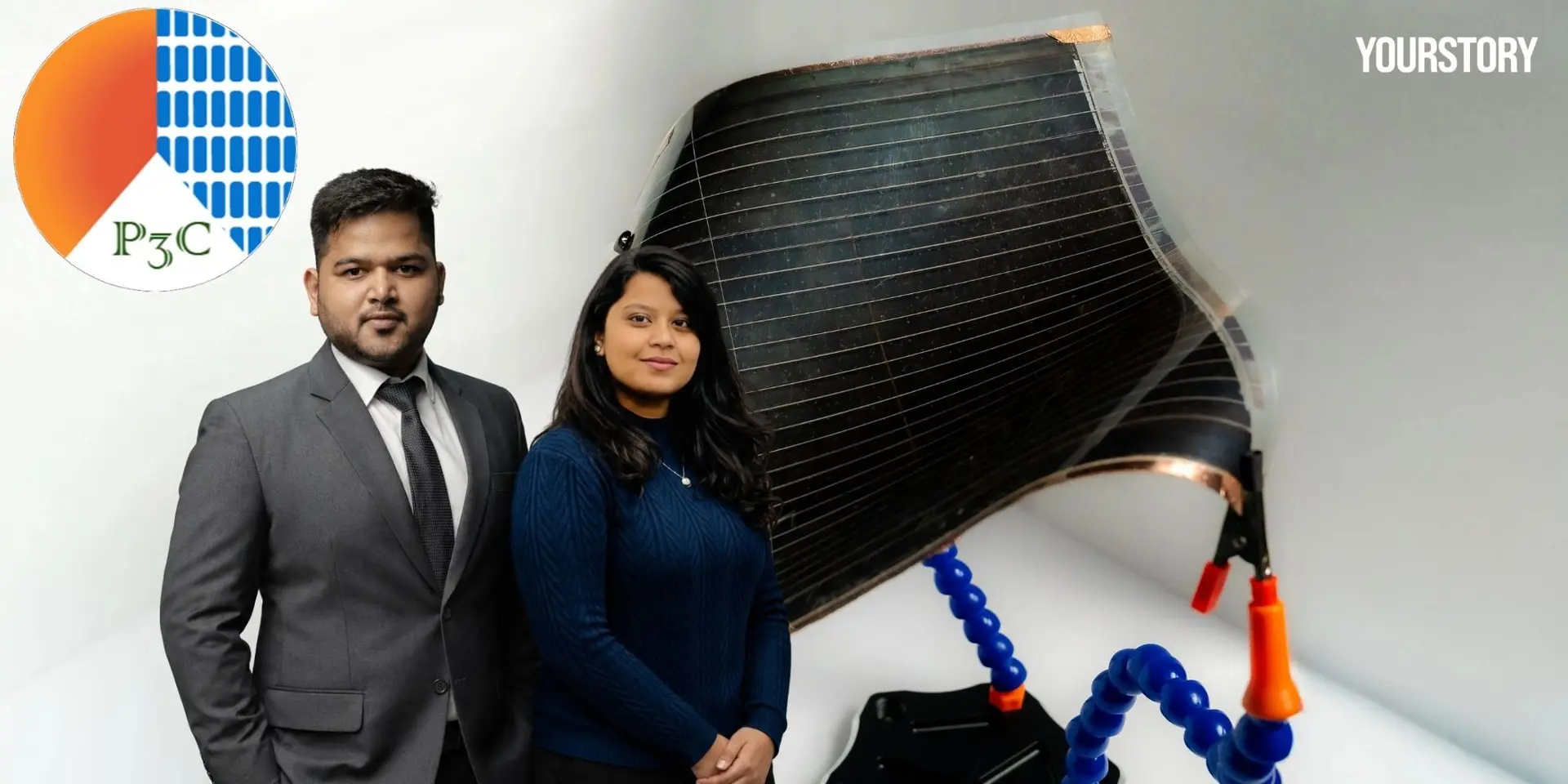

Almost every solar panel in the world is made of silicon, and silicon is close to the limit of what it can do. Perovskite is the material the industry has been watching for a decade: it converts light more efficiently, it can be processed at low temperatures, and it can be laid onto glass or onto a flexible sheet rather than requiring a rigid wafer.
The problem has never been efficiency. Perovskite cells have broken record after record in laboratories. The problem is that they degrade, sometimes within months, under heat, moisture and ultraviolet light, which is precisely what a solar panel spends its life in. Almost nobody has moved the technology from a laboratory record to a product that lasts.
is attempting it. Founded in 2019 by Sooraj Kumar, among others, who began working on the material as a student at IIT BHU. The company runs a research and manufacturing facility in Gurugram and is incubated at FITT, the technology transfer arm of IIT Delhi.
Two substrates and a testing platform
P3C Technology makes two products. MySUN Glass puts perovskite modules on glass, in the way a conventional panel is built. MySUN Flex puts them on flexible substrates, which is where the material's advantage over silicon is clearest, since a bendable panel can go onto surfaces a rigid one cannot.
Its certified performance sits at 19.3% cell efficiency, verified by the National Institute of Solar Energy, an autonomous body under the Ministry of New and Renewable Energy. Modules, which are larger and always test lower than individual cells, have been measured at around 15%. Its semi-transparent research cells reach about 20%.
Production runs on an assembly line the company says it developed itself, with capacity of around 100 kilowatts of small-format modules and a stated plan to reach one megawatt. It has been sending modules for durability testing at NISE and has said it intends to send them to the United States National Renewable Energy Laboratory for validation.
In March 2026, it launched something called P3SKY, a platform for manufacturers to test and validate perovskite modules under real-world conditions before committing to production. Kumar's stated reasoning is that the industry's obstacle is not efficiency records but reliability data, which is an unusual position for a company selling the technology to take.

A long list of applications, and a small line
The markets the company names are broad: commercial field installations, rooftops, automobiles, space, defence, railways and agriculture. It is also working on perovskite-silicon tandem modules with what it has described as one of India's largest silicon manufacturers, without naming the partner, and on anti-soiling and anti-reflective coatings.
Its funding came first as a grant from FITT at IIT Delhi, followed by a $250,000 seed round from Oberoi Thermit, an industrial machinery company in Uttar Pradesh, announced in June 2023. A further $3 million was committed at the time, conditional on successful trials. An industrial manufacturer as a backer is a different kind of investor from a venture fund, and suits a business whose problem is building a production line rather than acquiring users.
The company describes itself as India's first perovskite solar cell manufacturer and targets gigawatt-scale capacity by 2027. Against a current line measured in hundreds of kilowatts, that is a very large step.
What it has not published is a customer, an order or a revenue figure. Institutional buyers have taken modules for initial trials, which is the stage before anyone commits to a purchase.
(This story has been researched and compiled using publicly available information.)