




When payments grow beyond the gateway
Accepting payments is only the beginning. As businesses grow, recurring billing, settlements, reconciliation, payouts and compliance create a new layer of operational complexity—one that calls for a more connected approach.

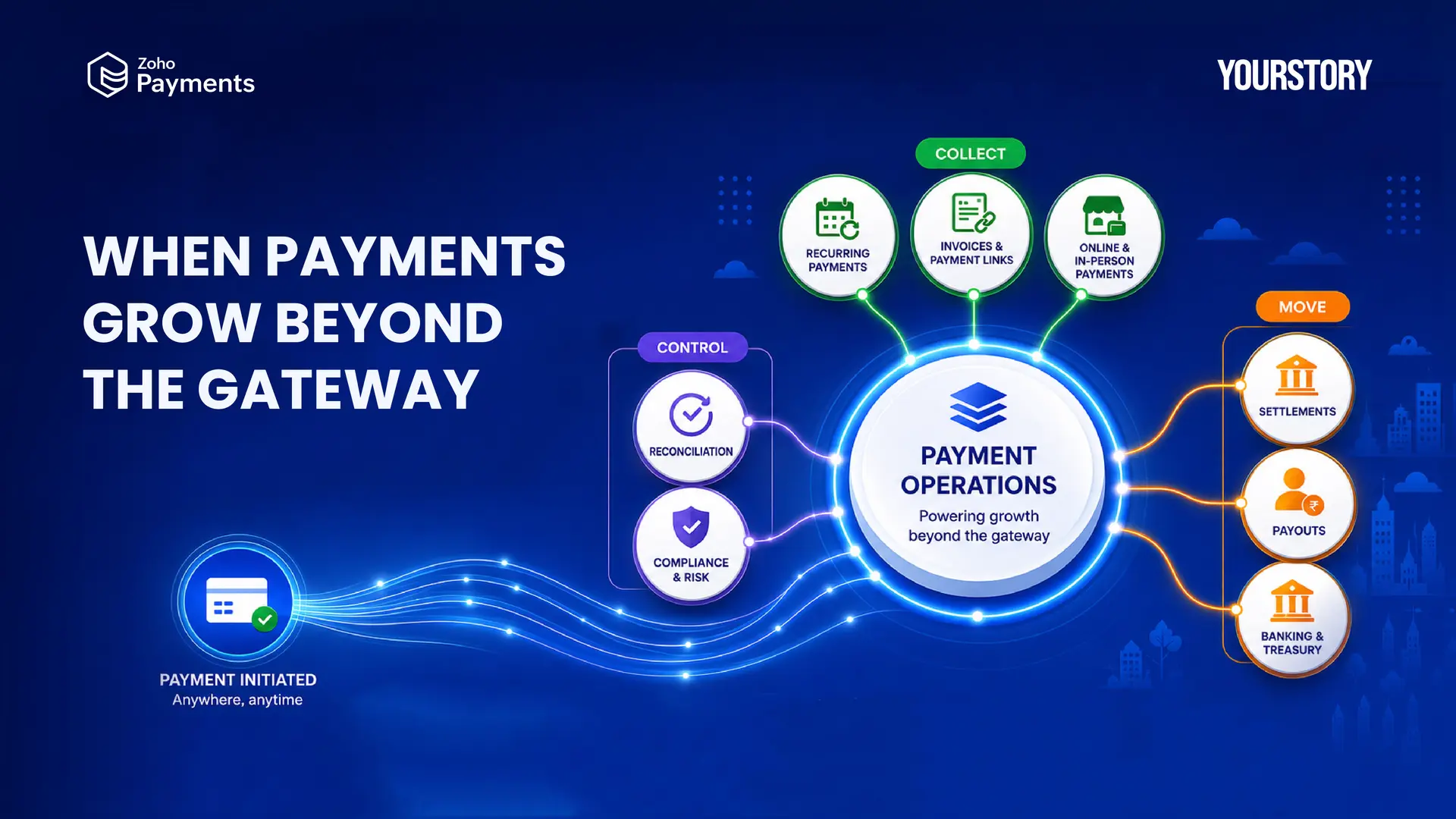

For most businesses, accepting the first payment is a milestone. Whether it comes through a website, an invoice or a payment link, the goal is simple: make it easy for customers to pay.
Growth changes the picture. A setup that once handled online transactions must now support subscriptions, recurring billing, payment links, invoices, marketplaces and in-person payments. Finance teams find themselves managing refunds, disputes, settlements, payouts and multiple banking relationships. What began as a straightforward payment workflow gradually becomes an operational function that touches nearly every part of the business.
Payment complexity typically emerges as businesses expand across customers, products, locations, sales channels and revenue models. The tipping point often comes when finance and operations teams begin relying on manual reconciliation and multiple systems to track payment status, subscriptions, refunds, and cash movement. At that stage, payments are no longer simply a transaction; they become an integral part of business operations.
As businesses scale, collecting money, paying vendors, processing salaries and managing cash flow often end up spread across multiple banking portals, payment gateways and finance applications. According to Zoho, bringing these functions together is becoming increasingly important as businesses look for greater visibility and control over their finances.
“Businesses that scale well aren’t necessarily the ones with the most advanced tools. They are usually the ones that have no friction between their financial systems,” says Sivaramakrishnan Iswaran, Global Head of Finance and Operations BU, Zoho. “Our vision is to bring business finance, banking and payments into one connected ecosystem, giving organizations better visibility into cash flow, smoother money movement and a simpler way to manage financial operations as they grow.”
Beyond processing a transaction
For many businesses, the payment gateway is where the payment conversation begins—and ends. It confirms whether a transaction has gone through. Growing businesses, however, need much more than that.
Recurring payments require mandates to be managed over time, along with retries when renewals fail. Settlements have to be reconciled against bank accounts operating on different schedules, while incoming payments need to be matched automatically to invoices.
As businesses expand into physical stores or service locations, in-person payments add another stream that has to sit alongside online transactions.
Money also moves in the other direction through vendor payments, payroll and reimbursements. Managing incoming and outgoing payments through separate systems often creates additional operational overhead, making it harder for finance teams to maintain a clear view of cash movement across the business.
Payments, in other words, become less about processing individual transactions and more about managing the movement of money across the business. As that footprint grows, adding more tools doesn't necessarily make operations simpler; it can make them harder to manage.

The hidden cost of fragmented payment operations
Reconciliation is often the first sign that payment operations have become more complex. As transaction volumes increase, finance teams can find themselves manually matching gateway records with bank statements and accounting systems.
But reconciliation is only part of the story.
Fragmented payment operations can also affect working capital. Money spread across different providers, each following its own settlement cycle, makes it harder for businesses to know exactly how much cash is available at any given time. That uncertainty often forces companies to maintain larger cash buffers than they otherwise would.
Payment success rates can also suffer. A transaction that fails on one gateway may have succeeded on another or with a different retry strategy. When payment data is distributed across multiple providers, identifying those patterns—and improving them—becomes significantly more difficult. The same challenge extends to fraud detection: suspicious activity that would be easier to identify through a single, unified payment history can remain hidden when every provider sees only part of the picture.
Over time, these gaps affect far more than operational efficiency. They influence cash flow, customer experience and, ultimately, revenue.
Why payments deserve a seat at the strategy table
For years, payments were treated as the final step in a customer's journey. Increasingly, businesses are beginning to see them differently.
Payments now sit at the intersection of finance, operations, compliance and customer experience. Regulatory changes from the Reserve Bank of India (RBI) and the National Payments Corporation of India (NPCI), including updates around tokenisation, UPI AutoPay mandates and payment authentication, require businesses to continually adapt their payment infrastructure.
At the same time, payment data has become increasingly valuable. It helps strengthen fraud detection, supports customer segmentation and, in lending businesses, contributes to underwriting decisions. Even the checkout experience itself can determine whether a customer completes a purchase or abandons it.
As a result, payments are no longer simply a commerce function. They have become part of broader financial and operational decision-making.
Bringing payment operations together
As payment operations become more complex, many businesses are looking beyond individual payment products towards a more connected financial ecosystem.
Instead of managing collections, recurring payments, settlements, banking relationships and reconciliation through separate systems, a unified platform allows these functions to work from the same set of data. That connected view links transactions to invoices, subscriptions to mandates and renewals, settlement entries to the payments that generated them, and incoming collections to vendor payments, reimbursements and payroll. The result is greater visibility into how money moves across the business and fewer operational silos.
Within the Zoho ecosystem, those connections extend directly into financial workflows. An invoice created in Zoho ERP, Zoho Books or Zoho Invoice, a recurring payment managed through Zoho Billing, or a salary payment initiated through Zoho Payroll remains connected to the corresponding payment and accounting records, reducing the need to move information manually between different systems.
For growing businesses, that means payment infrastructure that can support new sales channels, revenue models, and business requirements without introducing additional complexity.
Growing with the business
The payment needs of a business on day one look very different from those of a business operating at scale.
Early-stage businesses generally need a simple and reliable way to start accepting payments with minimal setup. As the business grows, those requirements expand to include recurring billing, multiple payment methods across online and offline channels, payout visibility and reconciliation processes that can keep pace with increasing transaction volumes.
For larger businesses and marketplaces, the challenges become even more sophisticated. Payments may need to be split across multiple sellers or vendors, while organizations require tighter controls around reserves, user permissions and risk thresholds. Payment data also becomes an important input for treasury management, compliance and financial reporting.
One of the clearest signs that a business has outgrown its payment setup is often visible behind the scenes rather than at checkout. When finance teams begin relying on spreadsheets, custom scripts or manual workarounds simply to reconcile transactions, it usually indicates that the payment infrastructure is no longer keeping pace with the business itself.
Where AI fits into payment operations
Artificial intelligence is beginning to reshape payment operations by reducing repetitive manual work and helping finance teams make faster decisions.
One area seeing immediate impact is reconciliation. AI can automatically match payment gateway records with bank statements and accounting systems, reducing the time finance teams spend manually verifying transactions. It can also identify anomalies, detect unusual transaction patterns and automate routine payment workflows.
AI is also changing how businesses interact with payment systems. Technologies such as Model Context Protocol (MCP) servers are beginning to connect AI agents and developer tools directly with payment workflows, allowing users to perform tasks such as investigating failed transactions or initiating refunds using natural language instead of navigating multiple dashboards. Zoho Payments already includes an MCP server designed to support these capabilities.
Beyond payment processing itself, AI is expected to play a larger role in accounting operations by categorizing transactions and payment fees, matching bank-feed entries with invoices even when records don't align perfectly, and assembling supporting documentation for payment disputes using existing order and shipment information.
Looking ahead, businesses are also preparing for a future where AI agents may initiate payments on a customer's behalf. As these capabilities evolve, customer consent, mandate management and regulatory compliance are expected to become even more important.
Rather than replacing human oversight, AI is helping reduce the operational effort required to manage increasingly complex payment environments, allowing finance teams to focus more on decision-making than administration.
Building for what's next
A business rarely knows on day one what it will look like a few years later. It may expand into subscriptions, launch a marketplace, open physical stores or enter new markets. At the same time, payment regulations continue to evolve, requiring businesses to continuously adapt the way they collect, move and manage money.
What begins as a simple payment gateway can eventually become the backbone of a much broader financial operation. As transaction volumes increase and business models diversify, switching payment systems becomes more disruptive and expensive, making the choice of payment infrastructure an increasingly important decision.
Platforms such as Zoho Payments are designed with that progression in mind. Beyond enabling businesses to accept online and in-person payments, the platform extends into recurring billing, collections, connected banking, settlements, payouts and reconciliation, allowing payment operations to remain connected as businesses grow more complex.
The launch of Zoho Payments also builds on the company's broader Connected Banking vision by bringing banking, finance and payments closer together within a single ecosystem. Combined with B2B payment capabilities and support for NBBL's Bharat Bill Payment System (BBPS), businesses gain access to multiple payment modes, instant payment confirmations, invoice presentment, financing capabilities and more streamlined reconciliation, helping reduce friction across financial operations.
For growing businesses, the challenge is no longer simply accepting payments. It's building a payment ecosystem that can grow with the business, adapt to changing operational needs and support expansion without adding unnecessary complexity.