



Peptris is using AI to find drug candidates to shorten the time it takes for laboratory validation
The Bengaluru-based company builds models that generate molecules and predict how they will behave, and has licensed its lead candidate to a US developer.


Developing a drug takes more than a decade and costs a great deal, and most of the money is spent on candidates that do not work. Failures are common at the preclinical stage, where a molecule that looks promising on paper turns out to be toxic, unstable, or unable to reach the targeted tissue. Each of those discoveries arrives after years of laboratory work.
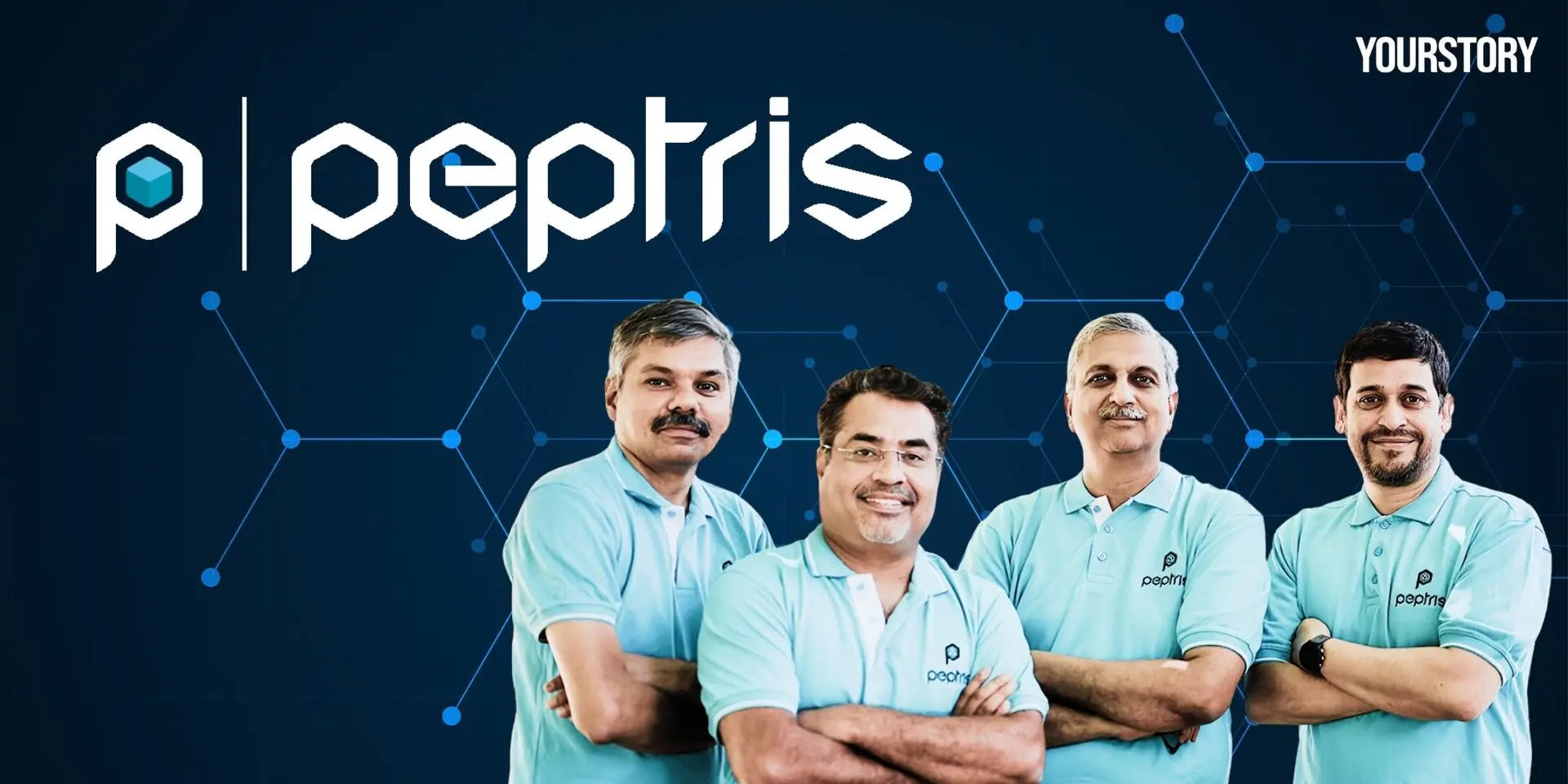
Technologies was founded in Bengaluru in 2019 to move some of those discoveries forward in time. It was co-founded by Narayanan Venkatasubramanian, the CEO, along with Shridhar Narayanan, Anand Budni and Amit Mahajan.
The founding team splits between the two disciplines the work needs. Venkatasubramanian, Mahajan and Budni come from computer science and engineering. Narayanan, the chief scientific advisor, is a pharmacologist who has worked on around twenty clinical drug candidates and led the team behind Enmetazobactam, an antibiotic now sold internationally as Exblifep.
Predicting failure before it costs anything
The platform does two things. It generates novel molecular structures, and it predicts the properties that determine whether a molecule can become a drug: how it behaves in the body, whether it is likely to be toxic, and how it might be optimised. The aim is to narrow a large chemical space to a small number of candidates worth making.
Alongside new molecules, the company works on repurposing and rescue: finding fresh uses for compounds that already exist, or reviving ones that failed for reasons a different indication might not care about. A repurposed compound carries safety data with it, which shortens the path considerably.
The B2B startup works with pharmaceutical companies, biotechnology firms and some consumer goods companies. The therapeutic areas it names are rare diseases, inflammation, oncology and women's health, the last of which has historically drawn less than required research funding.
The clearest evidence that the approach has produced something is its lead asset. PEPR-124, a repurposed candidate discovered on the platform, has been licensed exclusively to Revio Therapeutics for development in Duchenne muscular dystrophy, a rare genetic muscle-wasting disorder. The company describes it as Phase 2-ready and mutation-agnostic, meaning it would not depend on which specific genetic fault a patient carries.
Rs 70 crore, and the distance still to go
Peptris raised Rs 70 crore, about $7.7 million, in a Series A announced in February 2026, co-led by IAN Alpha Fund and Speciale Invest with Tenacity Ventures and BYT Ventures participating. Speciale Invest had led an earlier round of about $1 million in December 2023.
The money is for deepening the technology, expanding the pipeline, pushing programmes towards clinical readiness, and building partnerships in North America and Europe, where large pharmaceutical companies increasingly work with AI-enabled discovery firms. It will also go towards strengthening the scientific and technology teams.
India has strong generic manufacturing and comparatively little drug innovation, and the argument its investors make is that AI-led discovery is a route to change that balance without matching Western research budgets.
PEPR-124 has been granted orphan drug designation by the United States Food and Drug Administration. That status brings development incentives for treatments aimed at rare conditions. It is not an approval and says nothing about whether the drug works.
No Peptris-discovered compound has completed a clinical trial. Phase 2-ready describes a candidate prepared to enter trials rather than one that has been through them, and the company competes with a growing group of Indian AI discovery firms including ImmunitoAI, Boltzmann and Aarogya AI.
(This story has been researched and compiled using publicly available information.)