


Pranos Fusion is building the machinery India would need to generate power from fusion
The Bengaluru-based company develops plasma control software, superconducting magnets and a compact tokamak, aiming at the engineering rather than the physics.


Nuclear fusion is the reaction that powers the sun: light atoms forced together to release energy, with no carbon dioxide and none of the long-lived radioactive waste that fission, splitting heavy atoms, produces.
Fusion has been expected to arrive "soon" for seventy years now, and the delay has nothing to do with the physics failing.
Laboratories have produced fusion reactions repeatedly. China's tokamak held a plasma for 1,066 seconds, and France's WEST broke that at 1,377 seconds. What still seems to be missing is the industrial apparatus around it: the magnets, the control systems, the design tools and the supply chain that would turn an experiment into a power plant.
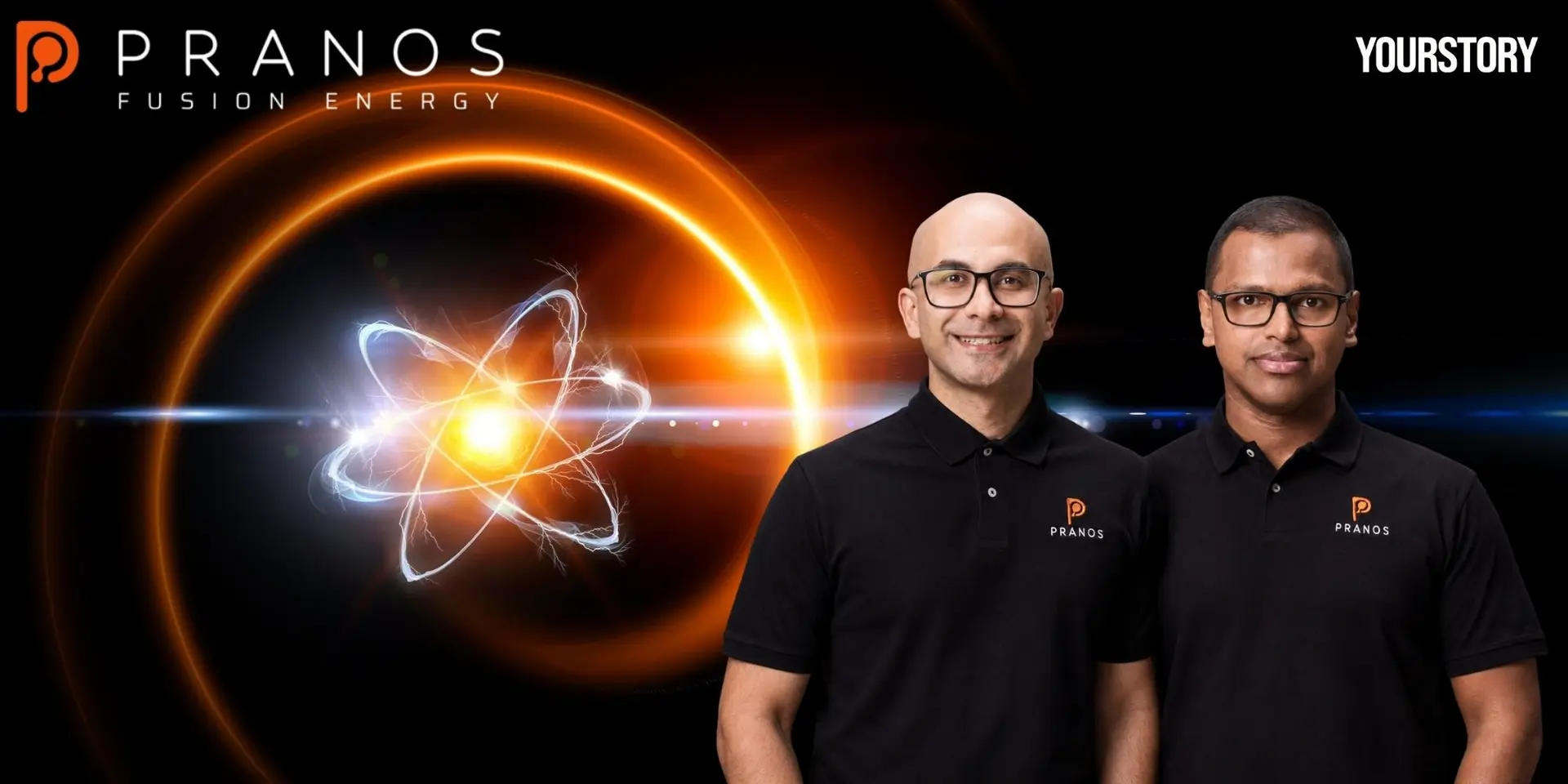
is aiming at that gap rather than at the reaction itself. Founded in Bengaluru in 2024 by Shaurya Kaushal and Roshan George, the company describes itself as building an integrated fusion technology stack, and its stated argument is that the world needs the commercial infrastructure to bring fusion to the grid.
Software, magnets and a machine
The stack has three parts. JENGA is a design and plasma-control platform, a digital twin that couples the physics of the plasma to the engineering of the plant, allowing the company to test configurations in simulation before committing to hardware.
MAGGA covers high-temperature superconducting magnets. These are what confine the plasma, and stronger magnets allow a smaller machine, which is a big part of why compact fusion has looked more achievable in the past decade.
PRAGYA is the machine itself, a compact spherical tokamak. A tokamak holds plasma in a magnetic field shaped like a doughnut, and the low aspect ratio version Pranos is building is squatter than the classical design, harder to engineer, but cheaper to build.
In August 2026, the company said it had completed India's first privately developed tokamak. It is targeting its first plasma milestone this year, which is a separate and harder step than building the machine.
The founders' backgrounds sit on opposite ends of the stack. Kaushal holds a doctorate in computational physics from JNCASR and an engineering degree from BITS Pilani, and has worked with the UK Atomic Energy Authority and CSIR-CEERI; he leads the physics and hardware. George comes from computer science and spent years building digital platforms for the energy industry; he leads the software and control algorithms.

Sixty-three crore, and eight people
The company began with about Rs 3.5 crore in pre-seed funding from Industrial47 and a Rs 20 lakh grant from the Startup India Seed Fund. In March 2026, it raised $6.8 million, around Rs 63 crore, co-led by pi Ventures and Ankur Capital, with Industrial47 returning alongside angels including Groww co-founder Lalit Keshre, the founders of Razorpay and Bhukhanwala Industries.
That takes total funding to about $7.22 million, going toward a team of roughly eight people, testing facilities, and the three technology tracks. It works with third-party manufacturers in Bengaluru, Pune and Chennai for hardware.
It is co-incubated at the Institute for Plasma Research, which runs India's operational tokamaks, and at JNCASR, and its plasma control systems are being developed with a view to deployment on IPR's existing machines.
The scale is worth keeping in view. Commonwealth Fusion Systems and Helion Energy have raised billions of dollars between them, and have not yet generated net power. Pranos has raised seven million and is attempting to build the industrial base rather than win the race.
(This story has been researched and compiled using publicly available information.)