



Quad AI Bet on Patna First. Can It Rethink Tech Education in India?
Quad AI began in Patna to make technology education more affordable and career-focused, using industry practitioners, resident faculty and early internships to build trust before its first batch graduates in 2029.

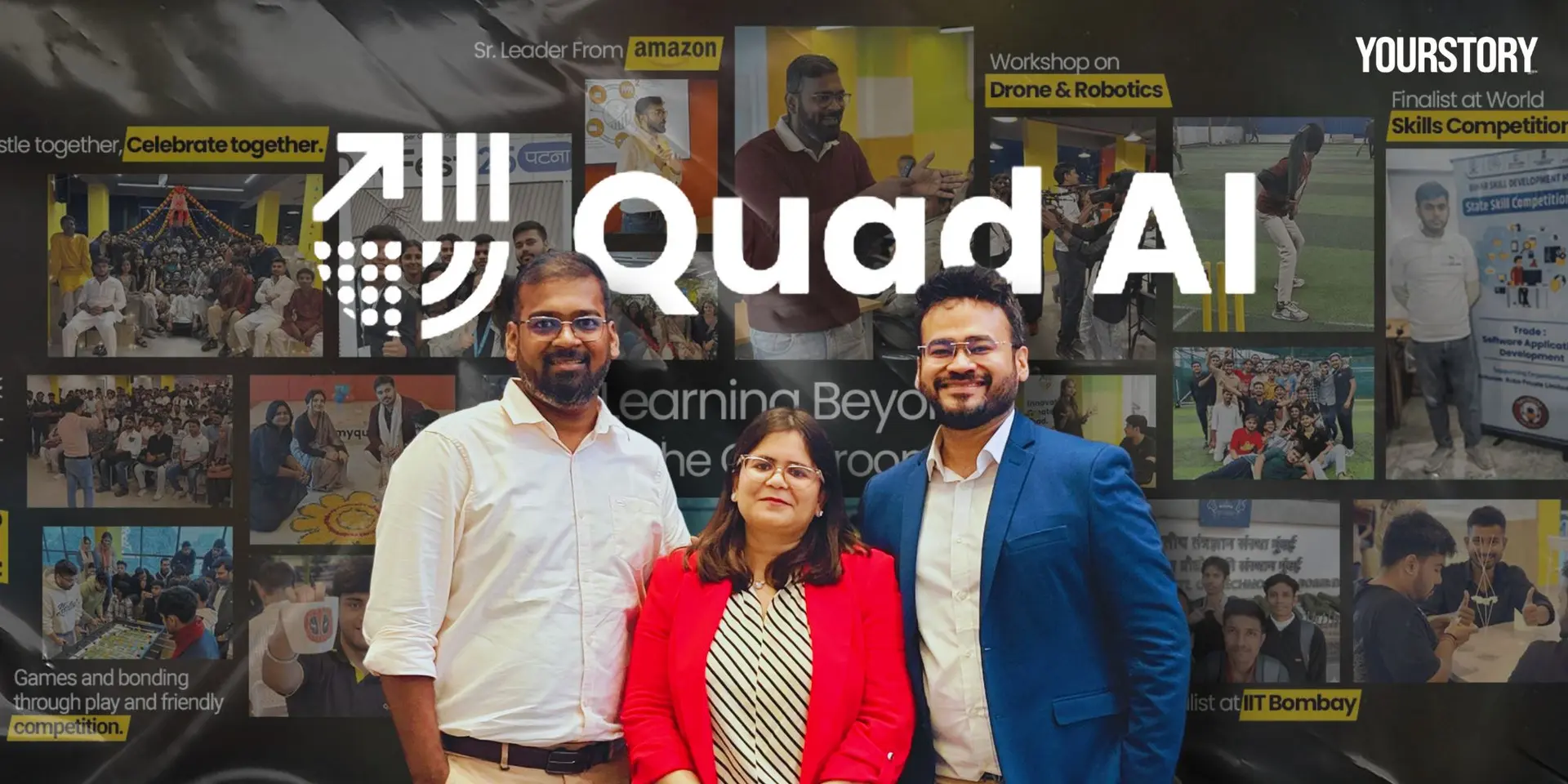

When Mohit Choudhary decided to build a technology school with co-founders Payal and Sourav, they made an unusual choice. Instead of starting in a metro, where the companies, mentors and internships are, they went to Patna first. It now operates campuses in Bengaluru and Mangalore with plans to open one in Mumbai next.
The decision was rooted in two ideas: technology education had to be affordable enough to reach students who could not afford to migrate to a metro, and relevant enough to improve their chances of employment. For Choudhary and his co-founders, the two were inseparable—access to education means little if students cannot turn it into a career.
Choudhary, who has worked at Mu Sigma, L'Oreal and OfBusiness, grew up in Patna. He says, after months of speaking to students and families across Muzaffarpur, Darbhanga, Gaya, and Patna, he saw a gap between the talent available in the region and the opportunities accessible to it: quality higher education, industry exposure, and pathways into technology careers. That gap became the starting point for Quad AI, a technology and management focussed school. The school took its first batch in Patna in 2025 and now has campuses in Patna, Bengaluru and Mangaluru, with plans to open one in Mumbai next.
But its first four-year computer science cohort will graduate only in 2029, leaving the founders with a more immediate question: how do you convince students and parents to trust a model before its ultimate outcomes can be measured?
The broader access problem is difficult to ignore. The All-India Survey on Higher Education for 2023-24 puts Bihar's college density at eight colleges per lakh population in the 18 to 23 age group, the lowest among states. The founders say this gap is what they are trying to address by bringing industry-led technology education to students where they live.
In this conversation, Choudhary talks about why he believes technology education in Bihar has to be built on the ground, how Quad is balancing practitioners with a resident academic team, and how the school wants to look at early student outcomes rather than wait for the first graduating batch.
Edited excerpts:
YourStory [YS]: Most technology schools are set up in the metros, the logic being that you need to be where the companies are. What did you see in Patna that made you believe the model could work there?
Mohit Choudhary [MC]: I was born and brought up in a Tier II city. It offered a good environment for school education, but the reality changes after Class 12. Most students who aspire for quality higher education have to move to a metro, and that comes with a significant financial barrier.
Around 60% to 70% of students cannot afford to move out and pay tuition and living expenses at good private colleges, especially if they don't make it to the IITs, NITs or other government institutions. So many talented students compromise on quality simply because of where they come from.
YS: Your model leans on practitioners flying in, with a small resident academic core. How do you make sure a student doesn't fall through the gaps over four years?
MC: We wanted students learning from people currently doing the job, not people who last did it a decade ago. Our mentor bench spans both large corporates and startups, from Microsoft, Google, Amazon, Salesforce, Cisco, Apple CRED, Samsung, Zepto among others.
But practitioners fly in and out, they can't own a student's four-year journey. That is what the resident core is for, a smaller permanent team tracking each student and making sure those sessions add up to something coherent rather than a series of disconnected guest lectures.
Quad's answer to the trust problem is the first year itself. Sultan Ansari joined when he was unable to speak more than a few words in English, but landed a paid front-end developer internship within a year. AS failed in Class 12 mathematics and cleared an improvement exam, a record conventional admission would filter out, and now holds the campus's highest-paid internship. Jaya Patel scored 97% in JEE and had an IIIT seat waiting, but chose Quad.
YS: Your first batch graduates in 2029. When a parent asks why they should trust an outcome that hasn't happened yet, what do you tell him?
Sourav Kumar (SK): They do not have to take our word for it. They can look at what is happening right now, before any degree is awarded. Our classroom sessions are industry-led. We've had Dominik Sasko, a frontend developer at Tensor Energy in Japan, run sessions with our students; design-thinking workshops built around real cases from Zepto; an ongoing partnership with Google Developer Groups; and hackathons like FOSS Hack 2026 — and that's just on our Patna campus. In Bangalore, that same community has gotten even stronger in a short period of time — we recently hosted BaseCamp, powered by Elevation Capital, in collaboration with Claude and a number of other startups. Events aren't limited to tech either: we hosted a SpringVerify event with senior HR leaders, to expose students to broader industry trends beyond the classroom.
Infact our first year students have participated and won at various competitions held at IIT Bombay, IIT Dhanbad, BIT Mesra, BITS Pilani and many more.
Those are leading indicators, and they are visible today, not in 2029. We also tell him plainly that we have the most at stake here, our reputation and our own capital, in a state where word travels fast.
What a stackable programme actually means for a student?
Most Indian degree programmes are all or nothing. If you leave the course in the third year, you leave with nothing beyond a transcript. Quad has built its programme in stages. If a student exits after two years, they will still hold a qualification and can return later to finish.
Whether the model works is a question only 2029 can settle.
Meanwhile, the company’s expansion into Bengaluru and Mangaluru sets up the more interesting experiment, pathway programmes letting Patna students spend time in a tech hub without losing the affordability that brought them in. If that pipeline holds, the harder question for the sector is why so few institutions have gone looking for students in Muzaffarpur or Darbhanga at all.