



Two childhood friends turned India’s trash paper into a multi-crore notebook brand
Bengaluru friends Naren Raj and Ashutosh Ananth transformed discarded office paper into Rescript, a multi-crore recycled paper business that has saved over 9,200 trees

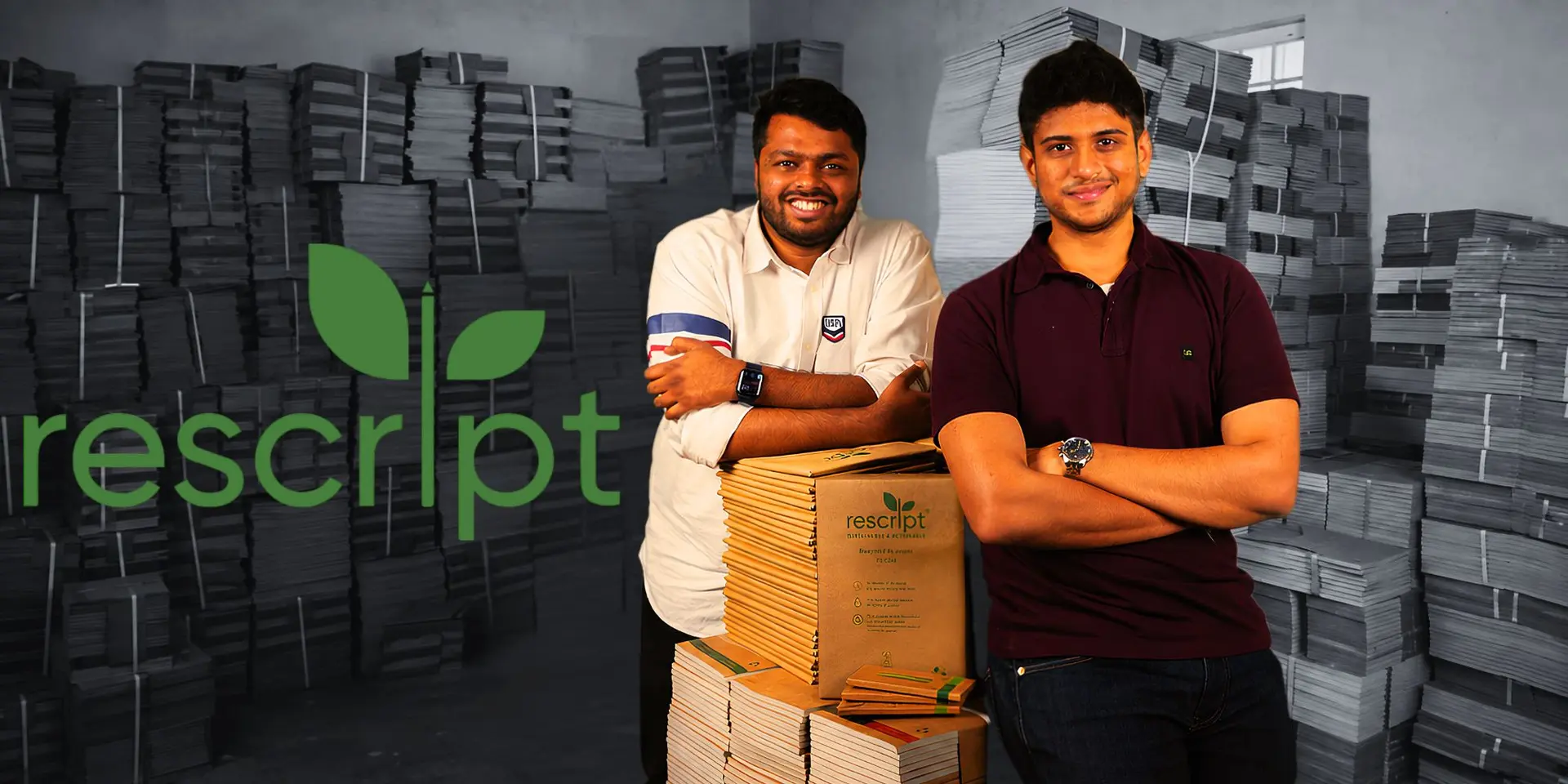

Every school and office in India generates mountains of used paper that ends up as waste. Naren Raj and Ashutosh Ananth, childhood friends from Bengaluru, looked at that pile and saw a notebook business instead.
A first idea that didn't quite work
Naren and Ashutosh had known each other since childhood, and both wanted to build something together in the sustainability space. After finishing their BBA from Christ University in 2016, Naren briefly worked at Ernst & Young before leaving within two months, unable to shake the pull to build something of his own. In 2019, the pair landed on plantable stationery, notebooks and pens embedded with seeds that could be planted after use, and even secured an early corporate order. It felt promising, but the novelty wore off fast.
Plantable products got appreciated once and rarely reordered, and a business built on one-time purchases isn't really a business at all.
The pivot that came from a pandemic
Then COVID-19 hit. Offices shut down almost overnight, but hospitals still needed paper, urgently and continuously. In that gap between collapsing demand in one sector and urgent need in another, Naren and Ashutosh saw the shape of a real business: not novelty paper people buy once, but everyday paper people need constantly. In 2021, they launched Rescript, focused specifically on recycled copier paper and notebooks.
The technical challenge wasn't trivial. Recycled paper has historically had a reputation for being rough, inconsistent, and unreliable for everyday printing. Rescript developed a proprietary process carefully balancing paper pulp and water ratios to produce sheets smooth and durable enough to run through modern printers without jamming or tearing. Discarded paper gets collected, sorted, pulped, and pressed into fresh sheets, giving waste paper a second working life instead of ending up in landfill. Notably, the finished paper isn't bright white, because Rescript's process uses no bleaching agents at all. "We don't use bleaching agents at all," co-founder Ashutosh Ananth has explained, describing the natural off-white shade of Rescript's paper as a visible symbol of how it was actually made, rather than a compromise to hide.
What the numbers behind it actually add up to
The impact, measured cumulatively, is now substantial: Rescript has recycled over 500 tonnes of waste paper, saved more than 9,200 trees, conserved over 18.4 million litres of water, and prevented more than 4.31 lakh kilograms of carbon emissions, according to the company's own figures. What began as two friends running a small operation has grown into what's now described as a multi-crore business, with products sold through offices, schools, and online retail across the country.
The business has also picked up national visibility: Rescript appeared on Shark Tank India Season 4, seeking Rs 1 crore for 3.33% equity at a Rs 30 crore valuation, a validation moment that pushed the brand well beyond its original Bengaluru customer base.
Why this story matters
Rescript's founders didn't invent a new category or chase a trendy pivot for its own sake. They built a business on the unglamorous insight that a genuinely sustainable product only survives if it's something people need to buy again and again, not something they admire once and forget. Turning discarded office paper into notebooks people use daily is a quieter, less headline-grabbing kind of innovation than most startup stories carry, but it's precisely the kind of business model, solving a boring, recurring problem instead of chasing a flashy one-time sale, that tends to actually last.