



An earthquake gives you mere seconds of warning. A Roorkee company is building the sensors that will act as the first responders
Seismic Hazard and Risk Investigations makes warning systems that respond to an earthquake early.


An earthquake announces itself twice. The first wave carries little destructive energy and travels the fastest; the second one does the damage. The gap between them is small, sometimes only seconds, but it is enough to cut a gas line, stop a train, or shut down a reactor, provided someone is listening.
Building that something is what Seismic Hazard and Risk Investigations does. The company was incorporated in Roorkee in September 2020 as a spin-off from IIT Roorkee, and its work runs from the sensors themselves to the reports that tell an engineer what ground motion a structure should be designed for.
The founding names on record include M L Sharma from the institute's earthquake engineering department, alongside B K Kaushik and Govind Rathore. The company's leadership has changed since. It describes its purpose in Make in India terms: seismic instrumentation designed and built here rather than imported.
That matters because the equipment is not cheap. A research-grade seismometer is an imported instrument with an import price, which is part of why India has fewer of them per square kilometre than its exposure would suggest.
Sensors, switches and warnings
The starting point was an early warning system developed with IIT Roorkee under IMPRINT, a government research programme, and demonstrated to the Department of Science and Technology. The company says IIT Roorkee has transferred the technology for one of its units to it, and that several pieces of its basic equipment are patented.
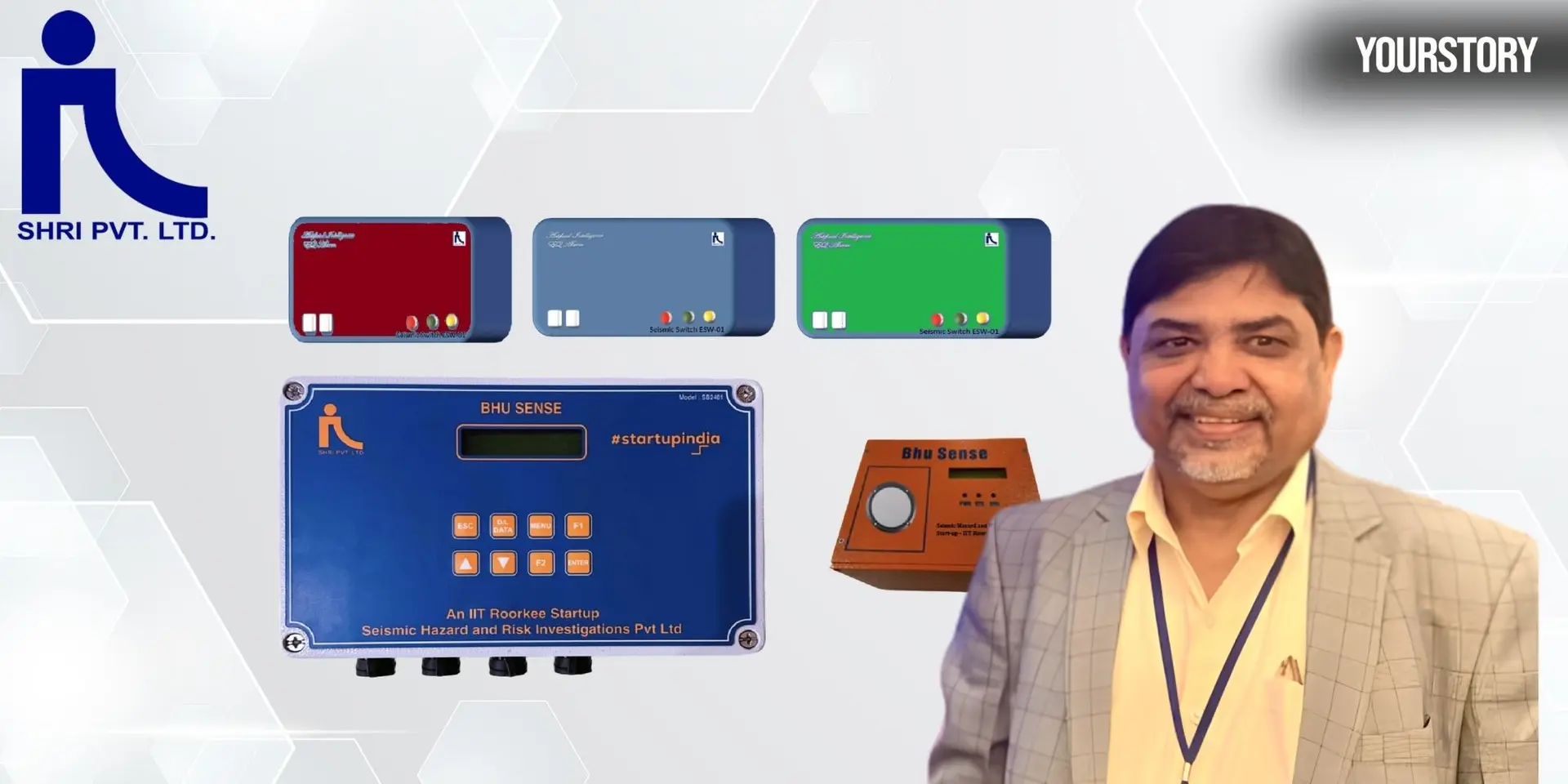
Its onsite system, which it calls BHU WARN, uses three sensors and a single data acquisition unit. Onsite systems of this kind detect the first wave at the building itself rather than relying on a regional network, which trades a little warning time for far less infrastructure.
Around it sits a range of smaller devices. Seismic switches for homes and offices are designed to cut power or gas automatically when shaking crosses a threshold. Damage calculators estimate what an earthquake of a given intensity would do to a particular structure.
The consulting side is the older discipline. SHRI carries out seismic hazard assessments using both deterministic and probabilistic methods, producing site-specific design earthquake parameters for dams, nuclear and thermal power plants, bridges, hospitals and large engineering projects, and it extends the same instrumentation to landslides and floods.

A small company with an institute behind it
Financially, the company is modest. Its authorised and paid-up capital are both about Rs 1 lakh, and company databases record one institutional investor, the TIDES Business Incubator at IIT Roorkee, with the amount undisclosed.
The link to the institute is the substance of the business. The technology came from its laboratories, the incubator is its investor, and the company marked its fourth foundation day on the campus.
India's exposure is not in doubt. A large share of the country sits in higher seismic zones, and the Himalayan front is among the more active plate boundaries in the world. The building stock in most of the towns along it was not designed for what it may have to withstand.
Roorkee sits close to that front, which is part of why the institute has had an earthquake engineering department for decades.
What the company has not published is a customer, a contract or a deployment figure. Warning systems are bought by governments and infrastructure operators rather than individuals, and none has been named.
(This story has been researched and compiled using publicly available information.)