


Sagar Defence Engineering builds uncrewed boats that patrol and survey without anyone aboard
The Maharashtra-based company makes unmanned surface vessels and aerial systems for the Navy, Coast Guard and energy sector, along with the autonomy software that runs them.

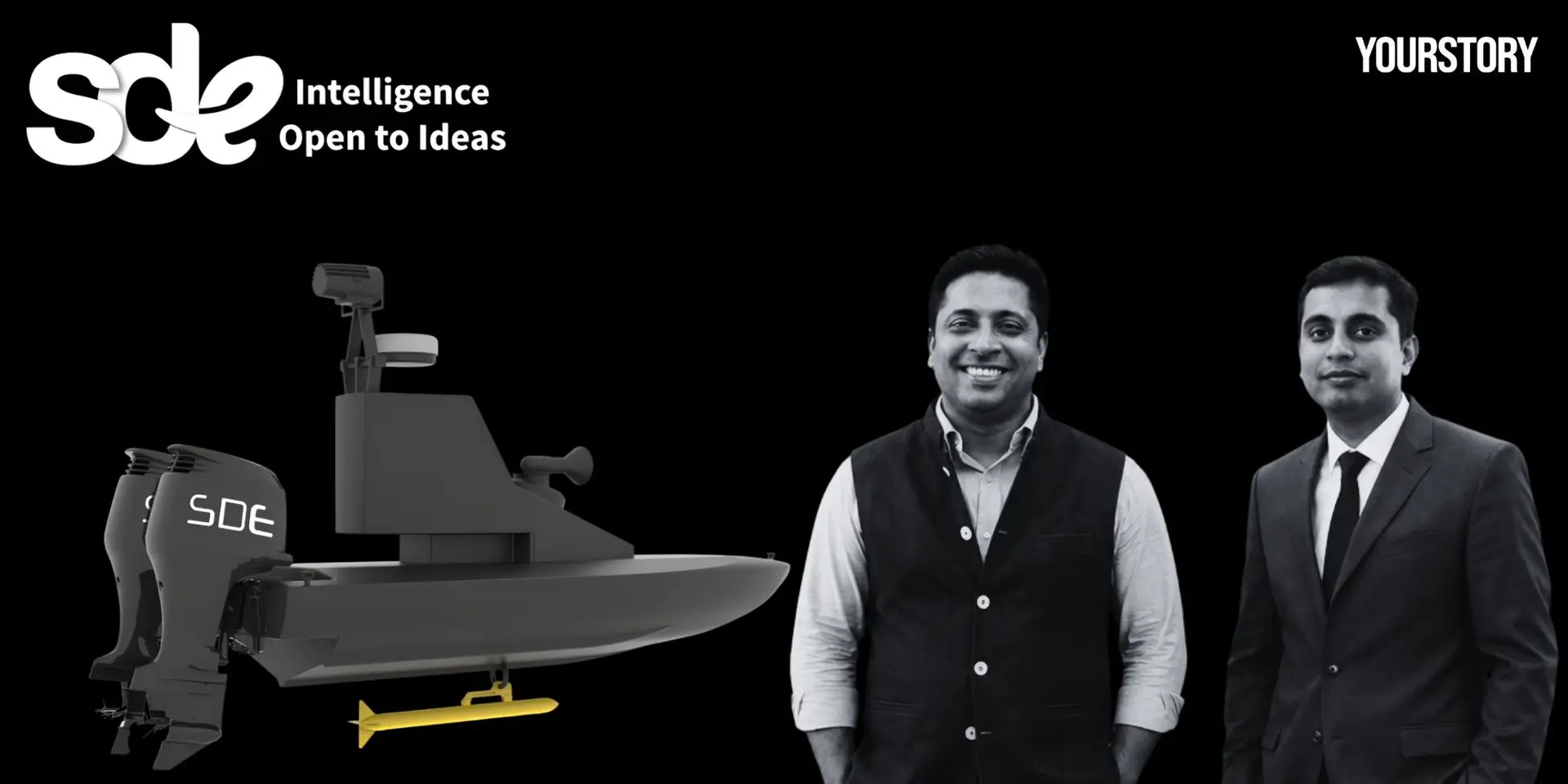

A patrol boat needs a crew, and a crew needs food, rest, safety margins and a reason to be at sea. For long, dull, dangerous work- surveying a seabed, watching a stretch of coast, checking a pipeline- the crew is the most expensive and most limiting part of the vessel.
Removing them changes the arithmetic. An uncrewed boat can be smaller, stay out longer, work in conditions that would be unsafe for people, and cost a fraction of what a manned equivalent does. India, with a coastline of over 7,500 kilometres and a large offshore energy industry, has a great deal of that work to do.
was founded in 2015 to build them. Its CEO, Captain Nikunj Parashar, spent more than a decade in shipping operations and commanded merchant ships before starting the company, alongside co-founder Mridul Babbar. It works from Pune and Mumbai.
Boats, drones and the software between them
The product range covers three things. Unmanned marine surface vessels operate on the water for survey, patrol and data collection. Unmanned aerial vehicles cover the air. Genesis is the autonomous navigation system that runs them, which is the part that turns a remotely operated boat into one that decides for itself.
The company describes its systems as embedding artificial intelligence and says they have been proven with the armed forces and internationally. Its named application areas run across defence, oil and gas, inland waterways, oceanography, disaster management and scientific research, with the Indian Navy, Coast Guard and border forces among the intended users.
Its stated framing is broader than any one product. Sagar Defence describes its purpose as accelerating the world's transition towards unmanned systems, which for a business selling into both defence and offshore energy is a way of saying the same hulls and the same autonomy serve very different buyers.
Its most visible demonstration was the Sagarmala Parikrama, an autonomous voyage completed in November 2024. A vessel making a long coastal passage without a crew aboard is the clearest proof that the autonomy works, because there is no one to intervene when it does not.
The company has also moved into partnerships rather than only products. In 2024 and 2025, it announced work with Liquid Robotics, the Boeing subsidiary that makes wave-powered autonomous surface vehicles, to scale unmanned surface vessel systems for maritime security.

Thirty million dollars, and a market forming around it
The funding record is substantial but inconsistent across sources. Company databases record between $30.1 million and $48.2 million raised across six to eight rounds, with the most recent described variously as a $25.4 million round in December 2024 and a Series B in March 2026.
The investor list is unusual for an Indian defence company. It includes ONGC, IDBI Capital Markets & Securities Limited, and Skegen as lead.
It also has revenue, which most companies in this field do not. Corporate records show about $4.68 million for the year ended March 2024.
Indian military technology funding has risen steeply over the past decade, and Sagar Defence sits among the handful of companies that have taken most of it. Its competitors are named in databases as Anduril, Saronic and Saildrone, all American and all operating at considerably larger scale, which is a fair measure of the company it now keeps and the gap it is working against.
(This story has been researched and compiled using publicly available information.)