



SBI Foundation and NSRCEL launch second iCube cohort to strengthen regional incubators
SBI Foundation and NSRCEL have launched the second iCube cohort to strengthen regional incubators and innovation ecosystems across India.

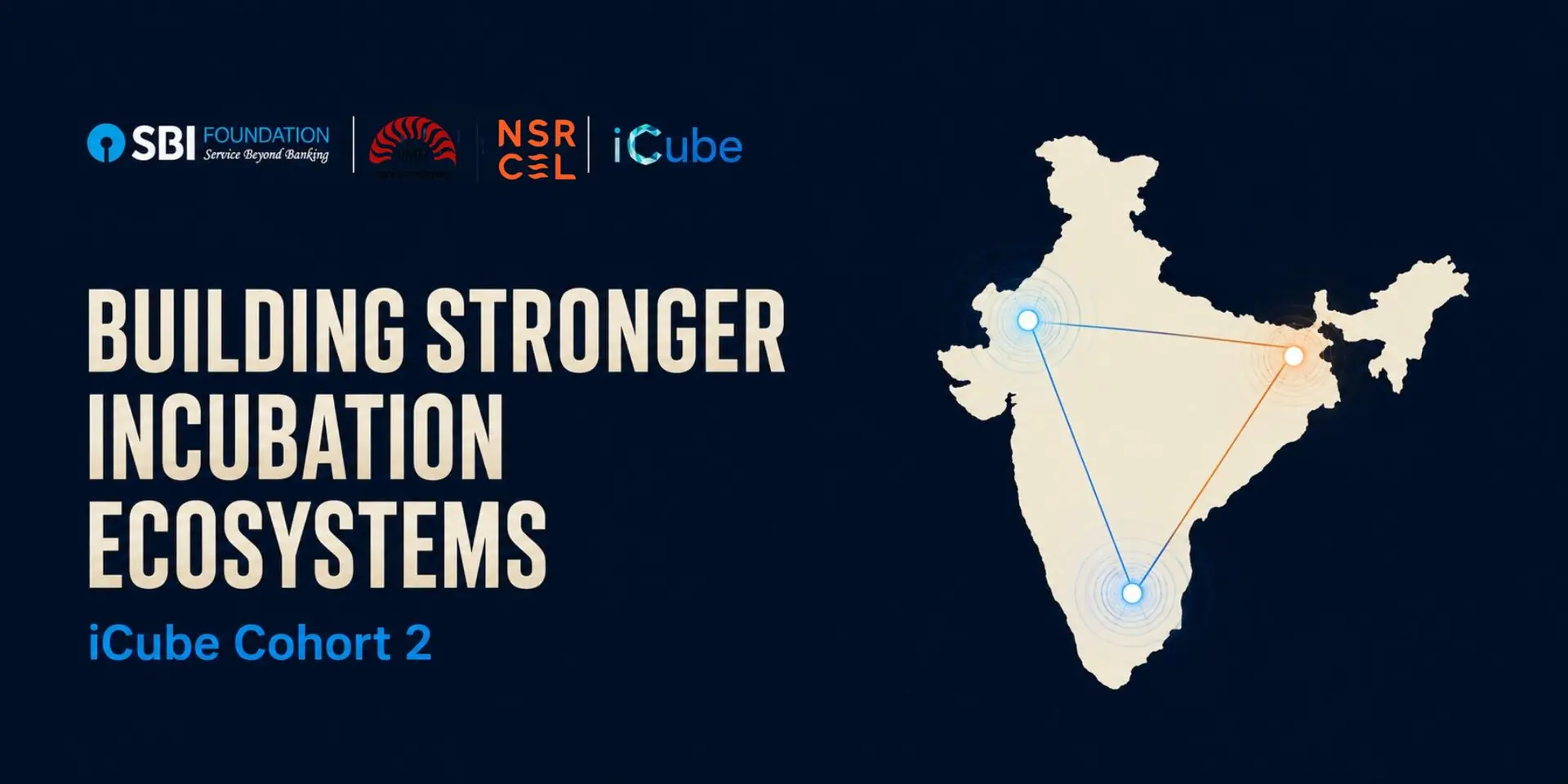

Building startups is only one part of the equation. India is now turning its attention to the incubators that help build them.
NSRCEL, the startup hub at the Indian Institute of Management Bangalore (IIM Bangalore), in partnership with SBI Foundation under its Innovators for Bharat initiative, has launched the second cohort of its Incubating Incubators (iCube) Initiative.
The programme aims to build institutional capacity by helping incubators strengthen their capabilities, adopt best practices and create lasting impact across regional innovation ecosystems.
Three incubators join the new cohort
The second cohort brings together three incubation partners: AIC MAGIC, or Marathwada Accelerator for Growth & Incubation Council, an initiative by the Chamber of Marathwada Industries and Agriculture (CMIA), Incubation Centre, IIT Patna (IC IIT Patna), and The Tripura Institution for Transformation (TIFT).
The three institutions represent different innovation ecosystems across India. Through the iCube programme, they will become part of NSRCEL’s partnership ecosystem, giving them deeper institutional engagement, access to specialised resources and a wider network of mentors and experts.
This initiative follows the idea that incubators need to develop according to the needs of their regions rather than follow a single model.
Building stronger institutions for startups
Unlike traditional incubation programmes that focus directly on entrepreneurs, iCube focuses on the institutions that nurture startups.
The programme uses structured learning, peer-to-peer engagement, strategic mentoring, governance frameworks and operational best practices to help incubators become stronger anchors for regional innovation. The second cohort builds on the learnings from iCube Cohort 1.
These learnings highlighted that every incubator requires a tailored approach based on its geography, governance structure, sectoral focus and local entrepreneurial ecosystem. The new cohort will therefore place greater emphasis on institutional reflection, strategic development, contextual problem-solving and peer-driven learning.
Access to mentors and learning resources
Participants will gain access to NSRCEL’s incubation ecosystem, including its network of more than 110 mentors, industry connect programmes, curated learning modules, institutional tools, strategic frameworks and knowledge-sharing sessions.
The programme also encourages collaboration between incubators. By exchanging experiences and adapting successful models to their regional contexts, participating institutions can work towards building stronger and more resilient systems for supporting founders.
The initiative also aligns with the wider focus on capacity building across India’s innovation ecosystem. Government ministries and departments, including NITI Aayog, Atal Innovation Mission (AIM), the Department of Science and Technology (DST) and the Ministry of Electronics and Information Technology (MeitY), through MeitY Startup Hub, have highlighted capacity building as an important part of strengthening innovation.
Through its Human Capability Development initiatives, AIM focuses on strengthening the capabilities of incubator managers, ecosystem enablers, mentors and innovation professionals.
A focus on regional entrepreneurship
For SBI Foundation, iCube is part of its wider focus on strengthening incubation ecosystems through the Innovators for Bharat initiative and its Livelihood and Entrepreneurship Acceleration Programme (LEAP).
Subhadip Mondal, Team Lead, LEAP, SBI Foundation, said the organisation aims to strengthen the foundations that allow entrepreneurship and innovation to grow across India. He highlighted the importance of enabling incubation centres to support entrepreneurs beyond metropolitan hubs.
Rasika Prashant, CEO, NSRCEL, said the next challenge for India’s startup ecosystem is not simply adding more incubators, but creating robust incubators. She also stressed the importance of building contextualised incubation models based on the conditions of individual regions.
Dr Kumar Siddharth Singh, Chief Manager, BioNEST, Incubation Centre, IIT Patna, said institutions need to continuously evolve and that iCube provides opportunities for reflection, identifying gaps and learning from experienced peers.
By strengthening incubators, iCube aims to create a wider impact across India’s entrepreneurial landscape. Better-equipped institutions can support more founders, enable stronger startups, generate quality employment and contribute to vibrant regional innovation ecosystems.