


Serendipity Space is building satellites that make medicines in orbit and bring them back
The Bhubaneswar-based company grows drug crystals in microgravity, where the absence of gravity may produce purer forms than are possible on Earth.


A drug is only as good as its crystals. The way a molecule arranges itself as it solidifies determines how well it dissolves, how stable it is on a shelf, and how much of it the body can absorb. Get the structure wrong, and a medicine that works in theory fails in practice.
Gravity interferes with that process. As a crystal forms in solution, denser material sinks and convection currents stir the liquid, both of which introduce defects. Remove gravity and the solution sits still, which in principle allows more uniform crystals to grow. Pharmaceutical companies have run these experiments aboard the International Space Station for years, including on cancer therapies.
Serendipity Space wants to do it commercially, from India. Founded in 2024 in Bhubaneswar by Antariksh Parichha, Jivitesh Debata and Dr Monica Ekal, the company is building satellites that would manufacture pharmaceutical compounds in orbit and return them to Earth.
A factory called Alchemy
The module that does the work is called Alchemy, an autonomous pharmaceutical manufacturing system designed to run without anyone present. That autonomy is the point: a satellite has no operator, so the crystallisation has to start, run and be preserved on its own.
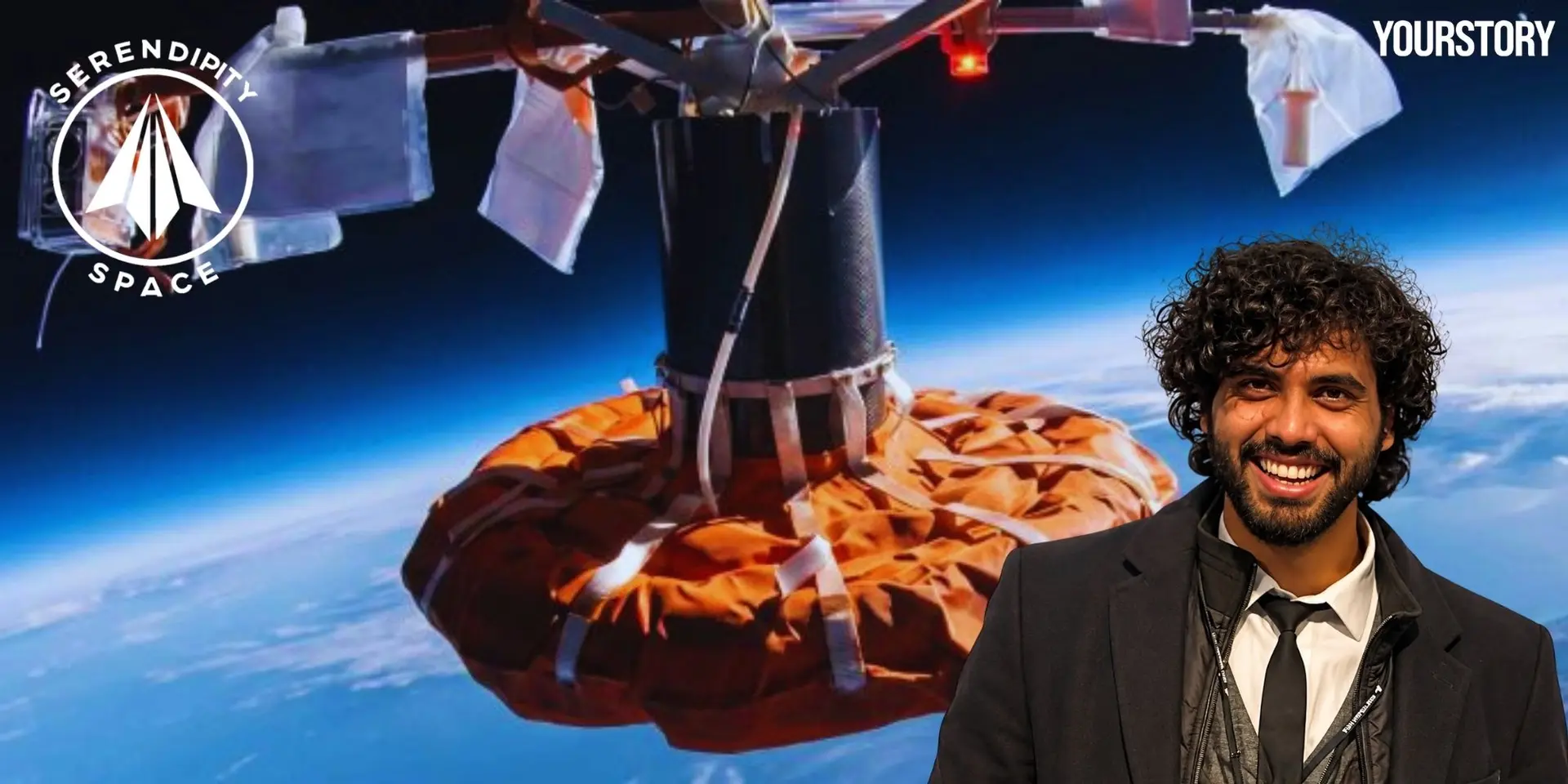
In March 2026, the company flew it. Working with the Tata Institute of Fundamental Research's Balloon Facility in Hyderabad, which has run high-altitude launches for decades, it sent a satellite prototype, built to an orbital-class design, to the edge of space on a stratospheric balloon.
The mission tested more than the chemistry. It put the company's heat shield and avionics through their paces, ran crystallisation during flight, and preserved the resulting crystals through descent, touchdown and recovery. The payload included monoclonal antibody therapeutics, small-molecule drugs and proteins used in drug discovery.
Recovery matters as much as production. A crystal grown in microgravity that is destroyed by the heat and force of re-entry is of no use to anyone, which is why the Serendipity describes preserving crystal integrity through the return as part of what it was testing.
The eventual plan is a reusable satellite that goes up, manufactures, comes down and flies again. That is a harder machine than a one-way spacecraft, and it is what would make the economics work, since a factory used once is not a factory.

Half a million dollars, and Odisha
The company has raised about $591,000 across two rounds, backed by Campus Fund, which invests in student and recent-graduate founders. It had a technical team in place by October 2025 and built a functional prototype, designed to orbital-class standards, in under four months.
The founding team combines physics, engineering, computer science and space operations. Ekal has worked at the German Aerospace Centre and at NASA, and the company was building functional pharmaceutical modules on the ground before it flew anything.
In August 2026, the company was among twenty Indian space startups whose founders met the Prime Minister on National Space Day.
What it has not announced is a pharmaceutical customer, an orbital mission or a commercial product. Its intended market is the drug companies that would pay for orbital manufacturing, and none has been named.
(This story has been researched and compiled using publicly available information.)