



Tagbin has built an AI platform that turns words into 3D building designs
Tagbin’s Brixx converts natural-language prompts into architectural designs, BIM models, drawings, cost estimates and project plans, potentially reducing months of construction planning to days.

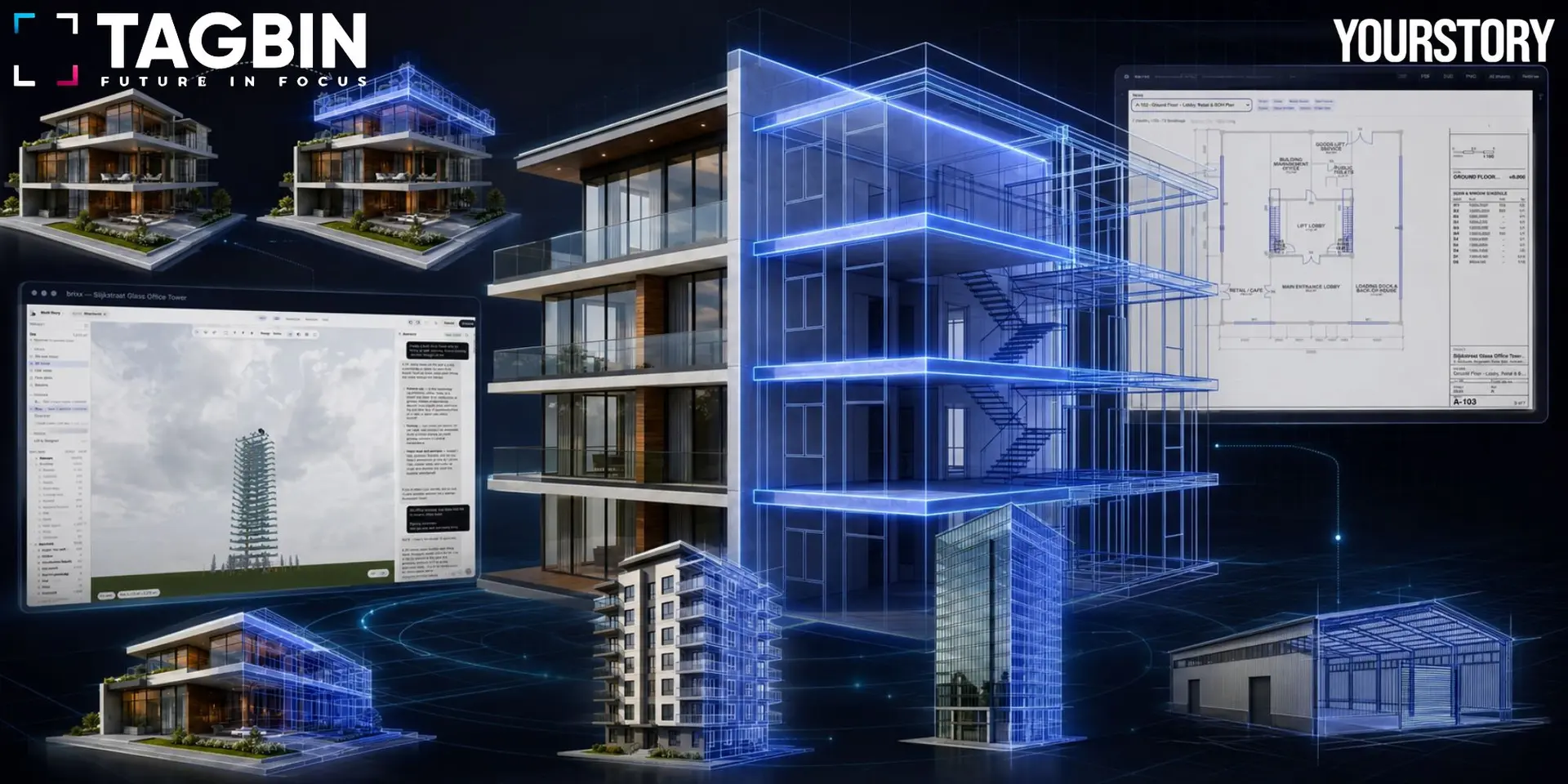

Gurugram-based Tagbin has launched Brixx, an AI-powered platform that allows architects and engineers to generate building designs and engineering outputs using natural-language prompts.
Users can describe what they want to build—say, a four-bedroom home—and Brixx can generate architectural designs, drawings, Building Information Modelling (BIM) models, cost estimates and project plans. Tagbin's website says the platform can produce IFC models, drawings, renders and bills of quantities.
“Software development is being transformed by platforms that convert ideas and prompts into working applications. We believe architecture and construction are ready for the same transformation,” Saurav Bhaik, Founder and CEO of Tagbin, said in a statement.
Cutting planning time from months to days
In a conversation with YourStory, Bhaik said that one of the problems Tagbin is trying to solve is the dependence on 2D drawings during the early stages of construction, which can make it harder to identify design conflicts and accurately estimate costs before work begins.
BIM creates a digital model of a building and its systems, allowing architects and engineers to coordinate different elements before construction begins.
Bhaik said Brixx seeks to make this process easier by allowing engineers and architects to create models through prompts rather than having to build them manually from scratch.
“Planning that happens in three to four months, you can now do in days,” he told YourStory.
The problem Tagbin is targeting is significant. India's large infrastructure projects continue to grapple with cost escalation. The 1,847 central-sector infrastructure projects monitored by the government in June 2026 had a combined revised cost of ₹40.54 lakh crore, compared with an original estimate of ₹35.61 lakh crore, a cumulative overrun of about ₹4.92 lakh crore.
Tagbin raised $10 million in December 2025 from investors including SageOne Flagship Growth OE Fund, Ramesh Damani, Jyotivardhan Sonthalia, Sanjay Kaul, Abhinandan Lodha and the Kurl-on Group. The company has previously said it plans to pursue an IPO by March 2027.

Founded in 2013 by IIT Roorkee graduates Saurav Bhaik, Ankit Sinha and Abhishek Negi, Tagbin had annual revenue of ₹160 crore and had been profitable for seven consecutive years as of March 2026.
From a government DPR project to Brixx
Brixx traces its origins to an AI-powered Detailed Project Report (DPR) project that Tagbin developed for the Ministry of Development of North Eastern Region (DoNER) under the IndiaAI Mission. Tagbin's press release says the DPR product subsequently evolved into the broader architecture, engineering and construction platform.
Tagbin secured the work order in March 2026 to develop an AI-based framework for creating and analysing DPRs. The system was designed to automate validation and compliance checks, map costs against government benchmarks, and generate outputs including Bills of Quantities and cost abstracts.
Bhaik said the company subsequently added a design-generation layer to the technology.
While generative AI is used to understand a user's design brief, Bhaik said the actual modelling relies on a combination of AI and mathematical algorithms.
“The LLM only understands the intent of the user,” he said. “The rest is mathematical modelling.”
Tagbin's longer-term ambition is to connect more stages of the construction lifecycle. Its roadmap includes design and BIM generation, cost estimation, regulatory compliance, DPR preparation, construction monitoring and comparing work on the ground with sanctioned designs.
Bhaik said Tagbin has also trained the system around state-specific building rules and is in discussions with some state governments about using the technology to assist with building-plan and occupancy-certificate approvals. Building regulations vary across states, even where they draw from the National Building Code of India.
Enterprise first
Tagbin is initially positioning Brixx for large enterprises and institutional customers rather than individual users.
“We are presently focusing on large customers,” Bhaik said, adding that the company eventually plans to make the platform directly available to engineers and architects.
For enterprise deployments, Tagbin also provides forward-deployed engineers and architects who work with customers as they implement the platform.
The company plans to monetise Brixx through a subscription model linked to the number and complexity of projects. Bhaik said pricing for enterprise deployments could vary between 0.5% and 3% of project value, depending on the nature and complexity of the engagement.
For Tagbin, Brixx represents a move beyond its earlier experiential-technology and government AI work into the architecture, engineering and construction software market. It’s a bet that natural-language interfaces can make sophisticated building-modelling tools accessible to a wider set of users.