



Tsalla Aerospace builds autonomy software that flies drones without GPS
The IISc-incubated company develops a hardware-agnostic autonomy stack for unmanned systems, and works with the Indian Navy and Army on reconnaissance and logistics projects.

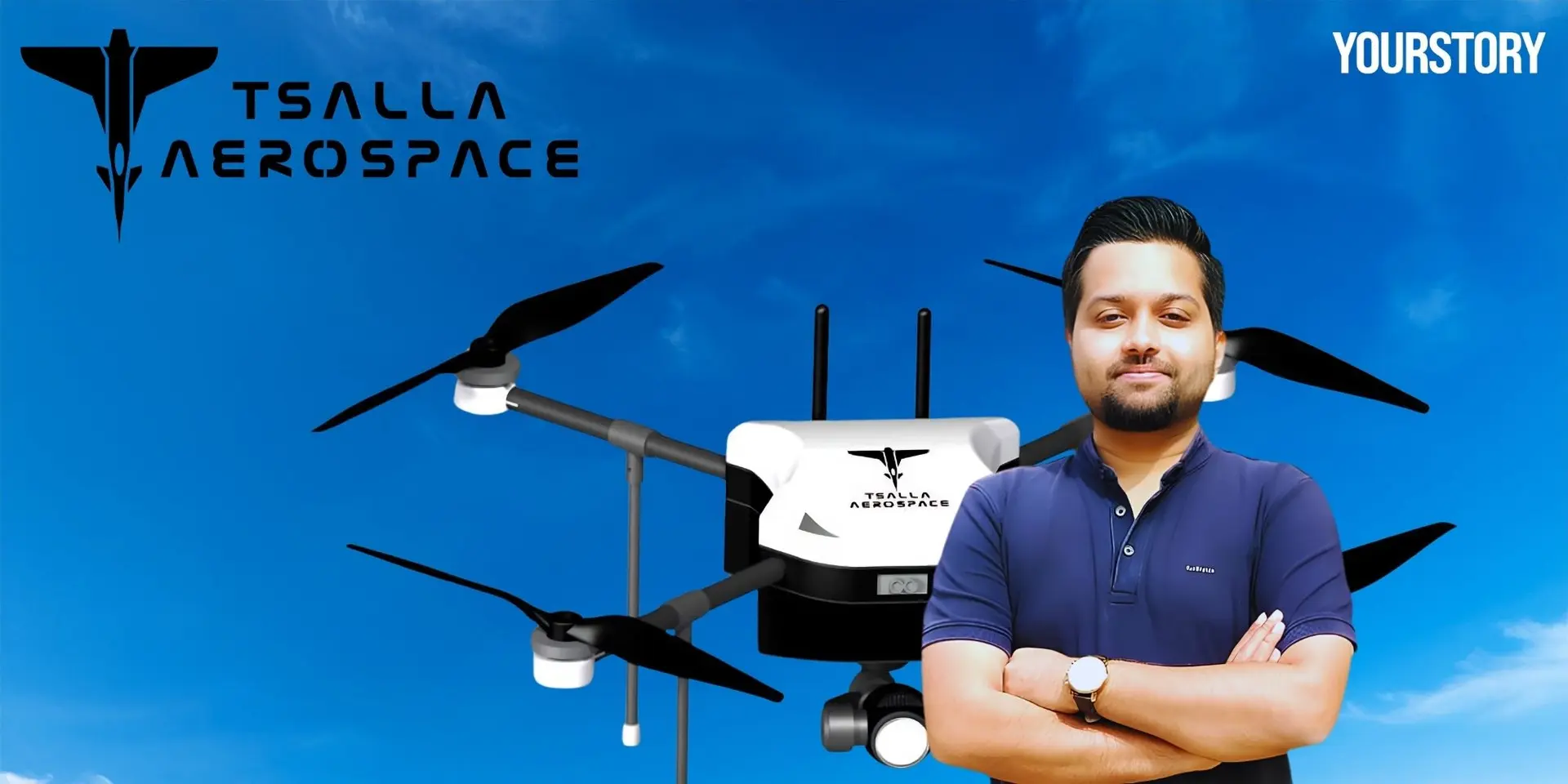

A drone flying on GPS is only as reliable as its signal. Jam the satellite link or the radio connection to the operator, and most unmanned aircraft become useless, which is precisely why interfering with those signals is standard practice against them. The same is true in places where signals never reach: inside buildings, underground, in mountain terrain.
works on that problem. The company was incorporated in Bengaluru in February 2019 by Vinayak Tsalla, who is CEO, and Siva Satyanarayana Tsalla, and is incubated at the Indian Institute of Science.
Its product is called AI Pilot, an autonomy stack the company describes as hardware-agnostic, meaning it is designed to run on platforms it did not build. The stated aim is operation with no operator input at all, in environments where GPS and communications are unavailable.
Software first, platforms second
The company started with unmanned aircraft, developing both fixed-wing and multi-rotor systems with in-house design and manufacturing, and describes its products as built to military and industrial grade with redundant systems.
Tsalla describes a vision extending beyond aircraft to ground vehicles, ships and underwater platforms operating on a shared autonomy layer, and the founder has framed the goal as unmanned systems that decide and act together without human intervention.
Selling software rather than airframes is a different business from selling drones. It puts the company alongside the platform manufacturers rather than against them, though it also means the value has to be demonstrated on somebody else's hardware.
Three defence projects are named in the company's own materials: reconnaissance systems for confined spaces, a vertical take-off platform that packs into a backpack and can be operated by one person, and logistics work including ship-to-ship delivery in poor weather.
Each of those is a case where the link to an operator is the weak point. A drone sent into a building loses its signal at the door, and a delivery between ships in bad weather is the kind of task where a human pilot is least reliable.

A million dollars, and eight more sought
Tsalla raised $1 million in its first external round, announced in November 2025 and led by Sunny Stalnaker, an executive vice president at ASML, the Dutch semiconductor equipment manufacturer. SIDBI participated, and the company also received equity-free grants through the Ministry of Defence's Innovations for Defence Excellence programme.
The company was incubated at the Indian Institute of Science and received equity-free grants through the Ministry of Defence's iDEX programme in its early years.
It has said it plans to raise $8 million in a seed round to expand its autonomy stack, grow deployments in India and abroad, and move into new defence and industrial segments. That plan was announced in November 2025 and hasn’t materialised since.
The company works with the Indian Navy and Indian Army on the projects listed above, but no contract value, delivered volume or revenue figure is public. It competes with established Indian firms including ideaForge, NewSpace Research and Technologies, Sagar Defence and CRON Systems, most of which build their own platforms as well as the software that runs them.
(This story has been researched and compiled using publicly available information.)