



TV Somanathan gets a year's extension as India's top bureaucrat
The government has extended Cabinet Secretary TV Somanathan’s tenure by one year. Here’s how his work on Chennai Metro, GST and public finance shaped his rise to India’s highest civil service post.

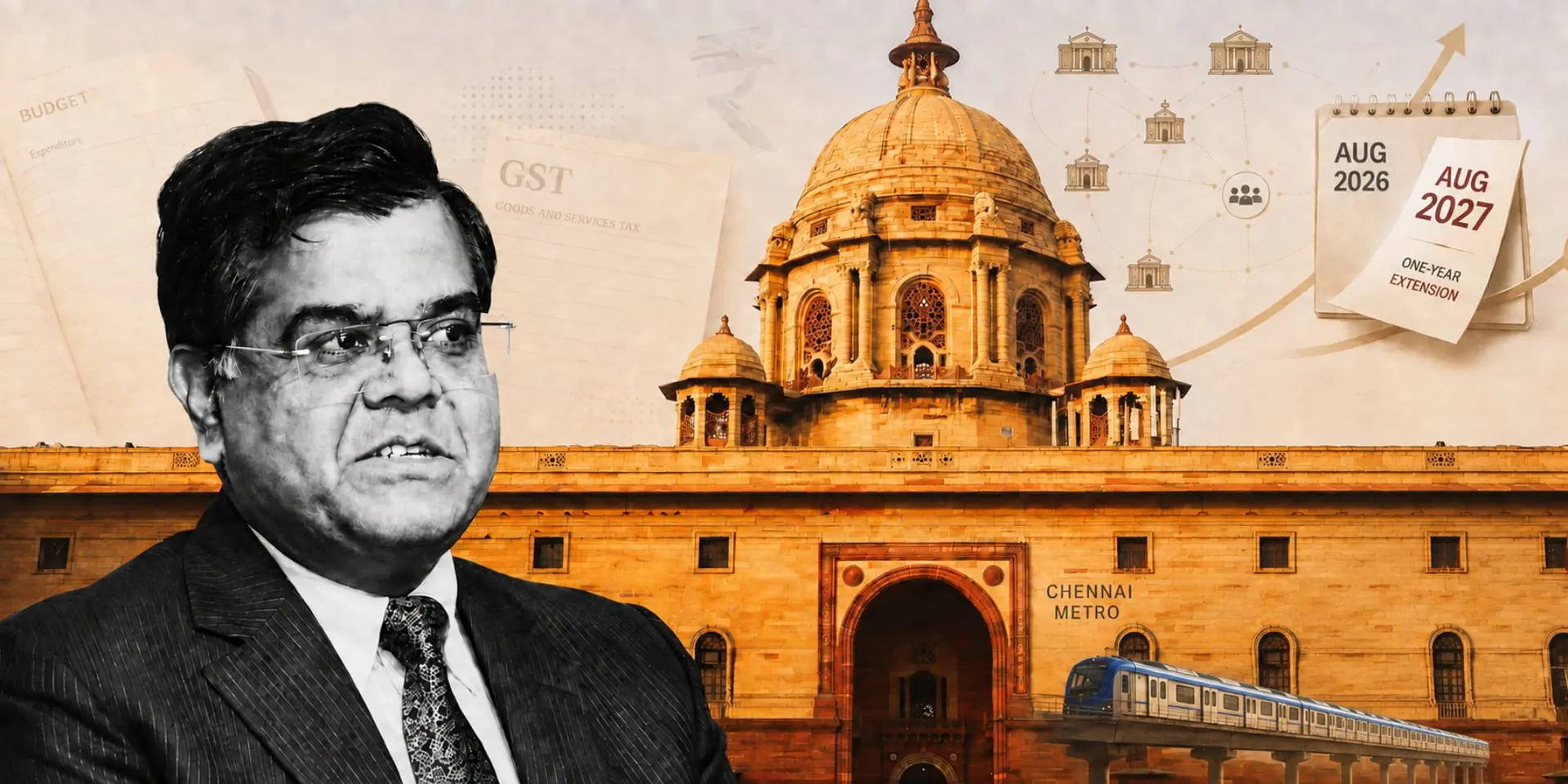

The man who ran Chennai's Metro, helped roll out GST, and sat atop the Finance Ministry as Finance Secretary isn't stepping away just yet.
On August 5, 2026, the Government of India cleared a one-year extension for Dr. T.V. Somanathan, the Cabinet Secretary. That post is the highest-ranking civil servant role in the country, and the person who holds it effectively keeps the wheels of the Union government turning.
An official order from the Ministry of Personnel put it in the government's characteristically spare language: "The Appointments Committee of the Cabinet has approved extension in service of Dr. T.V. Somanathan, IAS (TN:87) as Cabinet Secretary for a further period of one year beyond 30.08.2026."
The decision came from the Appointments Committee of the Cabinet, chaired by Prime Minister Narendra Modi. With his tenure originally set to end on August 30, 2026, Somanathan will now continue in the post through much of 2027.
Cabinet Secretary role explained
The Cabinet Secretary sits at the apex of India's permanent executive. Reporting to the Prime Minister, the office is the top-most executive position and the senior-most civil servant post in the Government of India.
Think of it as the connective tissue between ministries, the Cabinet, and the sprawling bureaucracy beneath.
That's why an extension here is more than a routine paperwork exercise. Keeping the same hand on the tiller signals a preference for stability and continuity at a moment when the government is pushing on governance reforms, big-ticket infrastructure, and inter-ministerial coordination.
For context: when Somanathan took charge in August 2024, it was on a two-year term. This one-year extension stacks on top of that, carrying him through to August 2027.
TV Somanathan career and education
If the civil services had a CV that made people do a double-take, Somanathan's would be it.
A 1987-batch Indian Administrative Service (IAS) officer of the Tamil Nadu cadre, he took over as Cabinet Secretary on August 30, 2024, after the superannuation of Rajiv Gauba. Before that, he served as Finance Secretary and Secretary, Department of Expenditure, roles that put him close to the heart of the government's fiscal decisions. He is credited with a major hand in the 2022 Union Budget's move to end off-budget borrowing and clean up the Centre's balance sheet.
His academic and professional credentials are unusually stacked. Somanathan holds a PhD in Economics from Calcutta University, completed the Executive Development Program at Harvard Business School, and is a fully qualified Chartered Accountant, Cost Accountant and Company Secretary. He was also deputed as Director, Corporate Affairs at the World Bank in Washington DC, bringing a dose of international policy exposure to the table.
Then there's the Tamil Nadu chapter, which is where his reputation as an operator was forged. He served as founder Managing Director of Chennai Metro Rail Corporation Ltd, Secretary to the Chief Minister, and Additional Chief Secretary and Commissioner of Commercial Taxes during the crucial phase of the GST rollout. As founder MD of the metro, he was responsible for achieving financial closure and awarding the initial tenders for the project. Building a metro from the ground up and helping shepherd India's biggest indirect-tax overhaul are not the sort of lines most bureaucrats get to write.
Why the extension matters
Insiders point to a simple logic: continuity. The extension ensures steady administrative leadership at a time when the government is advancing key governance reforms, major infrastructure projects, and national security initiatives.
During his tenure as Cabinet Secretary, Somanathan has focused on improving administrative efficiency, expediting project implementation, and strengthening coordination among ministries. Those are precisely the areas where a change at the top could cost momentum.
Tenure extension debate
Not everyone reads a tenure extension the same way. Somanathan's competence is rarely in question. A PhD economist and triple-qualified professional with a metro and a GST rollout on his ledger is a hard profile to argue with. But recurring extensions at the very top do reopen a familiar conversation in bureaucratic circles about succession, and about how long the queue of senior IAS officers waiting for the corner office should be.
It's a tension worth naming rather than glossing over: stability at the summit versus the churn that opens doors lower down. For now, the government has clearly decided which side of that trade-off it values more.