



UrjanovaC captures carbon dioxide from factory chimneys and turns it into something commercial
The Mumbai-based company, founded by two IIT Bombay professors, has built a modular system that mineralises industrial emissions into carbonate products a plant can sell.


Carbon capture has a commercial problem more than a technical one. Pulling carbon dioxide out of a factory's exhaust can be done. However, paying for it is harder, because the captured gas has to be compressed, transported and buried, and none of those steps produces anything anyone wants to buy. For an industrial plant, it is pure cost.
The alternative is to turn the carbon dioxide into a product. Mineralisation does that: the gas is reacted with elements that are cheap and abundant to form solid carbonates, the family of materials that includes limestone, which have industrial uses and can be sold.
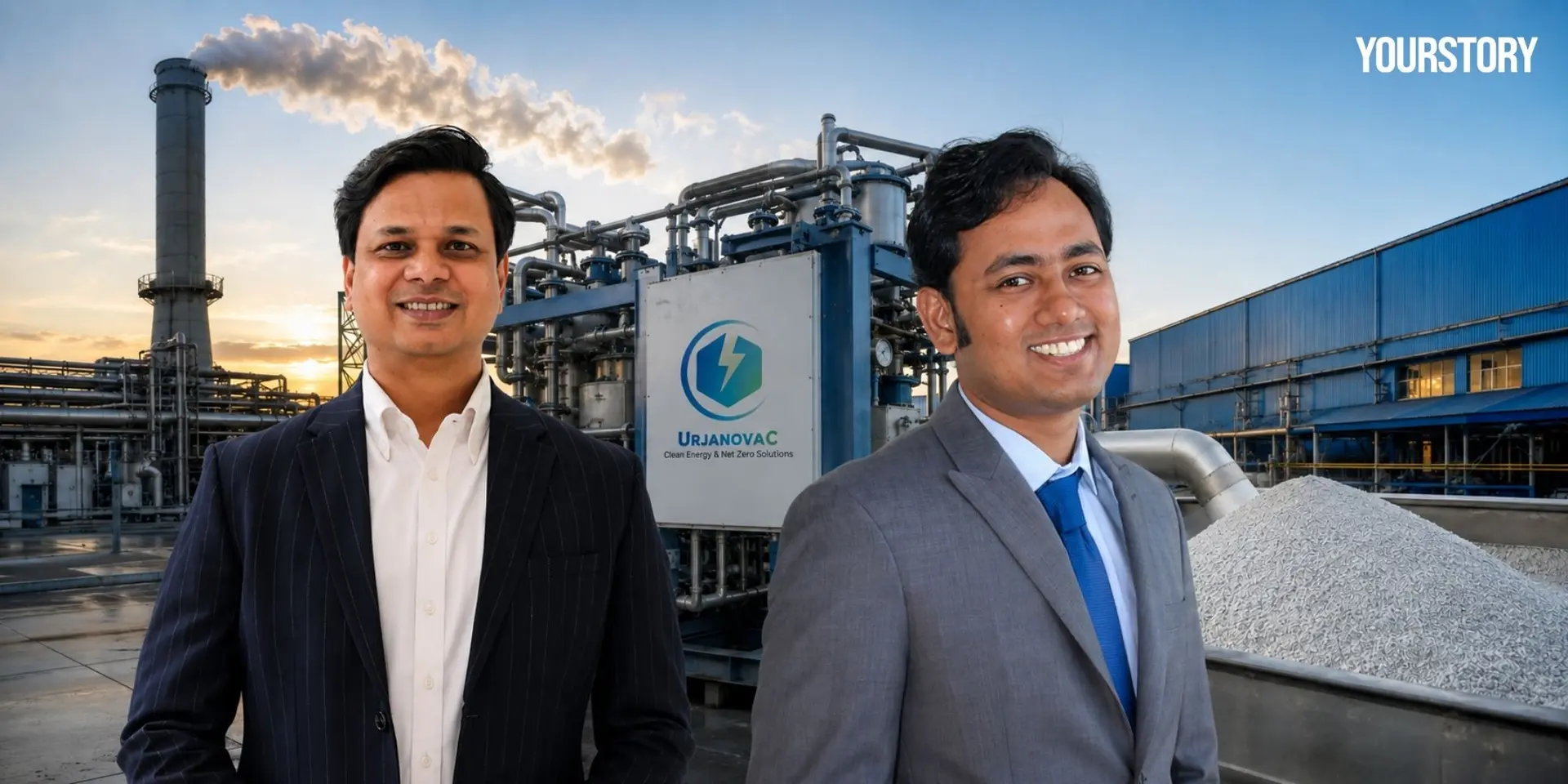
works on that route. Founded in January 2023 and nurtured at IIT Bombay, it was set up by Vikram Vishal and Arnab Dutta, both faculty members at the institute. The company describes its purpose as making carbon management economically viable rather than only technically possible.
The industries it is aiming at are the ones that have no simpler alternatives to opt for. A steel plant or a cement kiln releases carbon dioxide as a by-product of the chemistry itself, not just from the fuel it burns, which is why these are called hard-to-abate: switching to renewable power does not remove the emissions.
Water, waste and abundant elements
The capture chemistry is aqueous, meaning water-based. The company announced in March 2024 that its system can pull carbon dioxide from industrial flue gas and from ambient air, and that it can do so using industrial wastewater or even seawater rather than clean water.
That last point is what makes the economics work on the company's account. The process relies on earth-abundant elements and non-potable water, both of which are cheap, and the catalyst is recycled rather than consumed. The captured gas is then converted into high-value minerals.
The system is built to retrofit. UrjanovaC describes modular units that can be fitted to an existing plant rather than requiring one to be designed around them, which matters for the hard-to-abate industries it is aiming at: cement, steel and the other processes where emissions come from chemistry rather than from burning fuel.
The company says it owns its intellectual property outright and holds patents on the capture and mineralisation technology. Scale is the constraint on this. Mineralisation consumes large volumes of feedstock to lock up meaningful quantities of carbon, which is why access to cheap inputs and wastewater matters as much as the chemistry.

A national challenge, and a trip to Nice
In April 2025, the company was named a winner of the Avaana Capital, Startup India and NITI Aayog AIM Grand Challenge for Climate Tech Innovation, held at Startup Mahakumbh. It was one of three chosen from 557 applications across 22 states, judged by a panel of industry, policy and sustainability figures.
Its funding is modest against the scale of the problem. The company reports about $1 million raised, and describes growth of more than 60% in active projects between the 2023 and 2024 financial years, though it does not say how many projects that represents.
In June 2026, it was among the Indian companies taken to Nice, France, for Bharat Innovates, where it presented itself as ready for pilots and procurement partnerships and pointed to its carbon capture record as a basis for engaging regulators working on decarbonisation mandates.
What has not been announced is a commercial deployment. No industrial customer, contract or operating installation appears in any public source, and the step from a working technology to a plant paying for it is the one still ahead.
(This story has been researched and compiled using publicly available information.)