



Vikra Ocean Tech builds underwater robots for inspection, survey and defence work
The Chennai-based company makes remotely operated vehicles, autonomous surface vessels and crawling robots, along with the cameras and lighting that go on them.

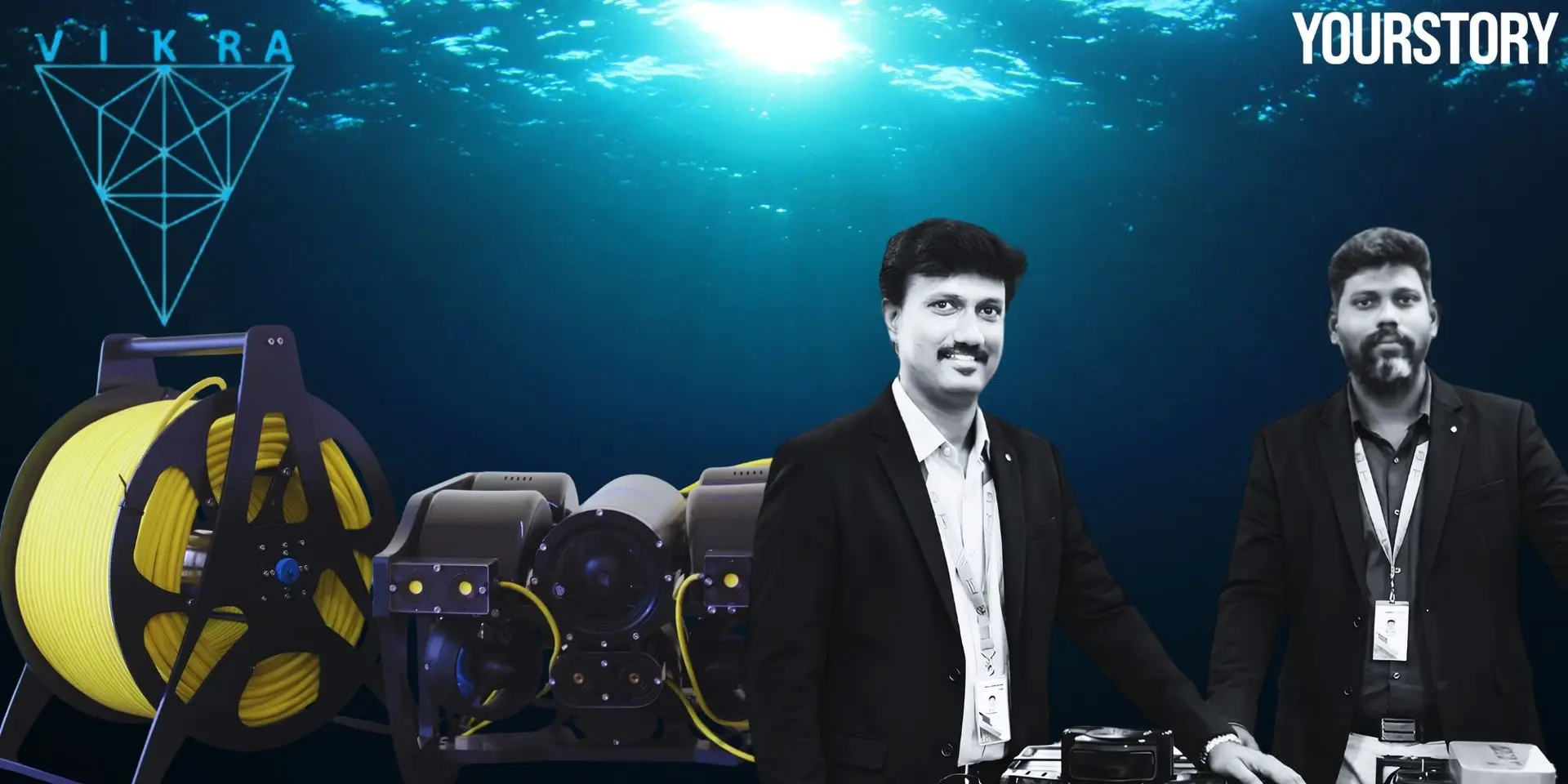

India has a long coastline, a great many dams and reservoirs, and a growing need to inspect what sits under the water in all of them. The machines that do that work, remotely operated vehicles and the cameras and lights they carry, have almost all been imported. That makes them expensive, slow to service, and designed for conditions that are not Indian
was founded in Chennai in 2019 by Rajeuv Govindan and Rajagurunathan Krishnasamy to build them indigenously instead. The company describes its aim as an indigenous ocean robotics stack, covering both what goes under the water and what floats on it, and says its systems are designed for Indian operating conditions.
The word stack matters to how the company positions itself. Rather than assembling imported parts, it says it builds the components too: cameras, lighting, diver communication systems and AI-based video enhancement, alongside the vehicles themselves.
Underwater and over it
The product range covers four things. Deep-water remotely operated vehicles (ROVs) do subsea inspection and intervention work. Autonomous surface vessels float over the water for survey missions. Amphibious crawling robots move across the seabed. Imaging and communication systems tie the rest together.
All of it runs through a single control platform, which is the company's argument for interoperability: an operator can run different machines from the same interface rather than learning four separate systems.
The hardware claim it repeats most is depth. Vikra says its deep-ocean camera and lighting systems are rated to 2,000 metres, which is well below where sunlight reaches and where pressure becomes the main engineering constraint. It says its autonomous surface vessels are being used in offshore marine exploration.
The applications it names run across defence, subsea infrastructure inspection, hydrographic survey and disaster response. Its own website adds dam, bridge and reservoir inspection, aquaculture and environmental research, which is the commercial side of the same technology.
India has a large number of ageing dams and bridges whose underwater structures need periodic inspection, work that is currently done by divers or by imported equipment. That is the civilian market a defence-capable machine can also address.

A million dollars, and two grants
The company raised $1 million, about Rs 8.8 crore, in a seed round announced in April 2026 and co-led by Finvolve and India Accelerator. The money is for scaling manufacturing, building a sales pipeline across defence and public sector undertakings, and setting up recurring revenue through service and maintenance contracts.
Before that, it had won two grants under the Ministry of Defence's Innovations for Defence Excellence programme, one from the Indian Army and one from the Indian Coast Guard. These are equity-free awards for developing a capability a service has asked for, and they are a signal that a customer has taken an interest, not that an order has followed.
Finvolve and India Accelerator have described subsea robotics as becoming a strategic priority for India across defence, infrastructure and disaster response, which is the case the round was made on. Both have backed several early hardware companies working on import substitution.
What is not public is the commercial record. No customer, contract value, delivered unit count or revenue figure appears anywhere, and the shift from grant-funded development to recurring service revenue is the thing this round is meant to fund rather than something already achieved.
(This story has been researched and compiled using publicly available information.)