



AgInvest 2026 in Coimbatore puts farm economics at the centre of AgriTech investment
AgInvest 2026 will bring founders, investors and research institutions to Coimbatore to back revenue-stage AgriTech startups focused on measurable economic value, field validation and scalable business models.

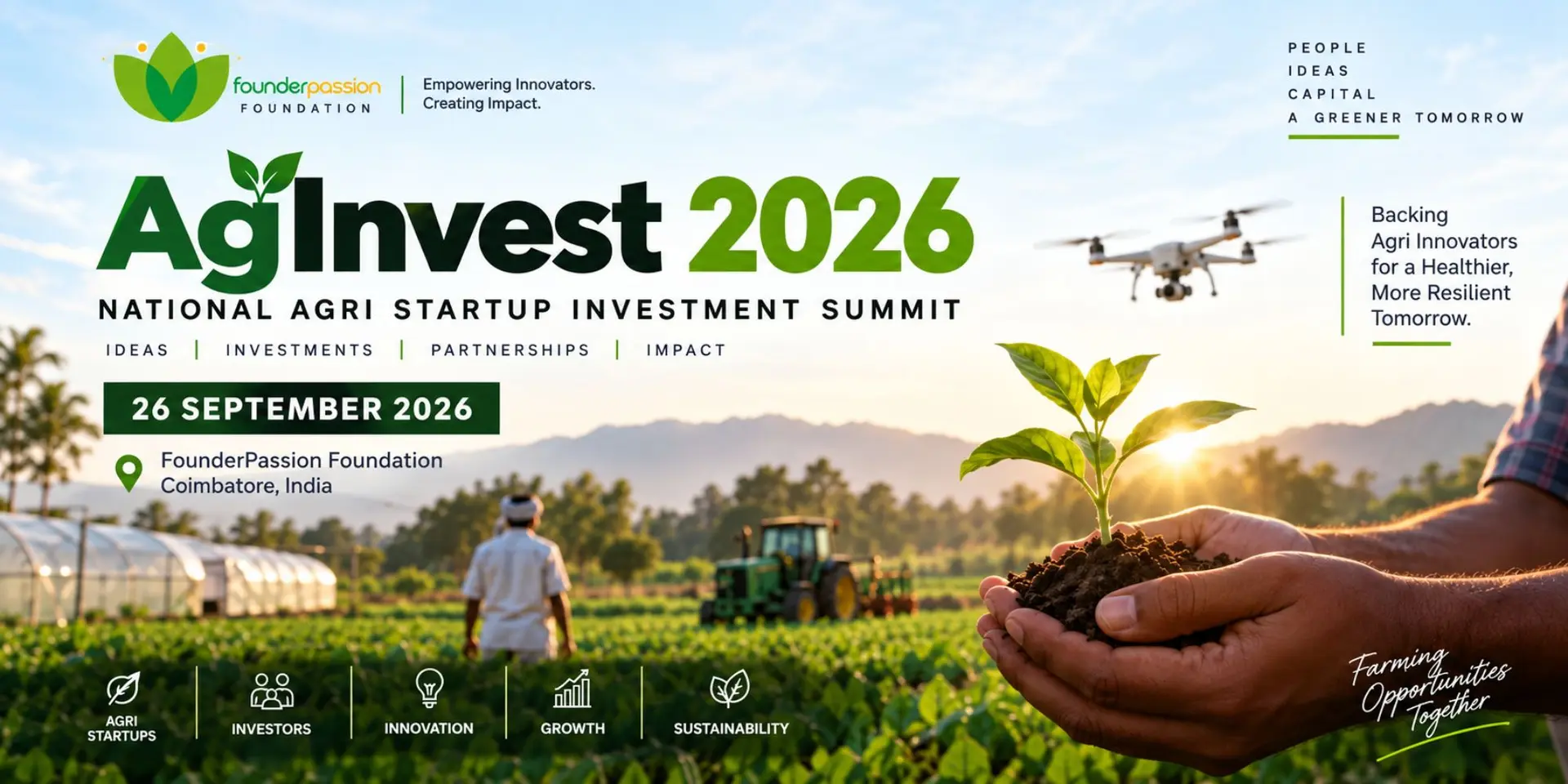

Coimbatore-based FounderPassion Foundation will host AgInvest 2026, an investment summit for revenue stage agriculture startups, on 26 September 2026. The event will bring AgriTech founders, investors, research institutions and agricultural bodies onto one platform at a time when AgriTech investment in India has become cautious and selective. Its message to founders is direct: build technology that solves agriculture's biggest economic problems, rather than adding to the long list of farm apps.
A sector working through a funding reset
FounderPassion Foundation is a not-for-profit Section 8 Startup Accelerator set up in 2018. It works with agriculture and sustainability startups, with a particular focus on ventures from Tier 2 and 3 cities that can influence the rural economy.
The summit arrives as Indian AgriTech works through a prolonged slowdown. According to Tracxn data, AgriTech companies in India raised $134 million in equity funding across 41 rounds up to July 2026, down from $198 million across 77 rounds in the same period of 2025. Annual funding in the sector had peaked at about $1.19 billion in 2021. Capital has not disappeared, but it has become far more selective about which models it backs.
What AgInvest 2026 will cover
The summit looks well beyond farm-management software. Focus areas identified by the organisers include food supply chains, preservation and storage, post-harvest technology, farm-to-market systems, precision and predictive agriculture, water technology, soil health, Agri-FinTech, agri-biotech, animal husbandry, sustainable feed, residue management and agro forestry. Technologies such as IoT, AI, drones, robotics and decision-support systems cut across these categories.
According to the organisers, invitations have gone out to investors including Indian Angel Network, IvyCap Ventures, Ankur Capital, TIH IITB, Chennai Angels, Mudhal Partners and some more VC’s. Institutional invitees include a-IDEA at ICAR-NAARM, Pusa Krishi at ICAR-IARI, the Technology Innovation Hub at IIT Bombay, Agrinnovate India and NABI.
Why AgriTech investment is moving from scale to value
The organisers frame the event around a clear change in investor priorities. Instead of rewarding the number of farmers reached, investors are now asking who the paying customer is, what measurable problem is being solved, how often that problem occurs, what return the buyer gets from adopting the technology, and whether the business can turn profitable without repeated rounds of external capital. Recent industry commentary points the same way, with investors describing the slowdown as a structural reset linked to a global shift towards profitability, rather than a retreat from the sector.
For founders, the organisers argue that the market is wider than farmers alone. Some of the most scalable businesses may sell to banks, insurers, farmer producer organisations (FPOs), processors, exporters and equipment operators, opening up B2B and B2B2F models. Extraction for the pharma, nutrition and wellness industries is flagged as another high-potential segment.
More than a one-day event
Led by Founder and Managing Director Vijayakumar NRR, FounderPassion Foundation is positioning AgInvest 2026 as the start of a longer engagement between startups, investors and institutions rather than a standalone pitch day. The organisers plan to work with incubators and accelerators to support startups from problem identification and prototyping through field validation, commercial pilots and investment.
This matters because AgriTech startups need more than capital and conventional mentoring. They need access to real farms, FPOs, laboratories, research institutions, machinery and early customers, and building those links takes time.
How does a field-to-market pathway help AgriTech startups raise capital
Unlike an app, an agricultural product has to prove itself across seasons, crops and regions before a buyer commits. A field-to-market pathway moves a startup through defined stages: research, prototype, field trial, farmer validation, commercial pilot and scale, with investment following the evidence gathered at each step.
For investors, this means startups arrive with field data rather than projections. The organisers suggest tracking outcomes such as farmer income, productivity per hectare, input savings, water efficiency, reduction in post-harvest losses, customer retention and capital efficiency. These metrics link a startup's performance directly to economic value on the ground.
What to watch after 26 September
The organisers see AgriTech less as a narrow sector and more as a meeting point for AI, climate technology, FinTech, deeptech and manufacturing. Dedicated capital remains thin, though. A recent industry report noted that of more than 210 venture, private equity and government-backed funds launched in India since 2024, only 23 specifically target AgriTech. If AgInvest 2026 can move a cohort of startups from field trials to paid pilots with investors tracking the data, it could offer a working template for how regional incubators channel capital into agriculture's harder, infrastructure-heavy problems. The real measure will be how many conversations in Coimbatore turn into pilots and term sheets in the months that follow.