



From AI pilots to production: Rebuilding the enterprise stack for intelligent agents
At DevSparks Hyderabad 2026, leaders from MetLife and Tiger Analytics explored what it will take to move enterprise AI from experimentation to production, from AI-ready data and semantic layers to governance, human judgment, and measurable business outcomes.


For the past few years, enterprise AI conversations have often revolved around one question: which model are you using? But as AI moves into production, the model is becoming one of the variables of a much larger equation.
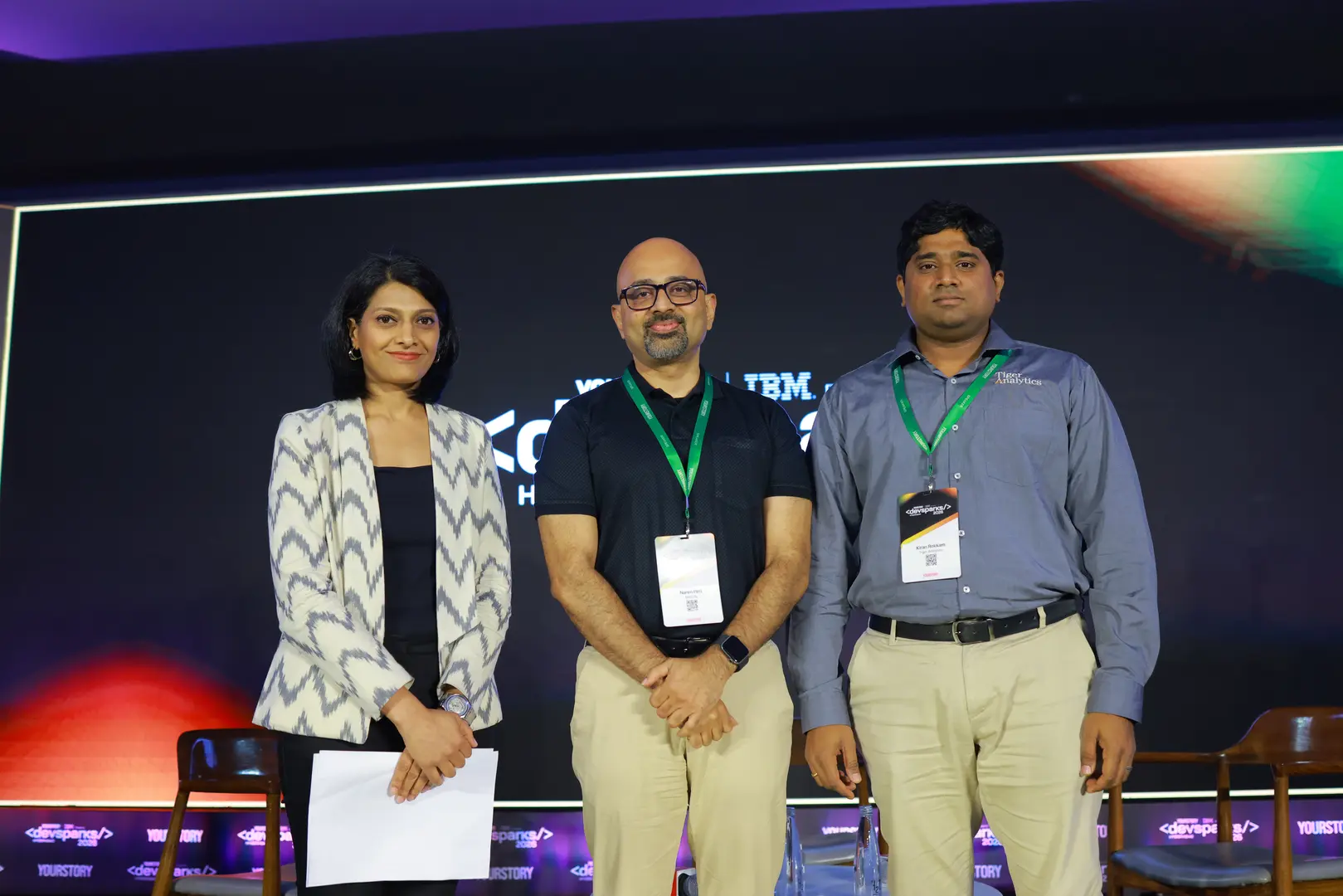
That was the central theme of a panel at DevSparks Hyderabad 2026, titled ‘The new enterprise stack: Data, agents, decision intelligence’, featuring Kiran Rokkam, Partner AI/ML at Tiger Analytics, and Naren Peri, Vice President, Data & Analytics and Site Leader at MetLife. The discussion was moderated by Shivani Muthanna, Senior Director, Content Partnerships, YourStory.
According to Rokkam, enterprises have moved from exploring AI to creating dedicated transformation functions around it. "About last year, eight out of 10 of our organizations, the companies that we work for, had a transformation practice," he said, adding that AI is now increasingly being tied to business operations rather than remaining an area of experimentation.
Peri pointed to another change: AI is no longer restricted to specialist teams. "The shift that we are seeing over the last couple of years with these frontier models is now everybody can benefit from that technology," he said. "Everyone can use it and benefit from it, but one must also be aware of the risks. Enterprises are realizing that model acquisition is one step, but the real work lies in learning to operationalize AI, integrate it into workflows and core business processes, and realize the anticipated business impact."
Data is becoming the enterprise AI bottleneck
As organizations move from copilots to agents, data quality and context become increasingly important. Peri said AI-ready data requires more than simply cleaning databases. Enterprises need to make their context understandable to machines through ontologies, knowledge graphs, and semantic layers.
“If I talk about an insurance company, one first needs to start with an ontology,” he explained, describing it as the grammar of an enterprise. “Knowledge graphs connect entities and relationships across domains, and the semantic layer acts as an interpreter and translator, translating business language into physical implementation and making enterprise context machine-readable.”
Rokkam added that the challenge grows because much of an enterprise's knowledge does not sit inside structured databases, but across emails, presentations, SharePoint, Google Drive, and team conversations.
"Rest of all the data is contextualized in emails, PPTs, SharePoint, Google Drives, and whatnot," he said. For AI systems that need to execute actions rather than simply retrieve information, understanding business processes and the knowledge held by employees becomes critical.
Legacy infrastructure adds another hurdle, with employee, customer, or operational data distributed across multiple systems, using different identifiers and definitions.
Rokkam's recommendation: focus on context before attempting sweeping transformation. "The first important thing everyone needs to do in this setup is to create enough context layer knowledge graphs in each of these systems," he said.
The future is not AI versus humans
The panel pushed back against the idea that enterprise AI is about replacing human work. For Peri, the immediate opportunity is combining machine scale with human judgment, particularly in industries such as insurance, where decisions affect significant moments in people's lives.
"The tech, the differentiator, brings the scale and the speed. The human judgment brings the empathy, the care, the moral judgment," he said. "The future is not high tech or high touch. We need both."
The value of AI also needs measuring beyond the number of models deployed or tools adopted. Rokkam said productivity remains a key metric, but enterprises are increasingly asking how AI translates into actual business value.
"By and large, now everyone is looking at some variation of productivity as the metric," he said, while noting that translating AI into direct business value remains less mature across many organizations.
As enterprises move toward more autonomous systems, governance will become just as important as capability. Rokkam expects organizations to become leaner as AI and automation take on more non-core processes, while Peri emphasized that oversight will remain essential to ensure AI agents operate within clearly defined guardrails and governance frameworks. “It’s akin to a ‘braking system’ because if the ‘braking system’ is in place, we are confident to move with speed and discipline.”
The emerging enterprise AI stack is not simply a collection of models and agents. It is an interconnected system of data, context, infrastructure, orchestration, governance, and human judgment. Getting those foundations right, the panel made clear, may determine whether the next wave of enterprise AI creates real business value or remains another round of promising pilots.