



Amazon Now reaches $1B annualised sales as quick commerce moves beyond metros
Amazon Now has crossed $1 billion in annualised gross sales in India, rapidly expanding its minutes-based delivery network beyond metros amid intensifying quick-commerce competition.

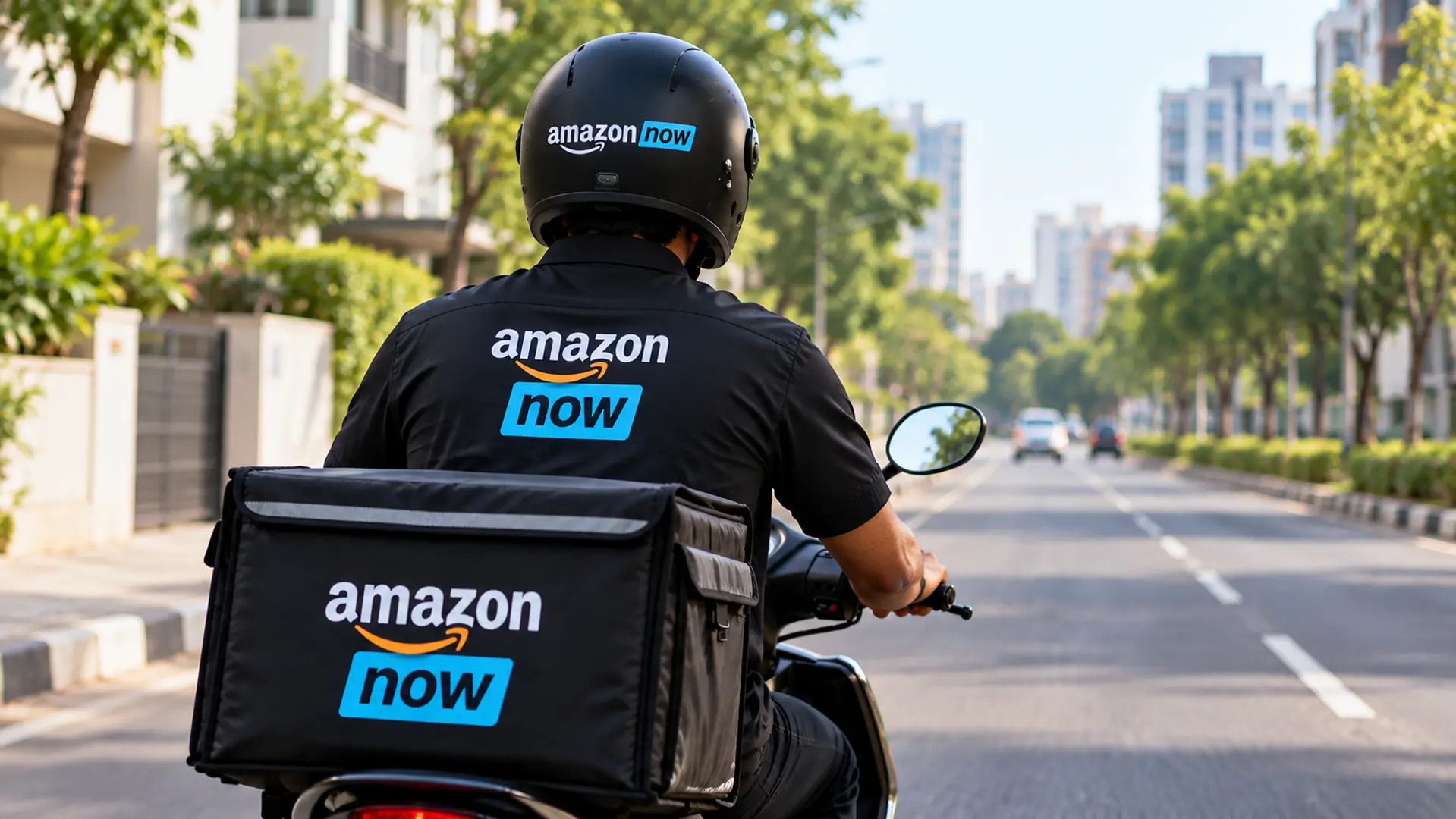

Amazon’s quick-commerce service, Amazon Now, has reached $1 billion in annualised gross sales in India over the past three-month period.
Amazon said orders on Now have doubled every quarter since launch, making it the fastest-growing ecommerce business unit in its India operations. The service has also expanded to more than 60 cities in less than 10 weeks, including smaller markets such as Tirupati, Guntur, Gurdaspur, Vellore and Warangal. The company is targeting 100 cities by Diwali.
The speed of the expansion marks a sharp change from Amazon Now’s initial footprint. Amazon began testing the service in Bengaluru in late 2024 and formally launched it in selected Bengaluru pin codes in June 2025, entering a quick-commerce market already led by Blinkit, Zepto and Swiggy Instamart.
Samir Kumar, Country Manager at Amazon India, attributed the acceleration to customer adoption. “In a short period of time, Amazon Now has crossed $1 billion in annualized gross sales in India, making it the fastest-growing e-commerce business unit in Amazon India’s history. We are humbled by the customer response, with orders doubling every quarter.”
The infrastructure behind that growth is becoming increasingly substantial. Amazon said, Now currently operates through more than 750 micro-fulfilment and urban fulfilment centres. These are local facilities that keep products close to customers so orders can be picked and dispatched rapidly. In June, Amazon said it planned more than 100 larger urban fulfilment centres, designed to broaden the assortment beyond everyday groceries into categories such as apparel, electronics, jewellery and furniture.
That strategy highlights a broader shift in Indian retail. RedSeer estimates that quick commerce reached about Rs 1.1 lakh crore in GMV in 2025, and projects roughly Rs 2 lakh crore in 2026. GMV, or gross merchandise value, refers broadly to the value of goods sold through the platform before certain discounts, fees and other adjustments. The consultancy noted quick commerce accounted for about 17% of India’s online retail in FY26 and is increasingly extending beyond groceries.
Competitors are pursuing similar expansion as Swiggy Instamart reached 100 cities in 2025, adding 32 cities in a year as demand spread into tier II and III markets. The competitive question is therefore shifting from who can deliver fastest to who can build enough local density, selection and operational efficiency to make that speed economically sustainable.
Meanwhile, regulation is also becoming more relevant as the sector scales. Recent amendments to India’s e-commerce rules have placed greater emphasis on price transparency, sponsored listings and deceptive interface practices, while recent food-safety inspections of quick-commerce storage facilities in Bengaluru underline the operational scrutiny that comes with handling large volumes of consumer goods.