



Building intelligent enterprises: why developers must bridge code and business reality
At DevSparks Hyderabad, Subish Ram traced a decade-long shift from RPA to agentic AI and made the case that in addition to building technology, the ability to understand business will define developers going forward.

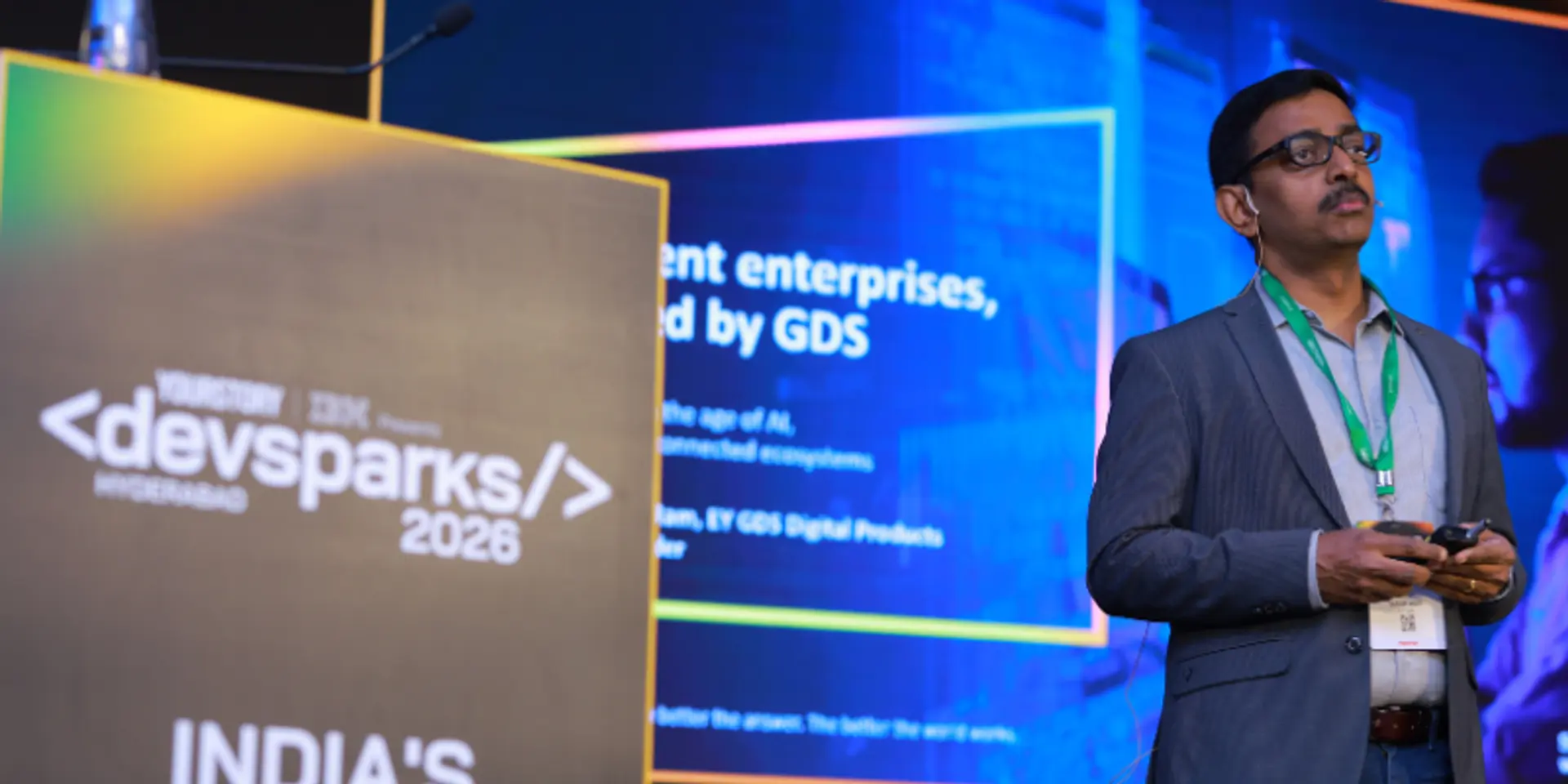

For years, software engineering in large enterprises followed a well-defined boundary: business teams outlined requirements, and centralized IT units built the software. Today, the rapid rise of generative AI (Gen AI), low-code tools and agentic workflows is upending that model.
Speaking at DevSparks Hyderabad, Subish Ram, Digital Products and Services leader, EY GDS highlighted that the enterprise delivery engine is undergoing a fundamental structural reset. Drawing from a decade of automation across the global EY organization, which supports a 400,000+ strong workforce across its member firms, Ram emphasized that engineering teams can no longer operate in technical silos.
“The standalone IT team that just does software development is no longer that prominent,” Ram observed. “More of that is shifting into the business side of the house. We need people who understand the business, who can talk the language of the business and bring technology into that.”
The shift from central IT to business prototyping
The enterprise automation journey began nearly a decade ago with robotic process automation (RPA) tackling repetitive back-office tasks. Over time, rule-based RPA evolved into intelligent workflows and it has now advanced into full-fledged agentic AI systems that orchestrate end-to-end business functions like finance, procurement and HR.
With tools like Replit, Cursor and enterprise-approved copilots widely accessible, nontechnical teams are taking development into their own hands. Tax consultants, HR leaders and finance analysts are increasingly building the first cut of internal tools themselves.
“The first cut of development today is happening at the business end,” Ram noted. “What comes to the technology team is: Can you help us scale this? Can you deploy this? Can you do security testing?” This transition changes the developer's core mandate. In the near future, business units will handle basic prototyping, testing, and AI-assisted bug resolution. The engineering community, in turn, will be responsible for system architecture, integration, governance and enterprise-grade scalability.
Solving the enterprise ROI and cost equation
While experimentation is surging, Ram offered a candid perspective on enterprise AI adoption: calculating clear return on investment (ROI) remains a major hurdle.
Unlike traditional RPA, where replacing manual hours generated clear, immediate cost savings, AI deployments entail substantial recurring token consumption, infrastructure, and maintenance costs.
“ROI is aspirational right now,” Ram explained. “If you automate a complete reporting process using AI, and it costs hundreds of thousands of dollars each year just to keep running, there is often no immediate ROI. We have seen business cases where token costs rivaled human costs.”
Ram stressed that end customers ultimately care about productivity, efficiency and the bottom line, rather than whether a solution uses Python, traditional dashboards or autonomous agents. To create sustainable value, developers must focus on building reusable accelerators, improving token economics and reducing AI consumption costs.
Domain context is the new technical moat
To remain indispensable in an AI-native world, engineers do not need to become domain consultants, but they must understand the mechanics of the domain.
“You don’t need to become a chartered accountant to build a solution for finance, but you need to understand the language they use and what business outcome they expect,” Ram concluded. As AI tools democratize code generation, a key competitive advantage for developers will be understanding the business problems they are solving.