



Every few years Ram Sukumar remakes Indium. AI is his best chance yet
Born into a Chennai business family, Ram Sukumar lost the cushion in 2001 and bootstrapped his way past $100 million in revenue. Now he’s betting AI will help Indium more than it hurts.

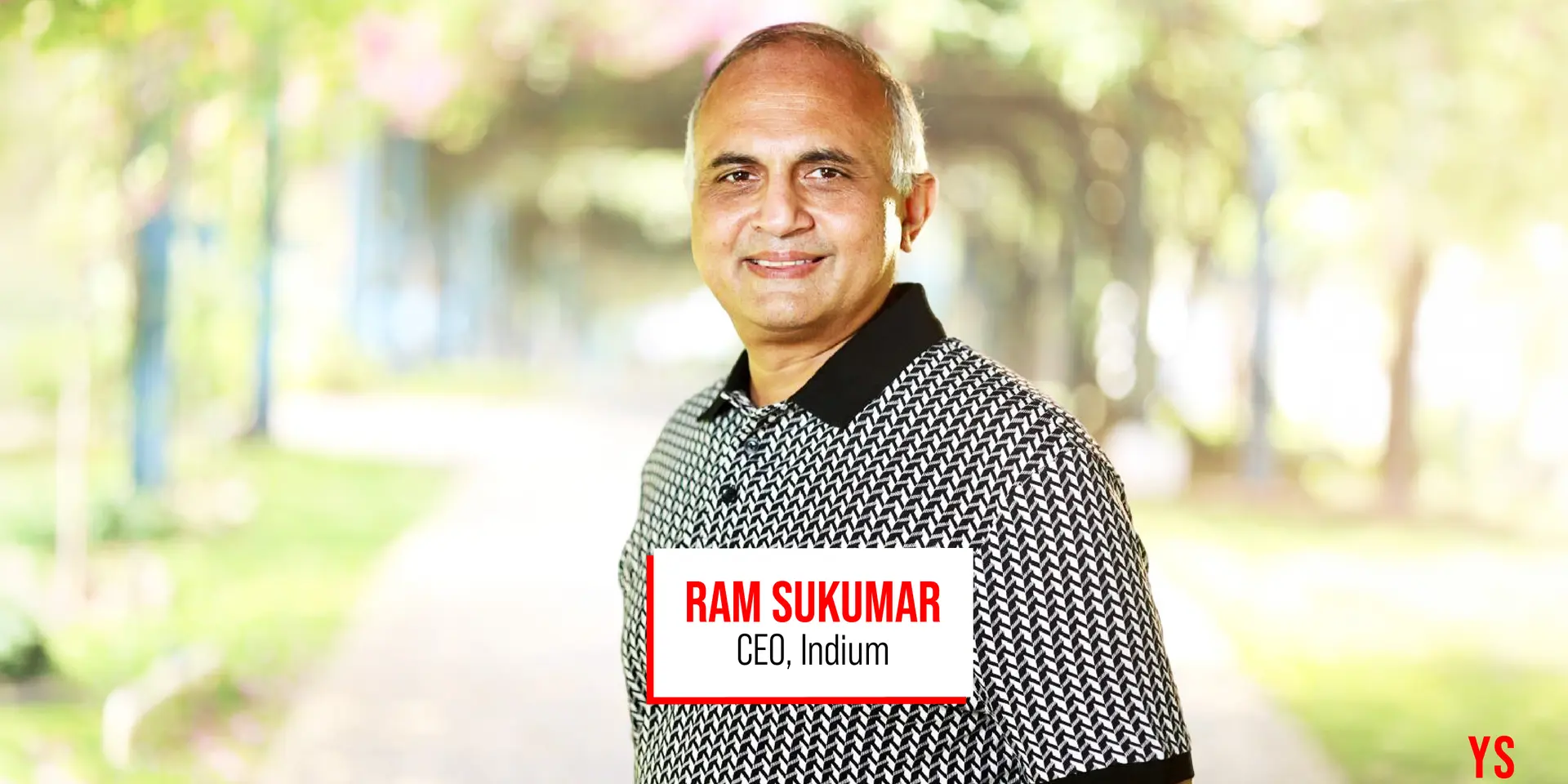

On a Friday morning, down the road from the house Kamal Haasan grew up in, Ram Sukumar is talking about tennis.
He’d played the evening before and overdone it a bit, so he went for a swim in the morning, and by the time I get there, the stiffness has gone altogether. My drive worries him more. I’ve come in from ECR, the road that connects Chennai to Bohemian Pondy, which is a long haul right across the city. He apologises for it twice, has coffee sent for, and says we could’ve met halfway at the Guindy office instead. It’s a bit late for that now.
We are in the conference room of the company’s head office on Eldams Road. Sukumar, in a linen shirt and jeans, smiles easily and brings up a few of my recent stories before he gets anywhere near his own.
The office has a history. “It’s been our lucky office from 2015,” he says. Indium has kept it as headquarters ever since, though most of the work happens in Guindy, Hyderabad, Bengaluru, Thiruvananthapuram, and Kochi.
Silver spoon, then valleys
Sukumar puts his privilege on the table early.
“I was born with a silver spoon,” he says. “Mine is not a rags to riches story, but it is a little different. It has its valleys in the story.”
Everyone in the family was in business, his father, uncles, grandfather, and his mother’s side too, trading and running the kind of firms that did well in the Chennai of the 70s and 80s. He grew up comfortable, went to Padma Seshadri in Nungambakkam and then left for BITS Pilani in Rajasthan to study mechanical engineering.
Pilani changed him more than anything before it. He’d never had to fend for himself, and hostel life far from home forced him to. He still keeps in close touch with that crowd, which would matter a lot later.
Next came a master’s in industrial engineering and operations research at the University of Massachusetts Amherst. Operations research is an older field about using data to make better decisions, and as he sees it, it is “the foundation of machine learning, which today is AI”. Software wasn’t on his mind until a roommate from IIT Madras, who would later build a unicorn of his own, steered him to a teaching assistantship in the computer science department. It waived his fees and had him teaching programming.
“That’s when I realised I love this. I love programming, I love code and I love technology,” he says.
A developer’s job in Boston followed, in C and Unix and then early Visual Basic. He was on an H-1B, and a green card would probably have come in a couple of years, but it didn’t appeal to him much. The family itch was there.
So he came back. He and his cousin Vijay Balaji registered Indium in 1999 and got going properly in 2000.
Then came 2001. The attacks of 9/11 froze spending across the American tech market just as Indium was trying to find its feet, and in the same year he and his father took serious financial blows at home. The family money he might have leaned on was suddenly gone.
“So despite my wealthy roots, at the time I started Indium, we were a startup with no investments that I could make,” he says.
For meetings in Mumbai he took the train, to save on flights.
At first Indium did bits and pieces of ERP (enterprise resource planning) work, like everyone else. Then an advisor, Mani Subramaniam, formerly of IBM, told the cousins to pick one thing and master it. He pointed them at software testing, which most of the industry was ignoring, and with no money to spread around they took his advice.
Bad news, good news
By 2004 India alone wasn’t enough, so they set up a company in the US and won customers there one at a time, mostly through friends, family, and the Pilani alumni network. In 2007 they raised money from a small fund run by Ajit Isaac and Sarath Reddy, two businessmen with successful companies of their own. The cheque came in around October.
By January 2008 the whole industry was in collapse.
Sukumar and Vijay went to their new investors straight away and laid out every problem. One of the good things about the two of them, he says, is that “we have always taken the bad news on the elevator and the good news on the stairs”. The idea is that bad news should reach the people at the top fast, while good news can take its time.
“I think none of us panicked. I think we said, okay, this will blow over,” he says. They were right. Business picked up in 2009, and 2008 remains the only year since 2003 that Indium didn’t make a profit.
The investors also brought a proper board. Until then the cousins had run Indium on a founder-led style, and he gives the board a lot of credit for the discipline it added.
A bet on his own
By 2012 he could see how far testing alone would take them. Pure-play testing firms of that time, RelQ and AppLabs among them, all ended up being bought by bigger players, because a company that only tests software can only grow so big.
His old interest in operations research came back. Everyone was talking about big data then, Cloudera, Hortonworks, Hadoop, and he wanted Indium to be in data and machine learning. The board saw it differently, and it had its reasons. The testing business was profitable and paying its shareholders good dividends, and no one could yet say how big the data market would get, or whether a small Chennai firm could win a place in it.
Their answer still left the door open. If he wanted to do it, he could do it on his own.
He did, in 2013, with a separate company called Noah Data. “It was just my passion. I want to do something in data,” he says. A few people did everything and cash was tight, which reminded him of Indium’s early days, and he has a name for it. “This was bootstrap 2.0 in my life.”
Big data never became as big as everyone thought. But Noah Data’s work was solid enough to bring in Uber and Lam Research, customers a small testing firm would have struggled to reach.
By 2017 each company was losing business because it couldn’t offer what the other did, so in 2018 they merged. The investors were in their 10th year, when most investors want out, and Sukumar walked in with another 5-year plan. They backed him anyway.
“The funny thing is we overshot that five year plan in two and a half years itself,” he says.
Before the merger Indium had been growing at about 25% a year. After it, the rate was close to 50% a year on average, apart from a gentler Covid year, and around 2021 the headcount almost doubled, from 1,000 to 2,000.
The company he keeps
“My philosophy of entrepreneurship has always been to surround myself with the right experts, learn from them and keep reinventing,” he says.
He means it. In 2021, with Indium at about $20 million in revenue and Sukumar eyeing $100 million, he brought in Catalincs, an advisory group set up by former Cognizant executives Ramkumar Ramamoorthy and Rajesh Balaji. The board asked why, since things were going well. He felt the next stage needed different thinking.
The advisors spotted a blind spot common to people who start companies young. Sukumar never spent 20 years inside a big IT firm, so winning new customers came naturally to him but growing existing accounts, which he calls farming, got far less attention. That changed from 2021.
Between 2021 and 2023 Indium almost tripled, from about $20 million to $60 million. The leadership team changed too, as it had in the 5 years before. His rough rule is that about half the people make it to the next phase.
“Because otherwise it will become like trying to run with an iron ball on your hand where things will slow you down,” he says. He’s just as keen to talk about old-school testers who reinvented themselves and whom the company now holds up as examples.
By then the 2007 investors had been along for 15 years and wanted to get off the bus. Baring Private Equity Asia, now EQT, invested in January 2024, and Sukumar talks warmly about the fit. EQT strengthened the board, helped hire senior executives, and taught a company that had never bought anything in 25 years how to do deals. He admits he had zero experience of it.
Experion, with about 400 people in Kerala, followed in November 2024. Growth has held up since, at 23% in the first year with EQT and 27% last year, and he expects about 20% this year. Once a firm crosses $100 million, keeping that pace is hard, and he knows it.
Debt was the hard part for him personally. Indium had never borrowed, and his troubles of 2001 had come from debt on the family side. With EQT he learnt how dollar debt is structured and how its risk is tracked, and he says it no longer frightens him. Indium still keeps about 20% of its revenue as operating profit.
He isn’t buying for the sake of it, and all of last year went by without a deal because nothing fit. Data and analytics make up about 25% of the business and he wants that closer to a third.
Why AI is different
Indium has come through 2001, 2008 and Covid. When I ask how AI compares, he’s clear that it’s a harder kind of problem.
In the earlier crises every company did roughly the same things. They cut costs, sent staff home, and got through the year. “Managing that crisis, I wouldn’t say was easier, but the decision making was simple,” he says.
AI gives a company a choice, and that’s what makes it tricky. A firm can carry on as it is and look fine for a while. “This challenge is very different because you have an option to do something or not,” he says. For him, the answer is to move early. “It’s important that we just don’t sit on the fence waiting for things to happen.”
Indium’s main bet is a platform called LIFTR, which the company started building in March 2024, long before most of its clients were talking about AI. Someone on the team asked to build it, and Sukumar gave them a team and a year with no questions asked.
“The LIFTR wasn’t my idea, I only had the audacity to approve it,” he says.
LIFTR comes in modules. One reads old software, say a 20-year-old COBOL system few people still understand, and works out how to modernise it. Others handle testing and data, and one for application maintenance is due soon.
Even the gaming arm has one. Indium has been in games for more than a decade through a division called iXie, which makes up about 8% of the business and does art, development and testing for studios such as Zynga and Krafton. The work is mostly casual mobile and web games, with nothing for casinos or real-money play. In early September iXie launched its own version of the platform.
Testing is now about 20% of Indium’s business, and you’d think AI would eat into it. Some of that is happening.
“The surprising thing is the disruption is actually working out to be a very positive disruption for us,” he says. Indium now offers clients the same testing work with 25% fewer people. That has got it into a large American bank.
He splits the work in two. AI in engineering is Indium using AI to build and test software faster, and that’s where LIFTR sits. AI for business is clients using AI in their own work, say in insurance claims or wealth management, where Indium has a product called AI Alpha. He admits that the second side is still early.
Inside the company the change is compulsory. Everyone is being assessed on AI skills according to their role, so a salesperson gets a different test from an AI engineer. There’s a bar to clear. “You need to meet certain minimum thresholds for you to even have a future role at Indium,” he says. He’s taking the test himself.
“I keep telling my team we should benchmark against a tech services company that is being born today,” he says. A firm started this week would think AI first about everything, and he wants Indium to think like that.
He has seen hype come and go, mind you. Around 2018 the headlines said software robots would kill the BPO industry. “Nothing really happened. BPO is still there,” he says. AI is a far bigger shift, he thinks, and he expects a shake-out before things settle and growth returns.
Size, he believes, helps. “We are neither too small, we are neither that large where we will be very monolithic in the way we go about things,” he says.
Tennis, books, and Thanjavur
The first 3 or 4 years were full of doubt, when he couldn’t take a salary and everything went back into the business. What kept him going were people who turned up at the right moment, a new customer or a well-wisher saying they were on to something big. He thinks of them as angels, and adds that “they don’t know that they’re an angel”.
He married in 2003, right in the thick of it. “It’s not for the faint hearted in those years,” he says, and he credits his wife’s support, and having Vijay as a co-founder to share the load with.
He calls himself very religious and draws strength from it. He is also, in his words, “an eternal optimist”, and so is his wife.
Tennis matters just as much. He played for school and college and never stopped. These days it’s veterans league matches. He says it has become meditative, and has helped him take wins and losses in business more calmly.
He reads more now that the team can run things without him, mostly biographies and self-help, and was halfway through Morgan Housel’s “The Art of Spending Money” when we met. He makes notes on anything useful and tries it out at work.
“I have this vision to be a billion dollar valuation in three years,” he says, and staff see that goal on the wall on their way in. He doesn’t want it to be the measure of his life, though. “I’m not necessarily looking at my success only in terms of where Indium’s valuation is and my net worth. I’d like to be more holistic.”
He and his wife have started a foundation. It’s early days, and she’s doing more of the work than he is right now, but the plan is to support education in the Thanjavur delta and to help autistic and differently abled young people in Chennai find jobs and careers.
“These will be the legacy that we’ll leave here,” he says.