



"Fundraising is tortuous": Nat Malupillai on how IIT Madras’ new fund gives founders room to breathe
IIT Madras Research Park and Unicorn India Ventures have launched the Rs 1,000-crore Frontier Fund I to provide patient capital to early-stage deep-tech startups. Group CEO Nat Malupillai explains how the fund eliminates fundraising distractions.


IIT Madras Research Park has teamed up with Unicorn India Ventures to launch the IITM Unicorn Frontier Fund I—a Rs 1,000-crore venture capital vehicle built to give early-stage deep-tech founders room to breathe. Backed by global IIT Madras alumni, financial institutions, and family offices, the fund has already hit its first close of Rs 450 crore and committed nearly Rs 55 crore across its first wave of startups, including Hathor, Quanstra, Triolt Energy, and Carbelim.
Hathor develops semi-cryogenic and cryogenic rocket engines; Quantum Technology specialises in single-photon detection; Triolt Energy advances battery and energy storage solutions; and Carbelim leads efforts in carbon capture.
The fund targets IP-heavy, early-stage (TRL 3–4) startups working across semiconductors, spacetech, EVs, battery materials, quantum tech, robotics, AI, biotech, and healthtech—sectors critical to building India’s technological sovereignty.
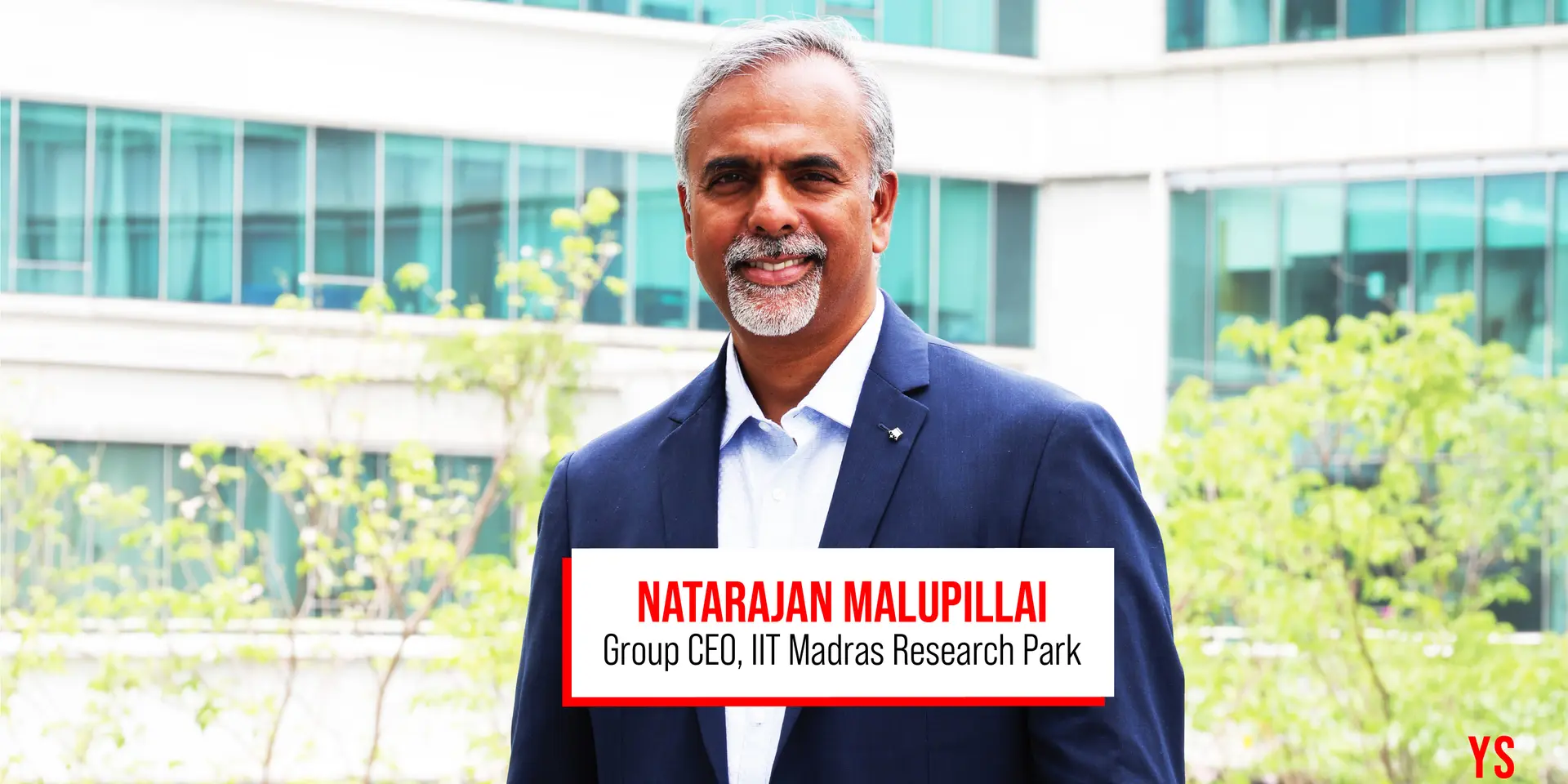
In an exclusive interview with YourStory, Natarajan (Nat) Malupillai, Group CEO of IIT Madras Research Park, breaks down why fundraising distraction is killing promising deep-tech ventures, how patient capital changes the game, and why India’s education system needs a complete reset.
Drowning in pitch decks instead of prototypes
For deep-tech founders, the hardest battle usually isn’t cracking a tough engineering problem—it’s the endless, exhausting search for money.
“Smart tech entrepreneurs were having to step away from their main work just to hunt for funds,” Malupillai explains. “Fundraising is still a tortuous, slow process. Founders lose precious months chasing term sheets that end up falling through, when their real strength lies in perfecting deep technical products.”
While the IIT Madras ecosystem had already built a strong pipeline from student innovation cells to its Research Park, a clear financial gap remained. Grants of Rs 20–50 lakh barely scratch the surface when you’re dealing with the heavy equipment and R&D costs of semiconductors, space tech, or battery chemistry. This new fund was created to give founders the runway they need to focus entirely on building and scaling.
Credibility meets professional execution
Initially planned as a Rs 600-crore fund, overwhelming investor interest quickly pushed the target to its Rs 1,000-crore ceiling.
“Thousand crores lets us deploy real, meaningful capital without throwing around money irresponsibly beyond what a startup actually needs,” says Malupillai. “It’s an amount the ecosystem can absorb and grow healthily, setting a benchmark for future funds and founders.”
While the IIT Madras brand gave the fund immediate weight and credibility in the market, Malupillai made a conscious choice not to run the venture operations internally. After looking at more than 30 fund management teams, they partnered with Unicorn India Ventures.
“We bring technical depth and incubation know-how, but managing a VC portfolio is a distinct skill set best left to seasoned professionals,” he notes. “Deep tech requires patience and relationship-building—it’s not about quick flips or fast exits.”
Capital with a national purpose
The fund stays focused on early-stage, high-impact ventures—both within the IIT Madras ecosystem and select outside startups building technology critical to India’s self-reliance. That includes fabless semiconductor design, rocket propulsion, EV battery chemistry, advanced materials, biotech, AI infrastructure, and robotics.
When asked if the fund would back mature scale-ups like fellow IIT Madras success story Ather Energy, Malupillai keeps the mission simple: “Ather has plenty of growth investors lined up. We want to step in where brilliant ideas have cleared the initial science risks, but founders are struggling to find that first catalytic check to scale.”
Beyond rote learning
For Malupillai, building a strong deep-tech pipeline isn’t just about write-ins from VC funds—it requires fixing how India teaches its students.
“Engineering colleges simply aren’t churning out the right kind of talent,” Malupillai says frankly. “Rote learning and gaming entrance exams don’t prepare people for what the country needs. We need genuine, hands-on learning where students get their hands dirty and figure out how things actually work.”
He believes practical curiosity—the kind that makes you want to understand how a basic electrical appliance or motor functions—is the real foundation of an innovation culture. “We have to encourage critical thinking and teach people how to turn theory into something useful for society.”
The IPL playbook for deep tech
When asked what advice he has for young founders stepping into the space, Malupillai draws an unexpected parallel to Indian sports.
“We used to be a country that only played Test cricket. Look at how the IPL transformed everything—it brought in top-tier global learning while pulling incredible raw talent right out of the hinterlands,” he says.
“The same thing is happening for startups. It doesn’t matter where you are in India today. If you have the hustle, the critical thinking, and the execution drive, the support system, funding, and policy push are all there. Having the brilliance to spot a problem—and the grit to stick with it—is half of what makes a successful entrepreneur.”