



AI will be the great equaliser only if India gets four things right: Gates Foundation CEO Mark Suzman
In conversation with Shradha Sharma, the Gates Foundation CEO lays out what the next 18 to 24 months will decide for 1.4 billion people

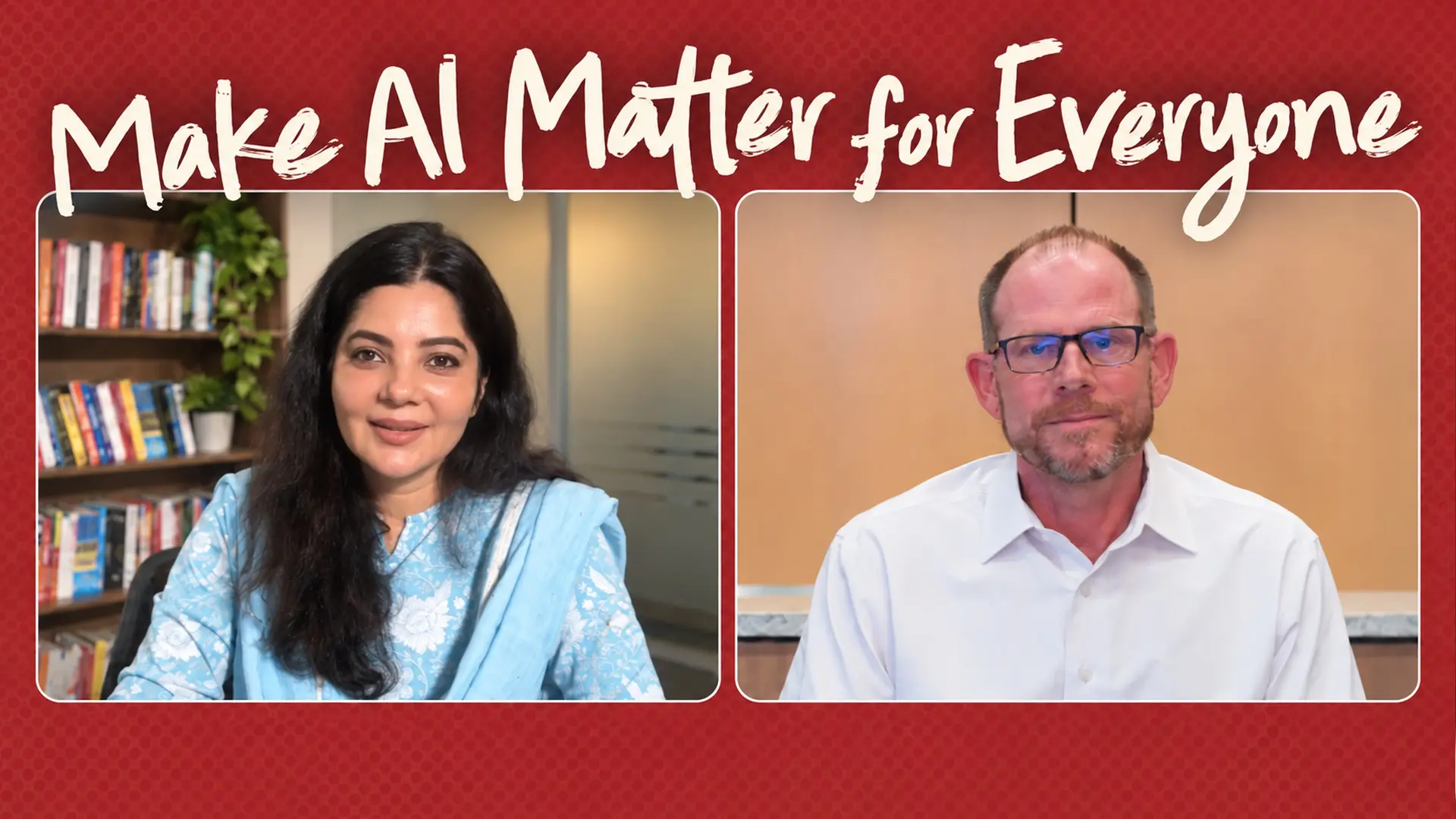

The Gates Foundation released its 2026 Goalkeepers report on 15 September 2026 with a blunt warning: artificial intelligence will either narrow the gap between rich and poor or widen it, and choices made in the next two years will decide which. It has backed the report with a $1 billion, two-year commitment to AI tools in local languages for health, education and agriculture.
Days before the release, Gates Foundation CEO Mark Suzman spoke to YourStory Founder and CEO Shradha Sharma about what that warning means for India. Suzman had just returned from a late August 2026 visit that took in government meetings, innovators and a district hospital in Uttar Pradesh.
Edited excerpts.
What the Gates Foundation CEO saw on the ground
Shradha Sharma: You were in India recently. What was different this time?
Mark Suzman: I've had the opportunity to visit Bharat nearly every year for close to the last 15 years, and each time, I really see new examples of energy and progress, especially in the areas of health, education, agricultural development.
And there, whether it's progress against tuberculosis, which is a key priority of the Honourable Prime Minister, whether it's agricultural development, what I've seen is both new tools and research. For example, we've been partnering with ICAR, the Indian Council of Agricultural Research, around ways to get smarter, more climate resilient crops, but also new AI tools that allow more efficient farming use.
It's always very exciting because India is one of the most dynamic ecosystems of people, just energetic, smart people aligned with government, working on the priorities the Gates Foundation has, which is to improve, give everyone the chance to a healthy and productive life.
Shradha: The report talks about community health workers in Rwanda doing better with better information. How does that apply here?
Suzman: Well, it's already happening in India in multiple cases. One partner we work with in India is called Eka Care. When you have a community healthcare worker or someone tracking what the needs of a pregnant woman are through her pregnancy, what you're able to do is upload that information, track it, and the Eka Care system will actually allow for much more efficient triage of is this an at risk pregnancy? Does it need extra support? Is the mother getting all the nutrition she needs? And things like that.
Another very exciting initiative is with Wadhwani AI. They've developed a new app, which you simply cough into a phone. And from the sound of the cough, they can use an AI algorithm to diagnose whether there should be a triage into more serious TB treatment.
Those are just two case studies that are similar to the Rwanda one you cited, but where India is showing how this can already work at scale. And there are many, many more.
The four things India must get right on AI
Shradha: The report says the coming months will decide whether AI widens inequality. How should a country of 1.4 billion think about its AI strategy?
Suzman: That is the most important question facing the planet and every single country, including India, over the next 18 to 24 months. And it's why we've made this the subject matter of our annual report.
You need four broad things. The first is you need to be able to make AI accessible and usable in every local language, that it needs to be able to be accessed as a spoken language with each phone, by the healthcare worker, by the teacher to the student, needs it in their local language to the smallholder farmer needs to be able to access it.
Then on top of that, you need to build for local context. When you're designing an AI app that's going to support a farmer in each state, it needs to be customised for their needs about their particular crops, their particular soil, their particular irrigation, their particular government investments. And you need local workers who are trained and able to support that.
Above all, you need real protections around data and governance. It's incredibly important that you are preserving both your personal data and making sure it's fully protected, but also national and sovereign data.
And then you need to invest in the people and access. People who are able to be trained for that local context of how you can use these AI tools most effectively, how you can actually use the data sets and build that. And then the access to compute, that we know this is a big global battle at the moment.
In each of those, India is actually making real progress, but it needs to continue to be prioritised by the government, but with support from the private sector, and very much we hope with support from philanthropies like ours.
Shradha: Every year, 12 to 14 million young Indians go looking for a job. What does AI mean for livelihoods?
Suzman: Bill Gates recently released a memo on his own personal blog, Gates Notes, which addresses some of these issues, some of the broader risks of AI. There's no question it's massively disruptive to certain types of jobs and opportunities.
At the Foundation, we can actually see how AI can be a job enhancer. In health, it can actually make the role of the healthcare worker more efficient. If you're a teacher, you can actually work productively, because you can customise your lesson plans for students. And in agriculture, when you're able to provide some of these tools, they become much more productive members of the economic community, and that itself becomes a job enhancer.
The risks are real, but so are the opportunities. I think India is very well placed relative to other countries to try and tackle these head on. You need students who are going to be trained and able to navigate in this new AI landscape. And I know that's something that India is really prioritising.
Shradha: If you had to ask Indian startups to prioritise one developmental space, what would it be?
Suzman: Look for the AI applications to enhance efficiency, but it'll look a little different sector by sector.
I had a chance to meet with a number of innovators who we're helping provide support for in India, and these are people doing some fascinating pioneering work on new mRNA treatments in Hyderabad, a new diagnostic tool called Remidio, which can look at the eye and look at blood vessels in the eye and use that to diagnose a wide range of ailments, from potentially, preeclampsia for pregnant mother to broader blood pressure or health risks, or cardiac risks for adults.
There is a thriving innovation system, and these are led by Indians, who see India as a very dynamic place to come in and be entrepreneurial. And I've seen rapid improvement in the last few years, both a commitment at the national level, but also at the state level to try and invest in innovative public-private partnerships that are drawing on those technologies, but each of them will use AI in slightly different ways.
AI has the opportunity not just to provide broader economic opportunity, but to be a great equaliser. If the actions around language, around access, around training are invested in, then we could see faster improvements over the next 10 to 20 years than we've ever seen before, but it is a big "if". It depends on that kind of very deliberate, focused investment.
Shradha: What keeps you excited, and what keeps you worried?
Suzman: India has big national debates and concerns about how you can get between 6 to 7% growth to 8 to 9% growth. Those are very real challenges in order to meet the vision of India as a middle-income country by 2047, but those are problems the rest of the world wish they had to grapple with.
In most of the countries where we work across the rest of Africa and Asia, countries are facing huge fiscal setbacks, much bigger challenges to economic growth. And so, it does make it more difficult, especially at a time when there's been a pullback from traditional support and engagement by much of the traditional Global North in these areas.
Then, what I'm most excited about is exactly what I've just been describing to you, the energy, the engagement, the excitement, the dynamism within the fields where I work, especially among some of the younger, more entrepreneurial. And by "entrepreneurial", I don't just mean in the private sector.
I got a chance to visit a hospital in Uttar Pradesh last week, and the innovation of the frontline nurses and doctors, their care for young mothers with underweight babies, that's really what gives me hope and energy and, in fact, a high degree of confidence that we will be able to navigate this current challenge and that the world will be able to take advantage of these tools.
But it does require very deliberate, focused action, and I think India has the potential and is already showing how to potentially lead the way on that. And I very much hope we can be part of that journey, going forward.
The report lands a week before the United Nations General Assembly's high-level meetings in New York, where AI governance is on the agenda. For India, Suzman's four tests are measurable: how fast Indic-language voice AI reaches frontline workers, whether farm advisories adapt to local context, how data and governance are prioritised, and who gets access to compute. The next 18 to 24 months will show whether that head start becomes a lead.