



Get AI to work on your terms: Microsoft's Puneet Chandok on navigating the modern tech race
Microsoft’s Puneet Chandok says young engineers must master AI skills while nurturing empathy and filter. Enterprises must look at a clear path to ROI and build a team of frontier professionals who balance automation with strong human judgement.


The pressure to adopt and adapt has never been higher for modern enterprises. Alongside AI adoption, they must also ask themselves this fundamental question: How can we work with AI tools without losing the human analytical edge?
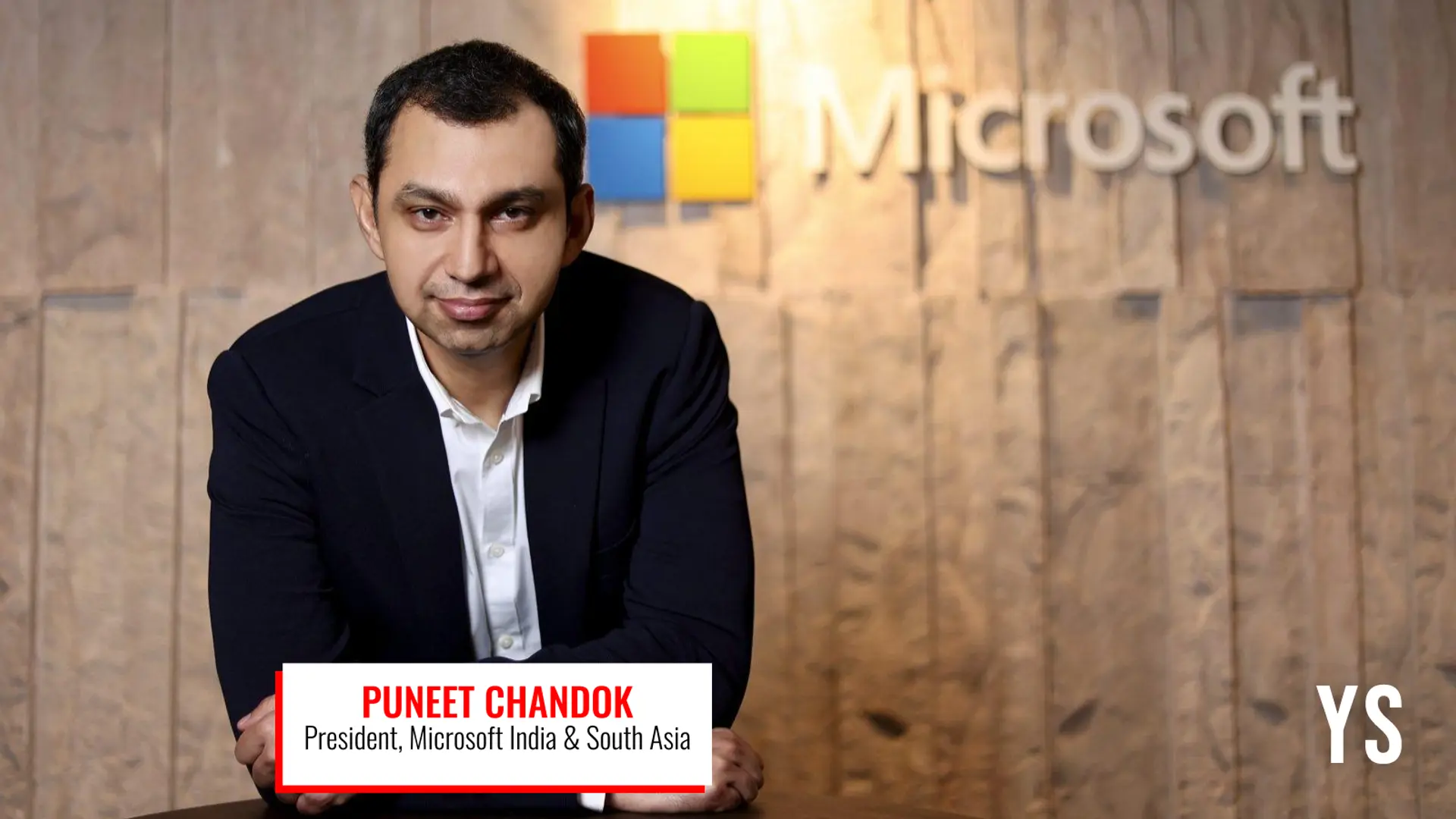
It’s all about the balance, says Puneet Chandok, President, Microsoft India & South Asia.
He believes the modern workforce is entering a new world shaped by the human-AI barbell. On one end are technical AI capabilities, and on the other are the uniquely human qualities that become more valuable as AI advances.
“We must maintain balance... between real AI skills and the judgement piece, the sense making, the curiosity, the emotional aspect, the empathy,” he says.
The good news is India is responding well to the new paradigm. In fact, it is taking the lead in the future of work. According to a new study by Microsoft, 32% of AI users in India are ‘frontier professionals’, who combine agentic automation with strong human judgement. This is double the global average, and the highest among the markets studied.
On the sidelines of an event to unveil the findings of the Microsoft Work Trend Index 2026 report in Bengaluru, Chandok offers a clear blueprint for navigating the future of work.
Edited excerpts:
YourStory: As tools like the copilot become widespread, how do we prevent human skill atrophy? How should tech users design their daily routine to sharpen their analytical skills?
Puneet Chandok: I believe that, with the copilot, I am honing my analytical and reasoning skills. This is because I’m now shameless in the questions I ask. With colleagues or teachers, you might hesitate, worry about their reaction, but you can ask the copilot everything on the planet.
Interrogating and reasoning with the tool actively sharpens my mind. For instance, a recent morning session of mine was entirely planned by the copilot. I asked it to analyse a report, we debated, and I pushed back when it missed a specific angle. It is a promotion that lifts my game. I call it my ‘guardian angel’, which generally kind of prevents me to do stupid things in life, it amplifies me.
At the same time, we must maintain balance. I think of it as a barbell: real AI skills, which I’m getting good at, but I can’t forget the judgement piece, the sense making, the curiosity, the emotional aspect, the empathy... How do I continue to build on that?
We cannot just talk to machines; we must work and connect with humans to keep those irreplaceable traits alive. So, on the reasoning side, the copilot is raising my game rather than reducing it.
YS: What should graduates do to get things right in the new tech landscape, which is seeing roles that didn’t exist three years ago? How has campus recruitment changed in recent times?
PC: The younger generation has a huge advantage as AI natives, free of the baggage my generation carries.
First, they must master AI skills. AI skills are the table stakes now, right? If you don’t have those basic AI skills, you don’t get into the room. This means learning to build and orchestrate agents responsibly, while continuing to build human skills like empathy and sense-making.
I also advise them to prepare for a dynamic portfolio career. Their careers will be long but non-static. Instead of slowly climbing the traditional corporate ladder, they can leapfrog. They don’t have to do the first two years of grunt work that you and I did in our lives.
They are entering a much kinder world. It is liberating to tell a 17-year-old that they can do ten different things in life rather than make a single lifelong decision now.
Consequently, campus hiring has evolved from looking at degrees to looking at proof.
My first question to any candidate is: what have you shipped in the last 90 days? But it is not just about raw shipping; anyone can write an unused app in hours. We look for taste, judgement, and filter. I ask young engineers how many versions they created and dropped before shipping. That reveals their filter and how they interrogate AI to work on their own terms.
YS: As we look at the human-agent combination, how are organisational operating models changing? What is being done internally to accelerate this AI transition?
PC: Both at Microsoft and with our customers, three shifts are changing corporate operating models.
First, there is a return on investment (ROI) focus. Our AI ambition must be clear: without a path to ROI, we avoid hobby projects. This is what every customer and board is demanding, and it is the healthiest debate.
Second, we are reimagining work for a new era where human and token capital work together. We cannot just put a model bandaid on an old, broken process and expect it to produce magic, that won’t happen.
We must redesign workflows around tokens that work 24/7 without ego, breaks, or sleep. This is happening at scale: Air India rebuilt customer service to handle 13 million queries with 97% accuracy, while partners like Adani Group, Axis Bank, Infosys, and TCS are deploying wall-to-wall copilots.
Third, we are skilling leaders and employees to become frontier professionals.
Are you truly becoming frontier? Are you drinking your own Kool-Aid? Or just talking about it (being frontier)?
YS: While entry-level workers are highly focused on upskilling, what needs to be done for middle and senior management? Which metrics are the most critical?
PC: First, we must give middle and senior management direct access to tools. You cannot learn AI theoretically: You can’t learn AI sitting in a room watching a video, right? You have to work with it. It’s a one-on-one full contact body sport. This is why companies are ensuring all knowledge workers have copilots, the most powerful UI (user interface) for AI today.
Once enabled, we must scale skilling. We aim to skill 20 million people in India, including 2 million teachers, who are the ultimate force multipliers in the world’s largest classroom.
Structurally, we must shift the culture. I advise CEOs that at least a third of their workforce should be frontier professionals, and eight out of ten employees should perform new work they could not do 12 months ago.
From our Work Trend Index, two numbers are critical to move. First, 44% of leaders in India are aligned on the AI mission, which flags a communication gap between leadership commitment and the shop floor. Second, 25% of employees feel experiments are rewarded before outcomes. We need widespread, design-driven experimentation where people feel rewarded regardless of the final outcome. Moving these two parameters is our priority.
YS: As traditional enterprises partner with fast-moving AI startups, how can they build mutual trust and ensure that human-agent teaming remains secure?
PC: At Microsoft, we use a framework called ‘intelligence plus trust’, which is an excellent template for any AI startup.
First, intelligence is not just about renting a frontier model. It is about translating models to work in your specific context. Without that, even the most powerful model is a brilliant stranger that does not understand your enterprise’s execution standards. Startups must have the ability to contextualise the intelligence they build, and translate the models to work on their own terms.
Second, trust is non-negotiable. Enterprises want to look a partner in the eye and ask: are you going to do something in a trusted, secure, guardrailed way? Because if you can't promise me that, you don't have the licence to be in the room.
We actively partner and co-build with AI-native startups to bridge this gap. Leveraging our 20,000 engineers in India and our B2B distribution engine, we help startups deliver secure, contextualised AI to traditional enterprises.
Our broader ambition is to turn celebrated digital public infrastructure into AI public infrastructure for citizen-scale service. The core intent is simple: can we lift a billion Indians with AI versus just a few people with tools?
Edited by Swetha Kannan