



Government-school teachers are ready for AI, survey finds
A JanAI survey finds 72% of government-school teachers support AI, while gaps in training, privacy and institutional support remain.

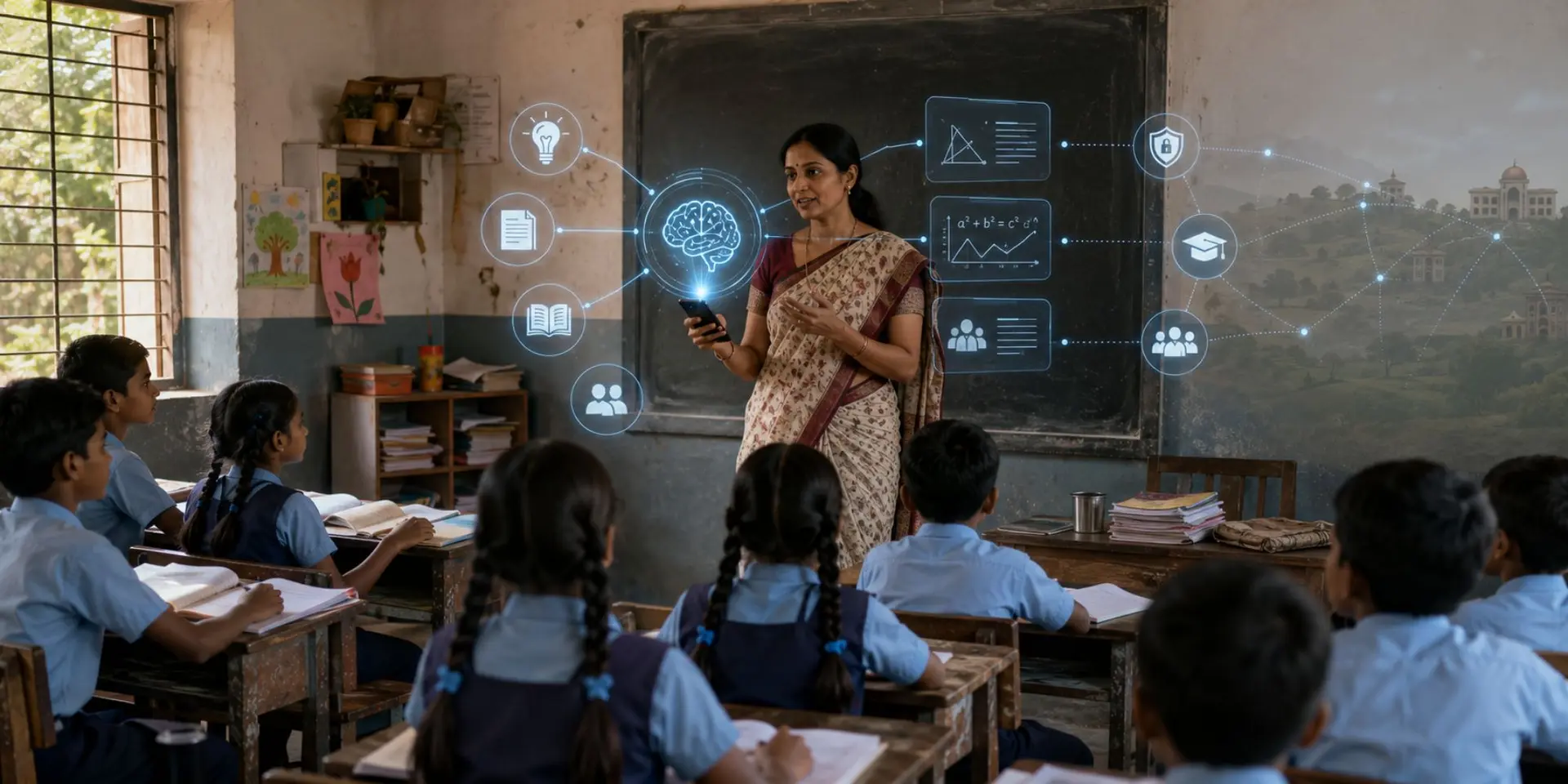

AI is entering India’s classrooms. But a new survey suggests the people expected to lead that transition may be further ahead than the system supporting them. A national survey of 797 government-school teachers has found that 72% feel positive about artificial intelligence, while 26% already use AI regularly.
The findings suggest that resistance may not be the biggest challenge facing AI adoption in government schools. Instead, teachers appear to need more guidance and institutional support to use the technology responsibly.
The report, “AI Readiness of India’s Government Schools Teachers”, was released by JanAI, an initiative of Head Held High Foundation, on September 1. It covers teachers across Uttar Pradesh, Karnataka, Jharkhand and Maharashtra and comes months before India begins introducing an AI and Computational Thinking curriculum for Classes 3 to 12 from the 2026-27 academic session.
The study specifically focuses on government-school teachers, rather than combining them with teachers from private schools in a broader national average.
Teachers are already reaching for AI
For many teachers, AI adoption is not beginning with new infrastructure. Teachers are already accessing AI through personal phones, including in schools without computer labs. The report describes this as adoption moving ahead of infrastructure rather than waiting for it.
The technology is largely being used as a teaching aid. Teachers most commonly use AI to simplify difficult concepts, generate examples and activities, and prepare worksheets and assessments. Grading and administrative paperwork, meanwhile, rank among the least common uses.
There is also little evidence that teachers see AI as a threat to their jobs. Concerns about AI replacing teachers were nearly absent from both structured responses and open-ended answers. The more significant gap is between sentiment and regular usage.
While 72% of teachers feel positive about AI, only 26% use it regularly. For JanAI, this suggests that teachers do not necessarily need to be convinced about the technology. They need a supported path from experimentation to responsible, regular use.
That becomes even more important for students. Among teachers who said AI makes them personally more effective, 86% were concerned that students could become overdependent on it. Across all teachers surveyed, 64% shared that concern. AI can help an educator explain a difficult concept or create classroom material, but unrestricted use by students could affect independent thinking.
The bigger challenge is responsible use
The survey also uncovered a significant privacy concern. More than half of teachers who use AI tools said they had entered a student's name, marks or photograph into an AI tool at some point. The report found that individual confidence around protecting student privacy does not necessarily translate into safer behaviour.
Instead, institutional support appears to matter more. School rules, state policy, training and having a named person to approach when something goes wrong can collectively influence responsible AI use. This shifts the question from whether teachers are ready for AI to whether the system around them is ready to support that readiness.
JanAI plans to build on the findings by identifying, training and organising a community of 50,000 rural government-school teachers as AI change agents over the next 12 to 18 months.
The programme will work state by state, reflecting the report's finding that Uttar Pradesh, Karnataka, Jharkhand and Maharashtra require different interventions. The teachers will serve as local points of support for peers navigating AI adoption and help encourage structured conversations around responsible use.
The survey will also continue, with JanAI planning to track the same teacher population, expand coverage to more states and publish updated findings every quarter as India rolls out its AI and Computational Thinking curriculum.
The first report leaves India with an encouraging but important message: government school teachers are not waiting to be introduced to AI. They are already experimenting with it. Now, the system around them needs to catch up.