



The authenticity premium: How heritage storytelling turns ordinary products into trusted brands
How Indian brands are turning nostalgia, regional identity and heritage into an “authenticity premium” that customers are willing to pay for.

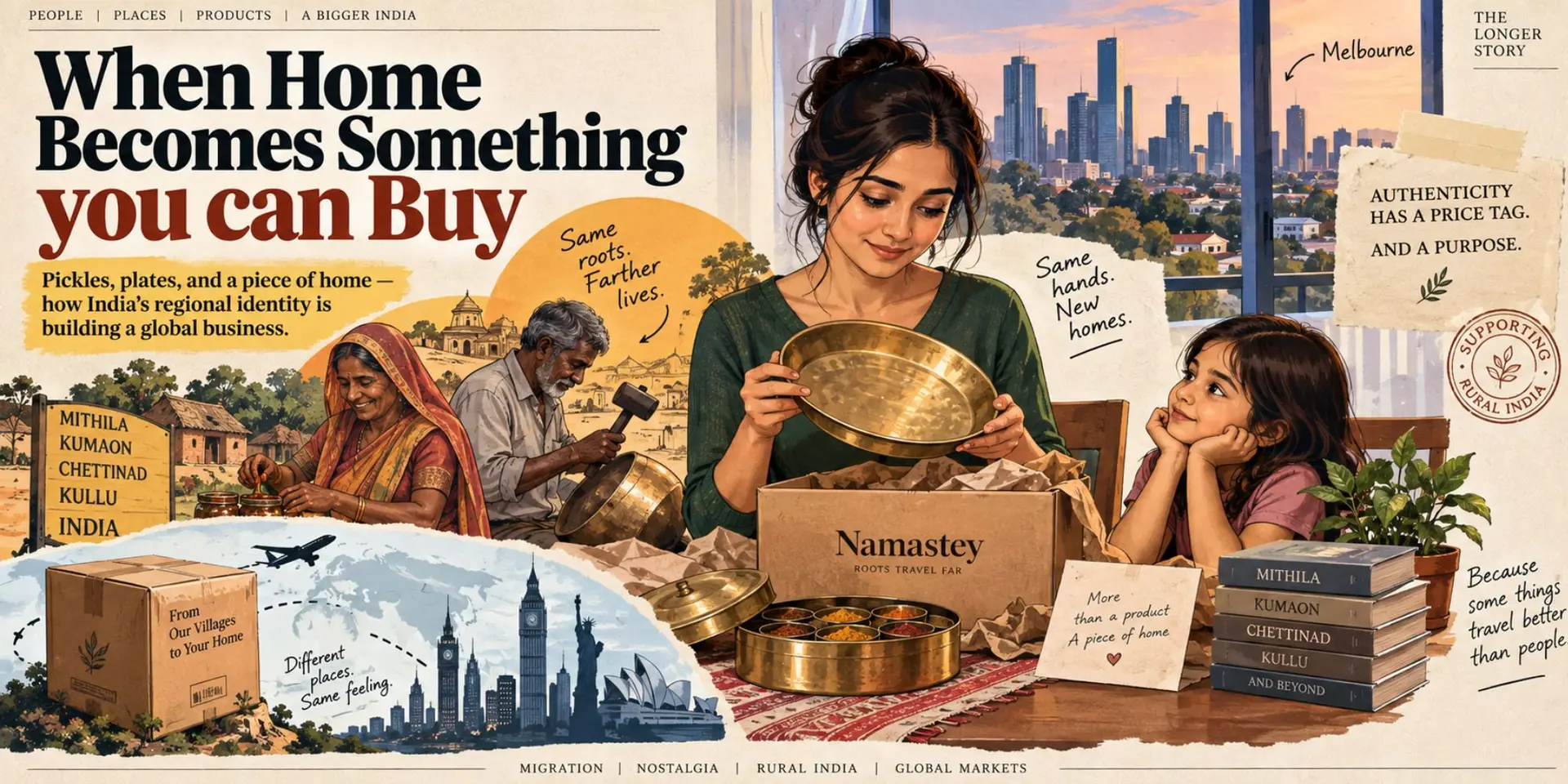

Nobody can pack a home, so somebody started shipping it. Somewhere in a flat in Melbourne, a woman is setting the table for her daughter, and she stops for a second because the plate in her hand is kansa (a traditional bell-metal alloy made of copper and tin), and the last time she ate off one of these, she was sitting on her grandmother's kitchen floor.
She had ordered it from a brand called Namastey, along with one of those round brass spice boxes with seven little bowls inside that every kitchen back home used to have. She did not need any of it; she had perfectly good steel, but her daughter is growing up in a house where nothing reminds her of the culture she belongs to, and she cannot carry a village across an ocean, so she bought a few objects and kept them where the child would see them every day.
And the brand knew exactly how to sell it to her by branding “hammered by the same artisan family for three generations, sourced straight from these artisans of India” and with the promise that one per cent of the brand's profit would go back into villages like theirs. That is what she paid for. Not the metal, the message.
When home becomes something you can buy
India is a country with 28 states, 8 union territories, close to 800 districts and more cultures than one can know in one lifetime, and what we see these days is that Indians are constantly moving, from villages to cities and from cities to other countries. Somewhere inside all that migration, a gap opens up between where a person lives and where a person actually belongs, and that gap is where a whole category of businesses has quietly been built.
These companies are not really selling food or fabric or utensils; they are selling the feeling of home to people who are deeply attached to their roots and have no practical way of staying connected to them.
The strange part is that the product itself is rarely special. A jar of pickles, a bottle of oil, a packet of spice mix, a cotton saree. These are ordinary things, cheap to make, available everywhere, with no patent behind them.
So the competition is not happening over the product at all. It is happening over the story. Who made this, where was it made, whose recipe is it, was it made the same authentic way it was made in your house or was it adjusted to suit everybody's palate? Two identical jars can sit next to each other in the same mart at the same time, and one will sell for three times the price of the other purely because of what is printed on the label. That extra amount is what I would call the authenticity premium, and it is not a small thing; it is an actual business model. Nostalgia has a price tag, and migrants are happy to pay it.
Why regional identity sells better than “made in India”
Look at how these brands introduce themselves, and the design becomes obvious. They will print a line in the local dialect on the packaging, and they will always name the region instead of the country, because "India" is too vast to feel personal, whereas "Mithila", "Kumaon" or "Chettinad" makes a very specific group of people feel personally spoken to. And once you feel personally spoken to, you stop comparing prices.
Take Jhaji, the Darbhanga-based pickle brand that promises to bring the taste of Mithilanchal into your home.
I say all this as someone sitting inside that market myself. I belong to a migrant Maithil family; I have lived in Delhi my whole life, and my Mithila is basically made up of summer holidays ... two months in the village every year with my grandparents, and then back to Delhi. When I taste a good achaar today, it doesn't feel like a product; it feels like my grandmother's hand, because that taste comes from mangoes grown in that soil, made with her recipe and her patience. So when a brand tells me it is bringing Mithilanchal to my home, I know exactly which nerve it is pressing.
Jhaji went on Shark Tank India and walked out with nothing; not one shark was ready to invest. The objections were the usual ones: that the market is too crowded, that pickle does not scale. A few years later, the brand is valued at around $7.89 million and ships over 10,000 orders a month. The sharks were valuing a pickle company. The customers were buying Mithila.
Many people argue that brands like this are exploiting vulnerable, homesick customers. In my opinion, they are simply doing business and giving something real back. A few minutes of nostalgia at the dinner table, and food that tastes like it was made for you and not for the whole country.
Both sides know exactly what is being sold here. Although I keep going back and forth on this. Some days I think that finally, somebody is giving the village the credit that it always deserved. Other days I feel a little sad that we now need to buy proof of where we come from.
The founders who became the story
There is a myth I want to break here: that business is something that happens in English, with a pitch deck, preferably after an MBA. Jhaji was started by two homemakers from Darbhanga who had spent their whole lives making achaar for their own families, and who pitched on national television in Hindi without knowing a word of the language of startups.
What they did have is the one thing no degree can manufacture... they were the story. Nobody had to be hired to make the brand sound authentic, because the founders came from the same soil the product was claiming. Rural India was never short of product or skill; it was short of distribution and of somebody willing to say the region's name out loud, and the internet has quietly fixed the first half of that problem.
The same playbook is running across handlooms, regional sweets, brass utensils and spice blends. Take Pahadan's, a sustainable fashion brand from Himachal Pradesh that does with clothes what Jhaji does with pickles.
What they are selling is not really a kurti or a cotton co-ord set; it is the mountains... the Kulluvi handwoven patti lace that has always belonged to Himachali dress, now stitched onto something a working woman in Gurgaon or Pune can actually wear to the office. It is a smart place to stand, because the customer does not have to dress like a villager to feel connected to one.
But the real strength of Pahadan's is that they also sell the women who make the clothes: the faces, the names, the villages, and the fact that one garment means several days of paid work for a woman in the hills. It is the same move Namastey makes when it names the family that hammered your plate. A kurti arrives with a kind of receipt attached, that somebody in Kullu who does not have many ways to earn got paid for her own skill and did not have to leave her village to do it. That is a different kind of premium from nostalgia, but it is built on the same thing: being able to point at a real person.
When a place becomes a premium
This business model is not an Indian invention, and the ceiling is much higher than a pickle jar. Sparkling wine made anywhere in the world is just sparkling wine, but the same drink from one particular region of France is Champagne, sold for several times the price for no good reason other than the place of production, and protected by law, because at some point the story became so valuable that governments began defending it like property.
Parmigiano Reggiano is a hard cheese made by small dairies in one part of Italy, stamped on the rind so it can be traced back, and it sits in supermarkets across the world priced above the identical-looking parmesan next to it. That is rural produce, made by farming families, turned into a global export almost entirely by protecting the origin. India already holds the same instrument. Mithila makhana carries a GI tag, and so does the Kullu shawl, which means both the regions in this article are already legally recognised as the source of what comes out of them. What is missing isn't authenticity; it is the number of people willing to build businesses on it.
What these brands have figured out is very simple. People will always pay to be reminded of who they are, and the ones selling that reminder are not selling pickles or plates or kurtis at all; they are selling an address. And I am not writing this as a critic; rather, I am writing it as one of their customers, because the day I ordered that jar, I was not buying achaar; I was buying two months of summer in a village I only half belong to now.
And this feeling is not limited to a few people; India has around 41.4 million inter-state migrants (Press Information Bureau et al., 2023), while around 18.5 million Indian-born people live outside the country (UN DESA et al., 2024). Globally, around 304 million people live outside their country of birth (IOM et al., 2024). As long as Indians keep leaving home, somebody will find a business in shipping that small piece of home to them.