



His software is inside your router. Now he wants it inside much smaller things
Rajesh Subramaniam grew up in Triplicane in Chennai, reached Silicon Valley in 1994, and has spent 22 years building embedUR into a company of nearly 500 people without taking a rupee from anybody.

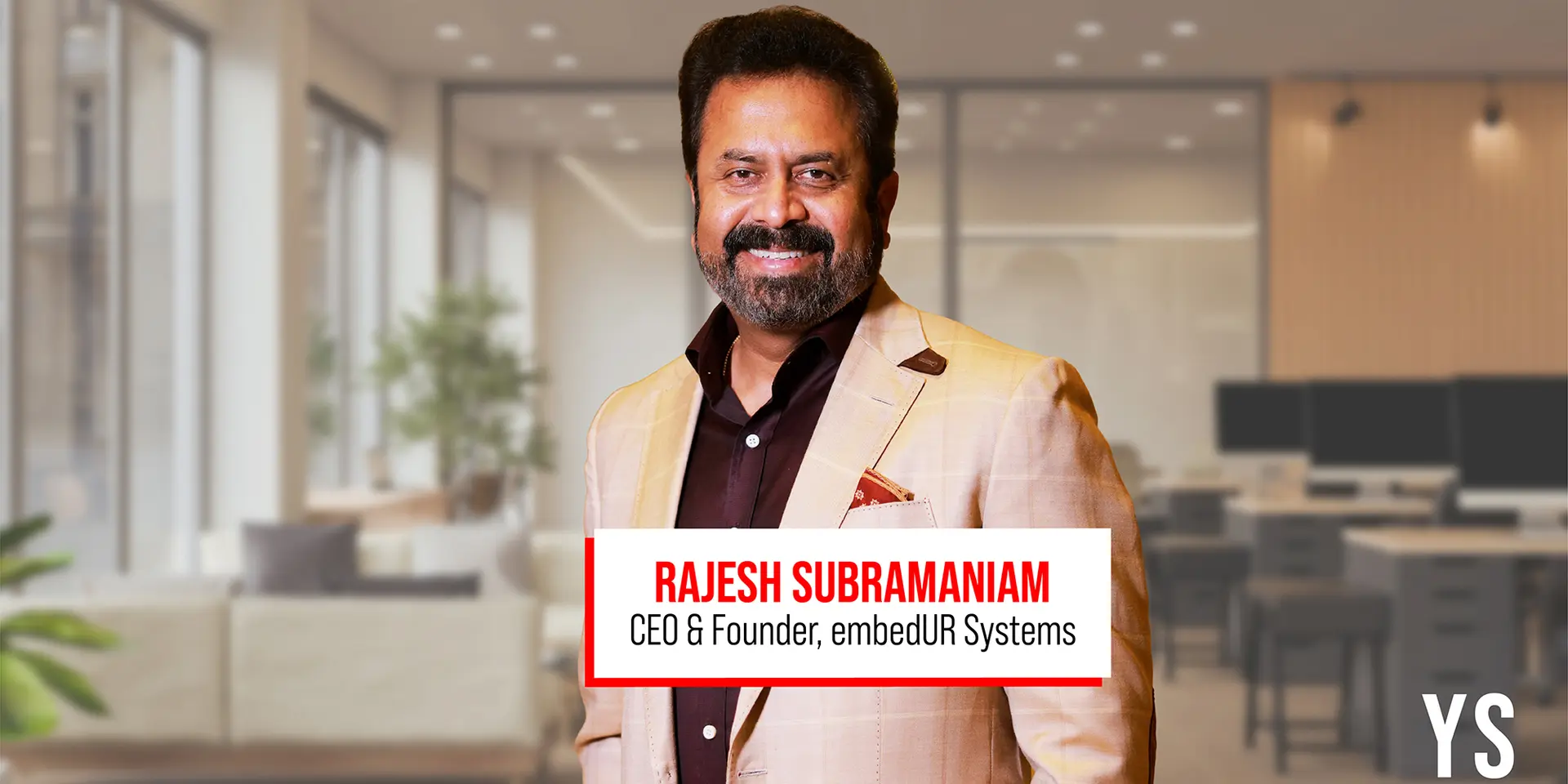

The first thing Rajesh Subramaniam wanted was to sort the lighting. “I just want to make sure my lighting is not that bad and you can still see me,” he said, before we had got anywhere near his company or his plans for it. When I told him the story would be written and not filmed, he settled back into his chair and talked for the better part of an hour about Wi-Fi.
I had asked him at the start to put the business in plain terms so that our readers can understand. He didn’t need a second invitation. He went back to the beginning and kept going, and somewhere in the middle, I gave up trying to get a word in and asked him to carry on.
Wi-Fi and the short-range signals that go with it have paid his bills for 22 years. The work itself is software, and it sits inside your router, your speakers, and the watch on your wrist, allowing your device to talk to another device without a wire running between them.
Subramaniam founded embedUR Systems in 2004 and still runs it. Hardly anybody outside the chip industry has heard of the company, and a fair number of very large chip companies would struggle to manage without it. It writes the software that lives inside the boxes and gadgets that carry the internet to you, and it has done that without a single round of outside funding. The India operation, which is based in Chennai, was set up in 2008.
He reached the United States in 1992, did a masters at the University of Arkansas and was in Silicon Valley by 1994. His first job there was at Schlumberger, and he stayed about four years. He went on to Bay Networks, which by then was being folded into Nortel, and there he wrote software for early switching gear, back when offices still pushed data around on hubs that broadcast everything to everybody. He moved on to a startup building fibre optic networks, at a time when getting from 10 megabits to a gigabit felt like magic. Somebody bought that company, he stayed with the buyer for a while, and by the end of the stint he had a mix of skills that didn’t usually sit in one head. He knew small devices, he knew networks, and he knew the infrastructure which keeps a network standing when a lot of people use it at once.
In 2004, he realised that the thing worth betting on was Wi-Fi. Within that he meant the free sort that anybody can transmit on, the kind your home router uses, and not the licensed spectrum that mobile operators pay for. He already knew embedded software, which was most of the job. The radio was the new part, and a radio only catches the signal. What arrives after that is packets to be sorted and passed on, and sorting packets was what he had spent 10 years doing on wired networks.
Three kinds of Wi-Fi, one company
Wi-Fi splits into three separate businesses and Subramaniam ended up in all three of them. The first is the box on the ceiling. When you walk into a large office or a hospital or an airport terminal and look up, you’ll see them, those flat white squares that take wireless connections from everyone in the room and hand them onward through a cable.
“So think of it as one side that’s talking all wireless, the other side is talking all wired,” he said.
That’s enterprise Wi-Fi, and it’s fussy work, because a company network has to satisfy itself about who you are before it lets you anywhere near anything. As he described it, that sort of network wants more software, more security, more checking and a lot more discipline from whoever writes it.
Home routers became a business of their own around 2006 and 2007, when American operators like AT&T and Comcast had to start selling home wireless as a service. The software has an easier time of it there. The operator polices everything from its own end, so the little box in your hall doesn’t have to be wary about whom it trusts.
Around 2011 the software inside your own phone became the thing. Your phone attaches itself to your home router in the evening and to an airport access point the next morning, and something has to manage all that. The chip companies were selling the parts and somebody had to make the parts behave. Bluetooth and Zigbee came along soon after, for the obvious reason that a house full of speakers and doorbells and fitness bands is a house full of tiny radios.
The company also built, somewhere along the way, the pieces that collect information off all those devices and park it in the cloud, and the software that lets a customer manage a whole fleet of them.
The bit that got its own company
Four or five years ago he started a unit inside embedUR called ModelNova. This July he cut it loose. Most of us met artificial intelligence (AI) as something huge that happens a long way away. You type a question into a box, the question travels to a data centre stuffed with expensive hardware, and a model with billions of settings inside it sends back an answer. The edge version turns all of that inside out. The small processors now come with a bit of circuitry meant for running models, so a cheap device can carry a small model of its own and decide things for itself without asking anybody.
“Hardware is hardware,” he said, when I asked how hard the move from software into the physical side had been. The hard part, for him, is fitting real intelligence into something that has very little memory and very little power, often running on a battery, and then trusting the thing to take the decision by itself.
He got animated when he came to the examples, though most of them are things his models can do rather than things already on sale.
The firm one is a medical equipment maker that has signed up to put his face recognition into a device, so that a nurse doesn’t have to type a password with her gloves on, which sounds like a trivial saving until you count how often she does it in a shift. The others he offered as illustrations. A coffee machine that holds a couple of hundred faces and pours your cappuccino because that is what you always order. Door locks with cameras in them. A factory gate that sets off an alarm when it sees a face that isn’t on its list.
He says the company has customers signed up across commercial, residential, industrial and medical work, and he didn’t name any of them. The model underneath is the same one in each case, doing the same job, sold into industries that have nothing to do with each other.
Sound works much the same way. The company has built a couple of noise removal models that run on an ordinary processor instead of a specialised one, and where they end up is still open. He points at construction helmets, cheap enough that two men on a site could hear each other over the racket, and at motorcycle helmets, so that a rider could hear a phone call over the wind. The third sort of model is fewer in number and a bit odder, and here he was describing something to imagine rather than something to buy. A model that understands the shape of a building. If you asked it where the flowers were in a shop, it would send you to aisle 13, section 4. If you were standing in a hospital car park and you asked how to reach a particular ward, it would walk you there.
The reason for the spin-off wasn’t the technology at all. The two businesses earn their money in completely different ways. embedUR builds to order, the customer ends up owning whatever comes out of it, and the money that follows comes from supporting the thing afterwards.
“We build once, sell once,” is how he described it. ModelNova works the other way round. The library of models is free to start with, a desktop toolkit called Fusion Studio sits on top of it and is still in beta, and the finished models are the part that gets licensed. The company builds something once and then sells it over and over again. He didn’t want one culture swallowing the other, so he split them.
Will the chip companies copy?
Everyone from Qualcomm to Nvidia talks about physical AI now, so I asked him what stops the chip companies he works with from building their own model libraries and cutting him out.
He began by ruling out the top of the market. Nvidia isn’t his world, and neither are AMD, Broadcom, Intel, Qualcomm or Marvell. The silicon he is after is the unglamorous sort that goes into factory equipment, farm equipment and cars, where a model has to squeeze into a few megabytes and survive on a battery. The 200 odd models he keeps ready to go were built for that. About 75 percent of them handle vision and most of the rest handle sound.
Software isn’t what the chip companies get paid for. Their customers expect the tools free with the parts, so a model library becomes a cost with no revenue against it and it slides down the list. embedUR has ended up building those libraries for them. There are 30 odd models of his on Infineon’s website, and he built a whole collection for the chip designer Ceva. He enjoyed the next bit. “The next biggest model zoo is ST Micro,” he said. “And ST Micro is our customer.”
He reckons he is more or less the big game in town at this end of the market. Two of his customers will be announcing things at CES in January and he is enjoying the wait.
What the discipline cost
He hasn’t taken outside capital in 22 years. The question about what that bought him and what it cost him got the shortest answer of the interview.
“Cost me? Growth.”
By his own count the company stands at somewhere between 475 and 500 people. With investors behind him he thinks it might have been a company of 5,000, or even 10,000. He would rather talk about output than headcount, and he claims that what comes out of embedUR matches what a company of 1,200 would produce. What staying unfunded bought him, he says, is the trust of his customers.
It bought him the right to keep his own counsel as well. He described what the other way looks like. The investors start watching your roadmap and asking whether a 5-year return is really in there, and then they want you to drop this and do that instead. With nobody doing any of that to him, he said, he can “follow one course until successful”.
The services side still brings in about 90 percent of the revenue and ModelNova brings in 7 to 10 percent. He expects the younger company to overtake its parent within 2 years of being born, and to pass whatever embedUR earns in 2026 by 2028. I asked for a ballpark and he gave me one, without saying which of the two businesses he had in mind. “Multiple tens of millions of dollars.”
At the investors meet in Chennai in 2024 he committed Rs 500 crore over 5 years, at Rs 100 crore a year. This year’s hundred is the third instalment, and a part of it goes to ModelNova.
Asking, and the reluctance to ask
I asked what one quality he looks for in somebody new, expecting an answer about code. He didn’t mention engineering at all. Communication came first in his list, then clarity of thought, and the fundamentals came after those two, with the concession that nobody has to be good at everything.
His argument is that most of the rework in this industry happens because nobody asked enough questions at the start. The teams are forever too busy to do the job properly and never too busy to do it twice. “If you don’t know what questions to ask, then you do all the wrong things,” he said.
The remedy came from his own coach and it has since become a slogan in the office, which is who, not how. If a problem is new to you but old to the company, then the sensible thing is to go and find the person who has already solved it rather than solve it a second time at your own cost.
What he sees in Indian offices is that people will not ask at all, he said, because they are afraid of looking foolish in front of the room. He has taken to telling his engineers that there are four sorts of questions worth asking, from the plain factual ones all the way to the ones that are really attempts to understand another person, and that his engineers ask far too few of any of them.
Most services companies hire in large numbers, put the new people on the bench and train them for 6 months. His company does not work that way. It hires from a small group of colleges it has known for 20 years. Its people sit with the faculty and help shape parts of the syllabus, and its engineers go and speak to the students long before they finish their degrees. So whole batches from one college end up in the same teams. There is a fair amount of ribbing between one college and another, and there is also, he says, a common way of working. He is doing the same thing for AI now, and his engineers have gone back to those colleges with new courses instead of waiting for graduates to arrive unprepared.
The arrangement doubles as a moat, and he is candid about that. Getting an engineer fluent in his toolkits takes real money and real time, and anybody starting out today would have to spend both before writing a line of useful code.
Triplicane, and a small coincidence
Near the end, once we were done with the strategy, I asked him about his life before America, and the conversation took a turn that neither of us had planned.
He was born in Chennai and he grew up around Triplicane, Ice House and Mylapore. He went to St Bede’s, and so did I, and the interview stalled for a moment in the way these things do. “Are you kidding me?” he said, and then he started reeling off the names of boys who played cricket for the school in the mid-eighties, half of whom I had heard of.
His last two years of school were at PS Senior. Before all the software he was a runner. He was part of the Don Bosco Athletic Club and he ran the 100 metres. In college he did a lot of drama and a lot of singing.
He doesn’t sing any more. “My wife sings a lot,” he said. “Now I listen.” He said it with a straight face. His reasoning was that taking it up again would disturb the peace at home fairly quickly.
The last thing he said was about the technology rather than about himself, and it was cheerful in a way that has rather gone out of fashion. He thinks we are living through an industrial revolution that will put a great many things within reach of people who can’t afford them today, and that within 5 to 10 years the gap between what the well-off can buy and what everybody else can buy will begin to close. I told him that most of what reaches me on this subject is about jobs going away.
He had heard all that before, he said, and he reminded me that people once said search engines would be the end of libraries. The insecurity, in his view, belongs to the people who have already decided not to engage with the thing.
In Tamil Nadu alone he is putting in Rs 100 crore a year, which is a good deal more than most people who talk this way are willing to spend.